Many people get confused when writing or using the terms maam or ma’am. At first glance, both look similar, but only one is widely accepted in formal English writing.
This confusion often appears in emails, customer service communication, academic writing, and even casual conversations. People search for this keyword to understand the correct spelling, pronunciation, and usage in different contexts.
The confusion mainly comes from punctuation rules and contractions in English. Some writers drop the apostrophe, while others include it, leading to inconsistency.
Knowing the correct form helps you sound professional and avoid common writing mistakes. It also ensures clarity when addressing women respectfully in formal communication.
In this article, you will learn the correct spelling, origin, differences between British and American English, and when to use each variation.
You’ll also see real-world examples, common mistakes, and practical advice so you can confidently use the term in any situation.
Ma’am or Maam – Quick Answer
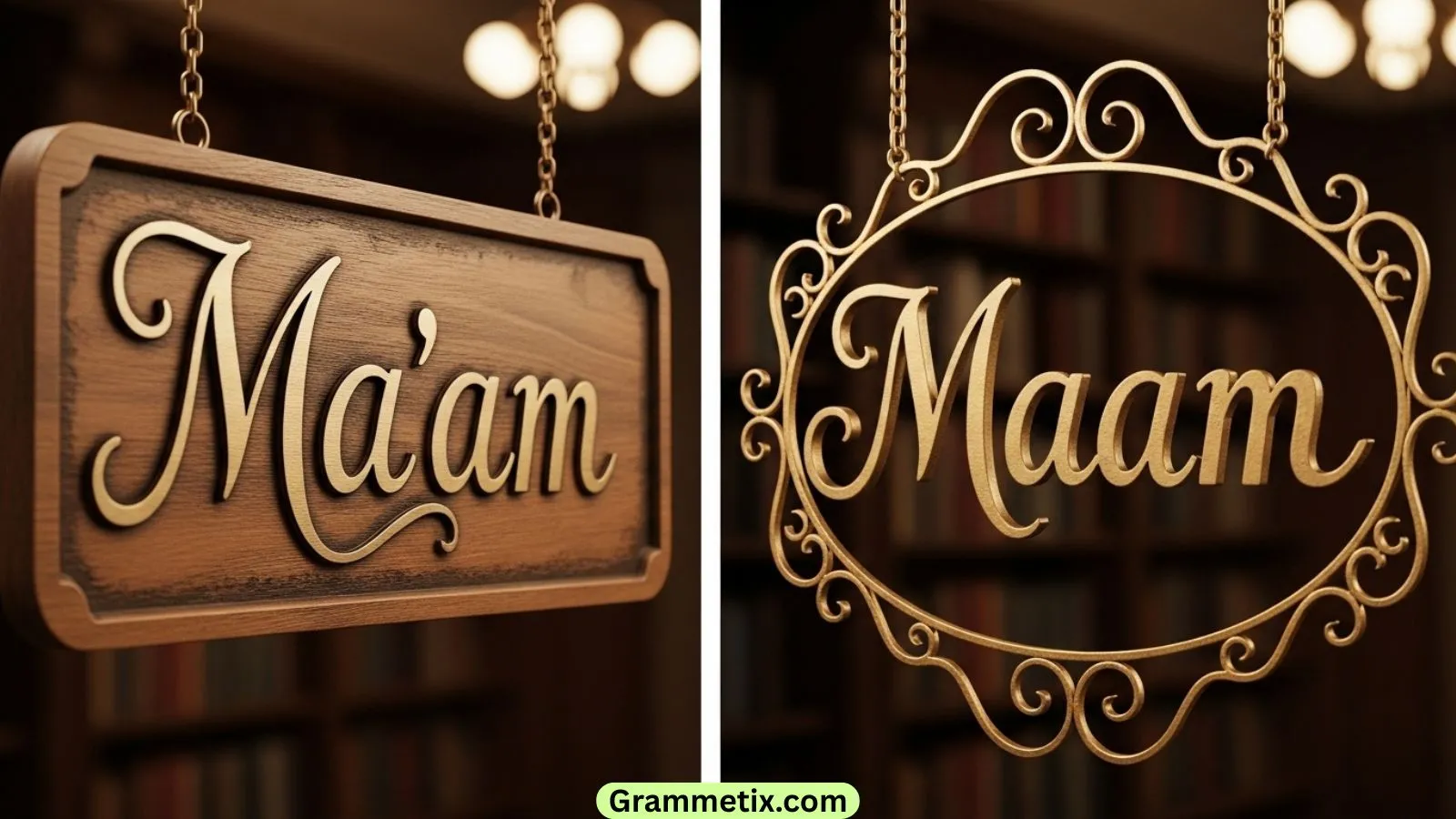
The correct and widely accepted spelling is ma’am, with an apostrophe.
It is a shortened form of the word madam, used as a polite way to address a woman.
Examples:
- Yes, ma’am, I understand your request.
- Excuse me, ma’am, you dropped your bag.
- Thank you, ma’am, for your time.
The version maam (without an apostrophe) is often seen in informal writing but is not considered standard in formal English.
The Origin of Ma’am or Maam
The word ma’am comes from the longer word madam, which has French origins. Over time, English speakers shortened it for easier and quicker speech.
The contraction follows a common English pattern where letters are removed and replaced with an apostrophe. This indicates missing letters from the original word. In this case, ma’am represents the shortened pronunciation of madam.
Historically, it has been used in formal address, especially in polite conversation, military communication, and customer service.
British English vs American English Spelling
Both British and American English recognize the term ma’am, but usage frequency and style can vary slightly.
In both forms, the apostrophe is generally included because it represents a contraction. However, informal writing or digital communication sometimes drops it.
Comparison Table
| Variation | Spelling | Usage | Notes |
|---|---|---|---|
| Standard form | ma’am | Formal writing | Correct contraction of madam |
| Informal variant | maam | Casual writing | Not grammatically standard |
| Capitalized form | Ma’am | Beginning of sentence or title | Same meaning |
| Alternative form | madam | Formal, full word | No apostrophe |
Which Spelling Should You Use?
Your choice depends on your audience and context:
- United States:
Use ma’am in formal and informal communication. It is widely accepted. - United Kingdom and Commonwealth countries:
Also use ma’am, especially in formal contexts like letters or respectful speech. - Global or professional writing:
Always prefer ma’am to maintain correctness and professionalism. - Informal chat or texting:
Some people write maam, but it is better to stick with ma’am for clarity.
Common Mistakes with Ma’am or Maam
Here are frequent errors people make:
- Writing maam in formal emails ❌
Use ma’am instead ✔ - Forgetting the apostrophe ❌
Apostrophe is required in standard English ✔ - Using it in the wrong context ❌
It should be used to address women respectfully ✔ - Confusing with similar terms like “mam” or “mom” ❌
These have different meanings ✔ - Capitalization errors ❌
Use Ma’am at the start of a sentence ✔
Ma’am or Maam in Everyday Examples
Emails:
- Dear Ma’am, I hope this message finds you well.
Customer Service:
- Ma’am, please allow me a moment to assist you.
News or Formal Writing:
- The officer responded politely, addressing her as ma’am.
Social Media:
- Ma’am, your content is very helpful, thank you!
Conversation:
- Yes, ma’am, I will complete the task today.
These examples show how ma’am is used in polite and respectful communication across different settings.
Ma’am or Maam – Google Trends & Usage Data
Search behavior shows that many users look up maam or ma’am to confirm correct spelling and usage.
- The keyword is commonly searched in countries where English is a second language.
- Higher search volume appears in regions like South Asia, Southeast Asia, and parts of Africa.
- Queries often come from students, professionals, and content writers.
- The confusion increases due to informal digital communication where punctuation is often ignored.
Overall, ma’am remains the preferred and grammatically correct form in formal English usage worldwide.
FAQs about Ma’am or Maam
1. What is the correct spelling: maam or ma’am?
The correct spelling is ma’am, with an apostrophe.
2. Is maam ever correct?
Maam is commonly used in informal writing but is not considered standard in formal English.
3. What does ma’am mean?
It is a polite contraction of madam, used to address a woman respectfully.
4. Is ma’am used in American and British English?
Yes, both use ma’am, especially in formal or polite communication.
5. Can ma’am be used in emails?
Yes, it is appropriate in professional and formal emails.
6. Is ma’am outdated?
No, it is still widely used in modern English for respectful address.
7. What is the difference between madam and ma’am?
Madam is the full formal word, while ma’am is its shortened, spoken version.
Conclusion
Understanding the difference between maam or ma’am helps you communicate more clearly and professionally. While both versions appear in everyday writing, ma’am is the correct and widely accepted form in formal English because it includes the apostrophe that represents the contraction of “madam.”
Using the correct spelling shows attention to detail and respect in communication, especially in professional, academic, or customer service settings. The version maam may appear in casual or informal contexts, but it is not grammatically standard.
By remembering the origin, spelling rules, and proper usage, you can confidently choose the right form every time. Whether you’re writing emails, speaking in conversation, or creating content, sticking with ma’am ensures clarity and correctness. This small detail can make your writing more polished and professional in any situation.