Have you ever paused while writing and wondered whether to use “practising” or “practicing”? You’re not alone. This is one of the most common spelling confusions in English.
People search for this keyword because they want a quick, clear answer that helps them write correctly, whether for school, work, emails, or online content.
The confusion exists because English has different spelling systems depending on region. British English and American English often spell the same word differently, and this is one of those cases. While both versions are correct, the choice depends on where your audience is located.
In this article, you’ll learn the exact difference between “practising” and “practicing,” when to use each one, and why both spellings exist.
You’ll also see real examples, common mistakes, and simple rules that make it easy to remember. By the end, you’ll confidently choose the right spelling every time.
Practising or Practicing – Quick Answer
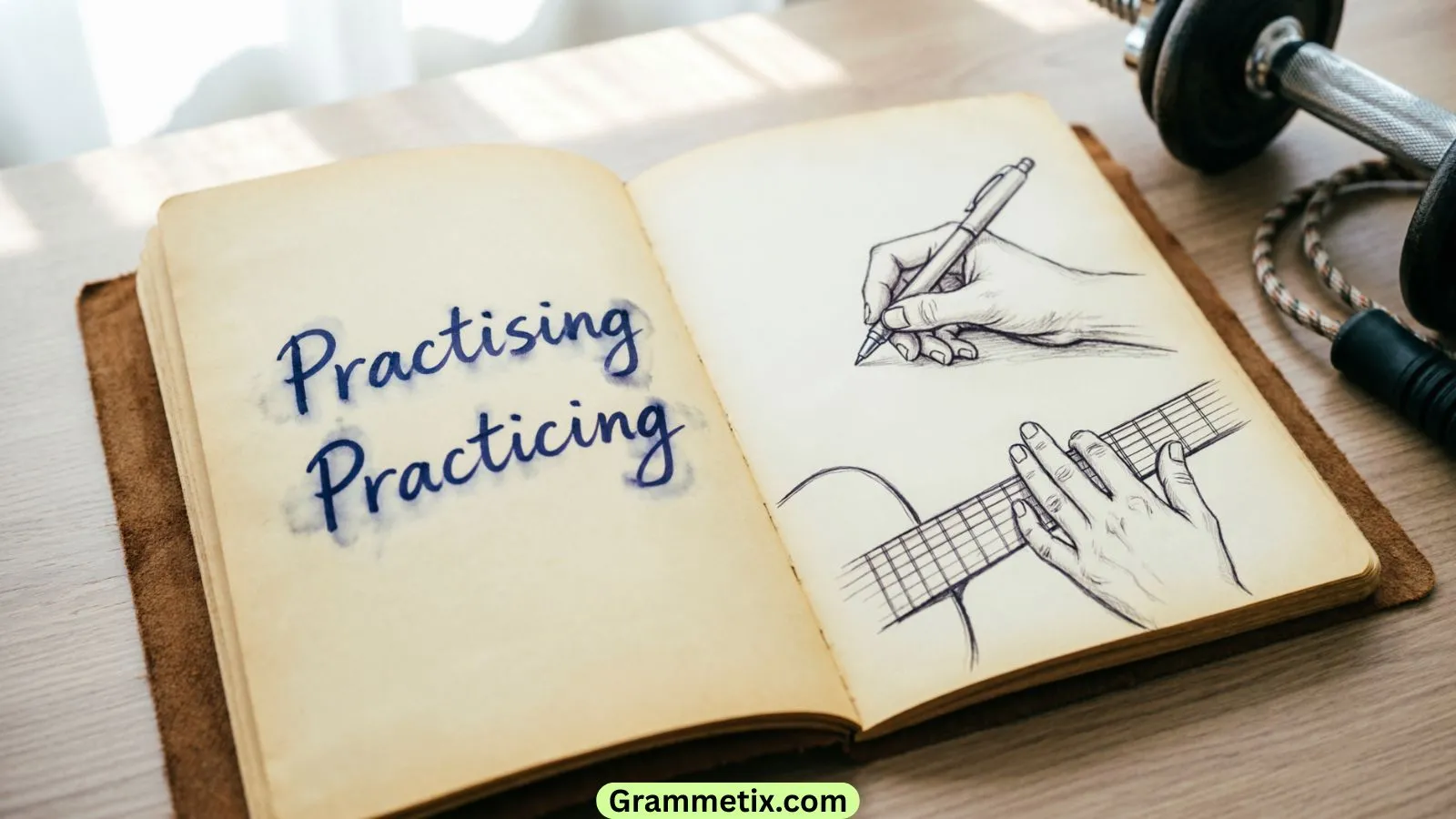
Both practising and practicing are correct spellings of the same word. The difference depends on English variation:
- Practising → British English (UK, India, Pakistan, Australia, etc.)
- Practicing → American English (USA)
Examples:
- She is practising piano every day. (British)
- She is practicing piano every day. (American)
Both words mean repeating an activity to improve skill or prepare for something.
The Origin of Practising or Practicing
The word comes from the verb “practice,” which originates from the Greek word praktikos, meaning “fit for action” or “active.” It passed through Latin and Old French before entering English.
Over time, English spelling evolved differently in various regions. British English kept the “-ise / -ising” and “-ce / -cing” patterns in certain words, while American English simplified many spellings for consistency.
That’s why:
- British English prefers practise (verb) and practising
- American English prefers practice (verb and noun) and practicing
The spelling difference is not about meaning—it’s about regional style.
British English vs American English Spelling
In British English:
- Verb: practise
- Gerund: practising
- Noun: practice
In American English:
- Verb: practice
- Gerund: practicing
- Noun: practice
Comparison Table
| Form | British English | American English |
|---|---|---|
| Verb | practise | practice |
| Gerund | practising | practicing |
| Noun | practice | practice |
| Example | I am practising guitar | I am practicing guitar |
Which Spelling Should You Use?
The correct spelling depends on your audience:
- Use “practising” if you are writing for:
- UK readers
- Commonwealth countries (Pakistan, India, Australia, etc.)
- Use “practicing” if you are writing for:
- US audience
- American publications or platforms
- For global or neutral content:
- Choose one style and stay consistent throughout your writing.
Consistency is more important than mixing both forms in the same document.
Common Mistakes with Practising or Practicing
- Mixing spellings in one article
- Incorrect: practising in one sentence and practicing in another
- Correct: choose one and stay consistent
- Using “practice” as both verb and noun in British English
- Incorrect: I am practice piano
- Correct: I am practising piano
- Confusing verb and noun usage
- Noun: I go to practice every day (US)
- Verb: I am practicing every day (US)
- Overcorrecting spelling
- Some writers incorrectly change all “-ise” words to “-ize” or vice versa without following a style guide
Practising or Practicing in Everyday Examples
Emails:
- British: I have been practising my presentation for the meeting.
- American: I have been practicing my presentation for the meeting.
Social Media:
- Practicing my guitar skills today 🎸
- Practising for exams all week 📚
News Writing:
- The athlete is practising daily to improve performance.
- The athlete is practicing daily to improve performance.
Formal Writing:
- Students are encouraged to practise regularly for better results.
- Students are encouraged to practice regularly for better results.
Practising or Practicing – Google Trends & Usage Data
Search trends show that:
- “Practicing” is more commonly searched in the United States.
- “Practising” appears more in countries that follow British English.
Globally:
- American English dominates online content due to the large US internet user base.
- British English remains standard in education systems across many Commonwealth countries.
In professional writing, the usage depends on the target audience rather than search volume alone.
FAQs
1. Is practising correct in English?
Yes, “practising” is correct in British English.
2. Is practicing wrong?
No, “practicing” is correct in American English.
3. What is the difference between practice and practise?
In British English, “practice” is a noun and “practise” is a verb. In American English, “practice” is used for both.
4. Which spelling is used in exams?
It depends on the exam board and country. UK exams use “practising,” while US exams use “practicing.”
5. Can I mix both spellings?
No, you should stay consistent with one style in the same document.
6. Which is more common globally?
“Practicing” is more common online due to American English dominance.
7. Does meaning change with spelling?
No, both spellings have the same meaning.
Conclusion
The confusion between “practising” and “practicing” comes down to regional spelling differences, not meaning. Both forms are correct, but they belong to different varieties of English.
British English uses “practising,” while American English uses “practicing.” The key is to understand your audience and stay consistent throughout your writing.
If you are writing for a UK or Commonwealth audience, use “practising.” If your readers are primarily in the United States, “practicing” is the better choice. In global content, consistency matters more than preference, so pick one style and apply it everywhere.
By remembering this simple rule, you can avoid confusion, improve clarity, and maintain professionalism in your writing. Whether you are writing emails, essays, or blog posts, choosing the correct spelling will make your communication clearer and more effective.