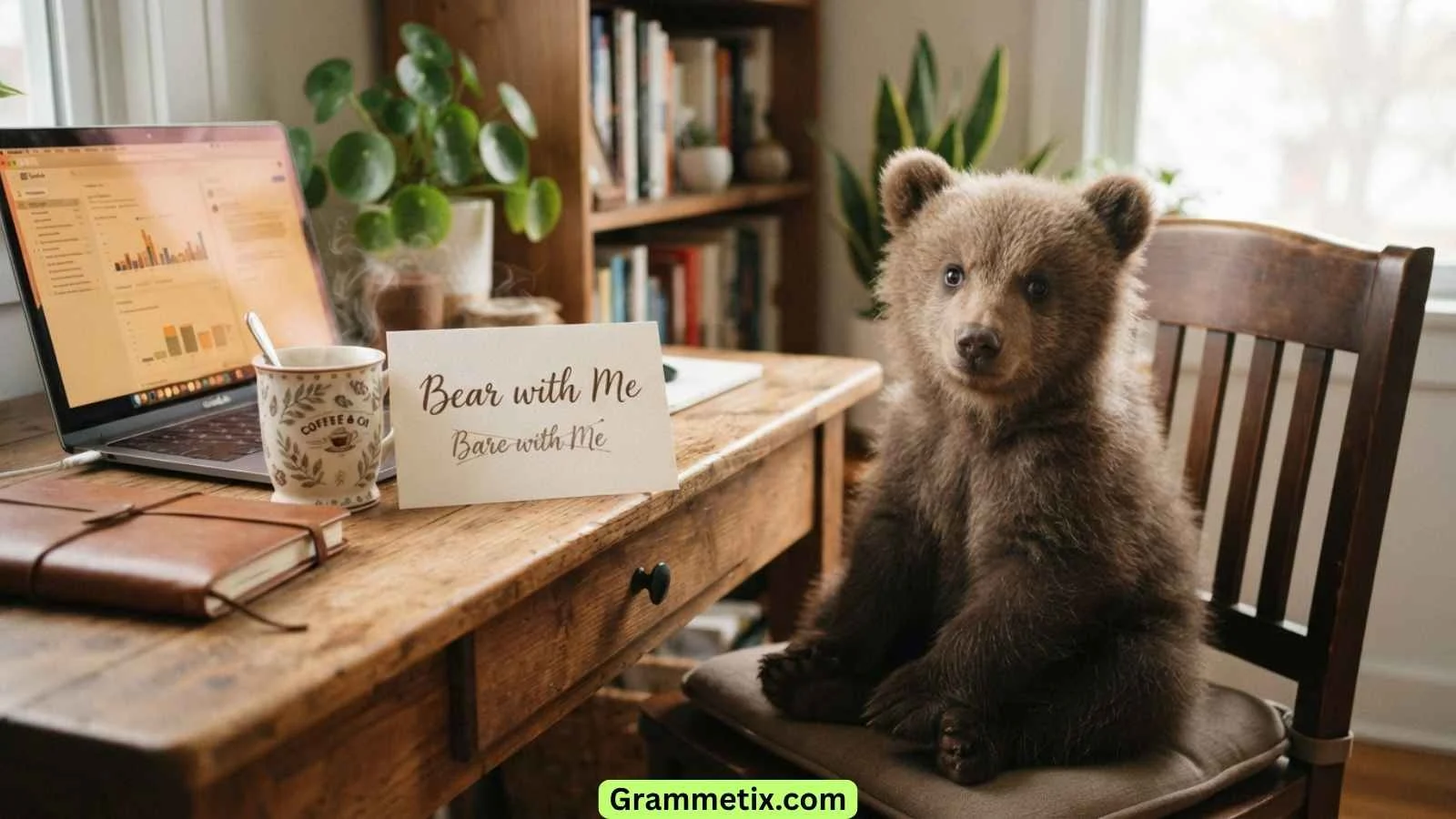
Have you ever stopped mid-sentence because you weren’t sure which spelling to use? You are not alone. The question “bear with me or bare with me” confuses thousands of people every single day.
It is one of the most common grammar mistakes in the English language. The two words sound exactly the same when spoken. That is why so many people mix them up when writing. But the difference in meaning is huge.
One phrase asks for patience. The other phrase asks for something very different. This confusion can lead to embarrassing mistakes in emails, reports, and social media posts.
You will learn the clear difference between the two phrases. We will explain the correct usage in simple, easy-to-understand language. You will also get helpful memory tricks and real-life examples.
By the time you finish reading, you will never have to wonder again. Let us solve this puzzle once and for all.
Bear with Me – Quick Answer
The correct phrase is “bear with me.” It means “be patient with me.” “Bare with me” is a mistake. It means something very different. It means “uncover with me.” That does not make sense in most situations. Always choose bear with me when asking for patience .
Key Difference Between Bear with Me and Bare with Me
This is where we break it down clearly. The difference is in the verb.
| Feature | Bear with Me | Bare with Me |
| Meaning | To be patient or to endure. | To uncover or to reveal. |
| Is it correct? | ✅ Yes, this is the standard, correct phrase. | ❌ No, it is a common misspelling of “bear with me.” |
| Use this when… | You are asking someone to wait or be tolerant. | You are asking someone to take off their clothes with you (and this is almost never the case!). |
Is Bear with Me Correct or Incorrect?
“Bear with me” is the correct phrase. It is the standard way to ask for patience. “Bare with me” is incorrect for this purpose. It is a common spelling error.
However, “bare” is a real word. It is just the wrong word for this context. If you write “bare with me,” you are asking someone to get naked with you. It is a very different request. So, always use bear with me when you want someone to wait .
Why Do People Confuse Bear with Me and Bare with Me?
There are a few reasons people confuse these two spellings.
- They sound the same: “Bear” and “bare” are homophones. This means they have the same pronunciation. You cannot hear the difference when you speak. You only see it when you write.
- English is confusing: English is full of words that sound the same. Even native speakers make mistakes.
- “Bear” is also an animal: People often think of the large, furry animal when they see the word “bear.” It can be funny to imagine a bear with you. This mental picture can cause them to choose “bare” by mistake.
The Origin of Bear with Me
The phrase “bear with me” has been around for a long time. It comes from the Old English word beran, which meant “to carry” or “to support” . Over time, the meaning evolved. It started to suggest enduring or being patient with someone.
You can find the phrase in John Heywood’s collection of proverbs from 1546 . It has been a common request for patience in the English language for hundreds of years.
British English vs American English Spelling
This is a simple one. There is no difference between British and American spelling for this phrase. “Bear with me” is the correct spelling in both forms of English. It has nothing to do with the region. It is just the correct way to write the phrase.
| Country/Variant | Spelling |
| US English | Bear with me |
| UK English | Bear with me |
| Australia/Canada | Bear with me |
Which Spelling Should You Use?
For US Audience
Always use bear with me. It is the standard and expected phrase.
For UK/Commonwealth Audience
Always use bear with me. It is the correct phrase for any English-speaking audience.
For Global/SEO Writing
Always use bear with me. The phrase is universally recognized. Using it will make you sound professional. It will also help you rank higher in search results.
How to Pronounce Bear with Me
The pronunciation of “bear” and “bare” is exactly the same. They both sound like “bair.” The whole phrase is pronounced “bair wih mee.” You cannot tell the difference in speech. The difference is only in writing.
Formal vs Informal Usage of Bear with Me
Academic writing
“Bear with me” is acceptable in academic writing. However, you might want to use a more formal alternative. You could say “I ask you to be patient” or “Please allow me a moment.”
Business communication
“Bear with me” is very common in business. It is a professional way to ask for patience. It is often used in emails and meetings.
Casual conversation
“Bear with me” is perfectly fine in casual talk. You can also say “Hang on” or “Give me a minute.”
Common Mistakes
1: Using “Bare” Instead of “Bear”
- Incorrect: “I am having technical issues. Please bare with me.”
- Correct: “I am having technical issues. Please bear with me.”
- Explanation: “Bear with me” means be patient. “Bare with me” is a request to get naked. You are asking people to be patient. You are not asking them to take off their clothes .
2: Using “Bear” as an Adjective
- Incorrect: “He gave the bear minimum effort.”
- Correct: “He gave the bare minimum effort.”
- Explanation: The correct phrase here is “bare minimum.” “Bare” is the adjective. It means the least possible amount . “Bear” is a verb or a noun.
3: “Bare in Mind”
- Incorrect: “Bare in mind that the deadline is tomorrow.”
- Correct: “Bear in mind that the deadline is tomorrow.”
- Explanation: This is another common mistake. “Bear in mind” means to remember something. “Bare in mind” is incorrect .
Bear with Me in Everyday Examples
In Emails
“Thank you for your patience. Please bear with me while I look into your issue.”
In News
The Washington Post used the phrase: “‘Please bear with me,’ said one team member at the meeting. ‘This is incredibly complex'” .
In Social Media
“I’m working on the next video. It is taking a little time. Please bear with me!”
In Formal Writing
“I understand this is a complex topic. I ask you to bear with me as I explain the details.”
Simple Rules to Remember
You can use a simple trick to remember the correct spelling.
- Think of an animal: Imagine a big, furry bear. You are asking the bear to be patient. A bear can be patient.
- Think about “bare”: “Bare” means to uncover. If you are not asking someone to take off their clothes, you do not need “bare.”
- Use the word “forbear”: It means to be patient. It contains the word “bear.” So “bear with me” has a direct connection to patience .
Bear with Me or Bare with Me – Google Trends & Usage Data
“Bear with me” is the dominant phrase worldwide. It is the standard and accepted spelling. “Bare with me” is often searched for, but this is because people are looking for the correct answer. They want to know which one is right. Data shows that “bear with me” is the correct term used by professionals .
| Phrase | Usage |
| Bear with me | Correct, used globally. |
| Bare with me | Incorrect, a common misspelling. |
Related Grammar Terms You Should Know
Here are a few other terms you might find helpful.
- Homophones: Words that sound the same but have different meanings and spellings (like “bear” and “bare”).
- Verb: An action word. “Bear” is a verb in this phrase.
- Adjective: A descriptive word. “Bare” is usually an adjective.
- Idiom: A common phrase with a meaning that is not literal.
FAQs
What does “bear with me” mean?
“Bear with me” means “be patient with me” or “tolerate me.” It is a polite way to ask someone to wait while you do something .
Is it “bear with me” or “bare with me”?
It is “bear with me.” “Bare with me” is a common misspelling. It means something completely different .
Why is it “bear” and not “bare”?
“Bear” is a verb meaning to “carry” or “endure.” “Bare” is a verb meaning to “uncover.” You are asking for patience, not to get naked .
What is a synonym for “bear with me”?
Some synonyms are “be patient with me,” “please wait,” “hold on a moment,” and “please stand by” .
Is “bear with me” formal or informal?
It is appropriate for both formal and informal contexts. It is very common in business and professional settings .
Can I use “bear with me” in an email?
Yes, absolutely. It is the perfect phrase to use when you need the recipient to be patient while you handle an issue or find information .
Where did the phrase “bear with me” come from?
It comes from the Old English word beran, which meant “to carry.” The phrase has been used to ask for patience since the 16th century .
Conclusion
The choice between bear with me and bare with me is an easy one.
Just remember that the correct phrase is bear with me. It means to ask someone to be patient. “Bare with me” is incorrect in this context. It is a very common mistake to make.
Now you know the difference. You can write with confidence. You will not make this error again.
So, go ahead and use bear with me in your next email or article. You will sound professional and knowledgeable.