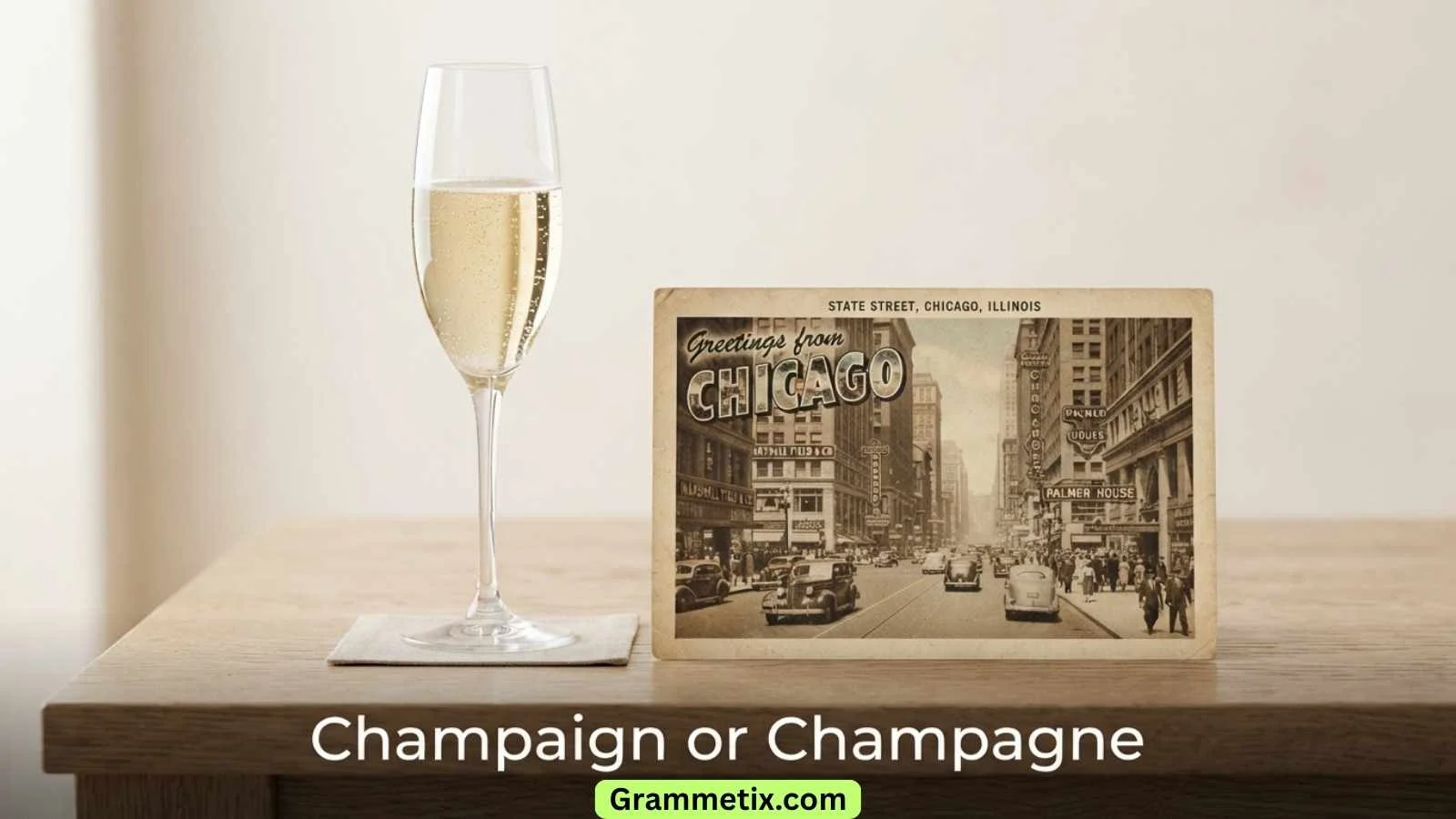
Have you ever stared at a menu and wondered about the spelling of your favorite bubbly drink? You are not alone. Many people search for the difference between champaign or champagne because these two words look and sound almost identical.
This confusion happens to everyone. It can make you feel unsure when writing an email, posting on social media, or even ordering a drink. Is one of them wrong? Or are they both correct?
This guide will give you a clear and simple answer right away. You will learn the exact difference between these two spellings. You will also discover when to use each word correctly.
By the end, you will never mix up champaign or champagne again. Let us clear up the confusion once and for all.
Champaign or Champagne – Quick Answer
The quick answer is: use “champagne” for the drink and “champaign” for a city in Illinois. If you are toasting a celebration, you want “champagne.” If you are talking about a place in the United States, you mean “Champaign.” They are not the same .
Key Difference Between Champaign or Champagne
The main difference is their meaning and where they come from.
- Champagne is a type of sparkling wine from France.
- Champaign is a city in the state of Illinois, USA.
- They are homophones, which means they sound alike but have different meanings and spellings .
Here is a simple table to show the differences side-by-side.
Is Champaign or Champagne Correct or Incorrect?
Both words are correct. However, they are correct in different situations. “Champagne” is the correct spelling for the wine. “Champaign” is the correct spelling for the city in Illinois. If you use the wrong word in the wrong context, it is a mistake .
Why Do People Confuse Champaign or Champagne?
The confusion comes from a few simple reasons.
- They Sound the Same: The words are homophones, which means they are pronounced the same way .
- Spelling is Similar: They are only a few letters apart. One small “g” vs. “i” changes everything.
- Global Exposure: People hear the word “sham-PAYN” in movies, songs, and conversations. They may see it spelled “champaign” somewhere and get confused.
The Origin of Champaign and Champagne
The word comes from the Latin word campania, which means “open land” or “plain” . This word passed into Old French.
It became “champagne,” which was a name for a region of France. Later, that region became famous for its sparkling wine . The English word “champaign” with an “i” also came from the same root. It meant an open plain, but this word is mostly not used anymore . It survives as the name of the city in Illinois .
British English vs American English Spelling
The spelling difference between “champaign” and “champagne” is not a British or American English issue. Both spelling differences come from different contexts, not from regional dialects.
Here is a table showing where the spellings are commonly used.
| Spelling | Where is it Used? |
|---|---|
| Champagne | For the French region, the sparkling wine, and luxury color . |
| Champaign | For the city in the United States, specifically Champaign, Illinois . |
Which Spelling Should You Use?
For US Audience
Use “Champaign” only when you are talking about the city in Illinois. For the drink, always use “champagne” .
For UK/Commonwealth Audience
Use “champagne” for the wine. The city in Illinois is not a common topic, but it is still spelled “Champaign.”
For Global/SEO Writing
When writing for a global audience, use “champagne” for the drink. It is the most recognized term. It is also the more common search term.
How to Pronounce Champaign or Champagne
Both words sound exactly the same. They are pronounced “sham-PAYN” .
Formal vs Informal Usage of Champaign and Champagne
Academic Writing: Be precise. Use “Champagne” with a capital “C” when referring to the wine from France. Use “sparkling wine” if the wine is not from there. And use “Champaign” when discussing the city .
Business Communication: If you are in the wine business, be accurate. If you are writing to clients in Illinois, spell the city correctly.
Casual Conversation: Most people will say “champagne” for the drink. It is okay to use “champagne” as a generic word for sparkling wine in casual settings .
Common Mistakes with Champaign and Champagne
1: Confusing Champaign and Champagne
- Incorrect example: “I bought a bottle of champaign for New Year’s.”
- Correct example: “I bought a bottle of champagne for New Year’s.”
- Short explanation: “Champaign” is a city, not a drink .
2: Spelling the French Region with an “i”
- Incorrect example: “The Champaign region of France is famous for its wine.”
- Correct example: “The Champagne region of France is famous for its wine.”
- Short explanation: The region in France is always spelled “Champagne” .
Champaign or Champagne in Everyday Examples
In Emails
- Incorrect: “Let’s celebrate with some champaign!”
- Correct: “Let’s celebrate with some champagne!”
In News
In Social Media
- Correct: “Cheers with my favorite champagne! 🥂”
- Correct: “Visiting the beautiful campus in Champaign!”
In Formal Writing
- Correct: “The Champagne region is protected by law.”
- Correct: “The University of Illinois is in Urbana-Champaign.”
Simple Rule to Remember
To remember the difference, follow this rule: “I go to Illinois.” The city “Champaign” has an “i” and is in Illinois.
Another easy tip: The French region has a “g” in its name (Champagne) and uses grapes to make wine. The city has an “i” and is in Illinois.
Champaign or Champagne – Google Trends & Usage Data
“Champagne” is searched for far more often than “Champaign” worldwide. This is because it is a popular drink.
“Champaign” is mainly searched for in the United States, especially in the Midwest, near Illinois. “Champagne” is a popular search term in all countries, especially in Europe and North America.
Related Grammar Terms You Should Know
Here are some related terms you might find useful.
- Homophones: Words that sound the same but have different meanings and spellings .
- Proper Noun: A name for a specific person, place, or thing, which is usually capitalized, like “Champaign, Illinois” or “Champagne, France.”
- Common Noun: A general word for a person, place, or thing, like “wine” or “city.”
FAQs
Is it correct to spell champagne as champaign?
No, “champaign” is not a correct spelling for the sparkling wine. It is a common misspelling. “Champagne” is the correct spelling for the drink .
What is the difference between champagne and champaign?
The difference is in the meaning. “Champagne” is a sparkling wine from France. “Champaign” is a city in Illinois, USA .
Does the word “champaign” exist?
Yes, “champaign” is a real word. It is a proper noun that refers to a city in Illinois . In the past, it also meant open country, but that use is outdated .
How do you say champaign?
You say “champaign” just like “champagne.” Both are pronounced “sham-PAYN” .
Is it spelled champagne or champaign in the UK?
In the UK, “champagne” is the correct spelling for the sparkling wine. The city in the US is still spelled “Champaign.” The difference is not based on dialect .
Why is there a confusion between these words?
The confusion exists because both words are homophones. They sound exactly the same, but they have different spellings and meanings .
Conclusion
In summary, the difference between “champaign” and “champagne” is simple.
You should use “champagne” for the delicious French sparkling wine. Use “Champaign” only when you are talking about the city in Illinois. Remember the simple rule: “I” go to “Illinois.” That will help you choose the right word.
Now you know the difference and can use each word correctly with confidence.