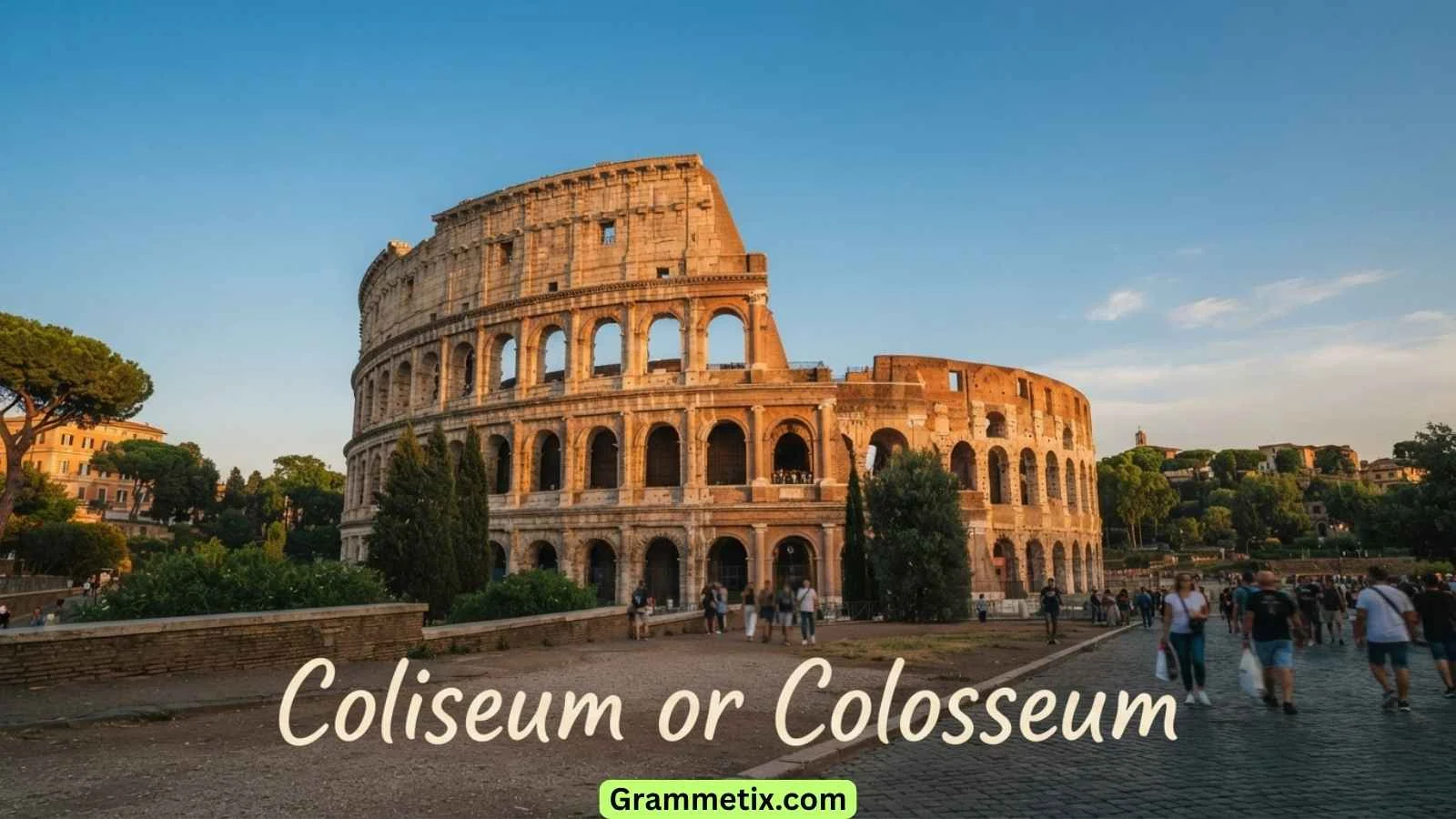
Do you know the difference between coliseum or Colosseum? Many people do not. This is one of the most common spelling questions online.
You see both words everywhere. But are they the same? The short answer is no. They look alike but mean different things. One is a famous building in Rome. The other is a word for any big stadium.
This mix-up confuses writers, students, and travelers. It can even make you sound less professional. In this post, we will clear up all the confusion. We will explain the difference in simple words.
You will learn exactly which spelling to use. We will also share easy rules to remember. By the end, you will never second-guess yourself again. Let’s dive in and solve this puzzle once and for all.
Coliseum or Colosseum – Quick Answer
The quick answer is simple. Use coliseum for a general stadium or arena. Use Colosseum for the specific ancient amphitheater in Rome, Italy. For example, “We went to the coliseum for a concert” is correct. “We visited the Colosseum in Rome” is also correct. Remember the rule: General uses “coliseum,” and the specific Roman landmark uses “Colosseum.”
Key Difference Between Coliseum or Colosseum
The main difference is specific versus general.
- Colosseum refers to one specific building: the famous ancient amphitheater in Rome.
- Coliseum is a common noun for any large stadium or theater.
Here is a quick comparison:
| Feature | Coliseum | Colosseum |
|---|---|---|
| Type of Word | Common noun | Proper noun |
| What It Means | Any large stadium or theater | The specific Roman amphitheater |
| Capitalization | Usually lowercase | Always capitalized |
| Examples | The city built a new coliseum. | We toured the Colosseum. |
Examples in Sentences
Let’s see them in action.
- Coliseum: The basketball game was held at the city coliseum.
- Colosseum: The Colosseum is a famous tourist attraction.
Is Coliseum or Colosseum Correct or Incorrect?
Here is the good news: both spellings are correct. They are not wrong. The choice depends on what you are talking about. If you are writing about the ancient Roman landmark, use “Colosseum.” If you are writing about any other large venue, use “coliseum.” You can’t go wrong if you follow this rule. The words have different uses but are both valid in modern English .
Why Do People Confuse Coliseum or Colosseum?
There are a few reasons why these words cause so much confusion.
British vs American English
Historically, there have been different preferences. In the past, British English often used “colosseum” more. American English preferred “coliseum.” Today, however, the modern rule is simple: specific building vs. general venue, no matter where you are .
Internet and Global Exposure
We see both words online. Travel blogs talk about the “Colosseum.” Sports news covers games at the “coliseum.” Seeing both words in different contexts can be confusing. It makes it hard to know which one is right for your own writing.
Education Differences
Not everyone learns the difference at school. Many people are taught one spelling and assume it applies everywhere. This leads to common mix-ups in everyday writing.
The Origin of Coliseum or Colosseum
The story behind these words is interesting. The famous amphitheater in Rome was originally called the Flavian Amphitheatre. Its current name comes from a giant statue of Nero that stood nearby. This statue was called a “colossus.” The name eventually became “Colosseum” .
The word “coliseum” comes from this original name. It started as a variant spelling. Over time, it became a general term for any similar large building . So, while one is a specific landmark, the other is a general term inspired by that landmark.
British English vs American English Spelling
In the past, spelling differences between British and American English were more strict. For example:
- British English: Often used “colosseum” for both the landmark and general venues.
- American English: Often used “coliseum” for general venues.
Today, this is less important. Both language communities now agree. “Colosseum” is for the Roman amphitheater. “Coliseum” is for all other venues .
| Region | Common Spelling for General Venue |
|---|---|
| United States | Coliseum |
| United Kingdom | Coliseum |
| Australia | Coliseum |
| Canada | Coliseum |
Which Spelling Should You Use?
This is the most important question. Here is a simple guide.
For US Audience
Use coliseum for any sports arena or theater in America. Use Colosseum only when writing about the one in Rome. For example, “The Los Angeles Coliseum is a famous stadium.”
For UK/Commonwealth Audience
The same rule applies. Use coliseum for general buildings. It is a common spelling in British English . Use Colosseum for the Italian landmark. Your audience will understand both.
For Global/SEO Writing
For content that anyone can read online, the rule is simple. Use “coliseum” for general venues. Use “Colosseum” for the Roman monument. This is the modern standard. It is clear and easy for everyone to understand.
How to Pronounce Coliseum or Colosseum
Do these words sound the same? They are very similar but not identical.
- Coliseum: Pronounced “KOL-uh-SEE-um”
- Colosseum: Pronounced “KOL-uh-SEE-um” or “KOL-oh-SEE-um”
In practice, many people pronounce them the same way. The difference in spelling is more important for writing than for speaking .
Formal vs Informal Usage of Coliseum and Colosseum
Academic Writing
Be precise. Always use Colosseum (capitalized) for the Roman landmark. For historical or architectural studies, use the exact term.
Business Communication
In business writing, clarity is key. If you are naming a venue, use its official name. Many are called “Coliseum.” Use coliseum as a common noun for any large event space.
Casual Conversation
In everyday talk, spelling doesn’t matter much. People will understand you either way. However, knowing the difference shows you pay attention to detail.
Common Mistakes with Coliseum or Colosseum
1: Using the Wrong Word for Rome
- Incorrect: We are planning a trip to see the Roman Coliseum.
- Correct: We are planning a trip to see the Roman Colosseum.
- Explanation: The famous building in Rome is always “Colosseum” .
2: Capitalizing the General Word
- Incorrect: The concert is at the local Coliseum.
- Correct: The concert is at the local coliseum.
- Explanation: “Coliseum” is a common noun and should not be capitalized.
3: Using “Colosseum” for a Modern Stadium
- Incorrect: The new basketball stadium is called the City Colosseum.
- Correct: The new basketball stadium is called the City Coliseum.
- Explanation: Modern venues usually use “coliseum” in their names .
Coliseum or Colosseum in Everyday Examples
In Emails
You might write: “Can you get the tickets for the show at the Grand Coliseum?”
In News
A news headline: “Colosseum Restoration Project Complete.” Another headline: “Thousands Pack City Coliseum for Final Game.”
In Social Media
A travel post: “I love Rome. Look at this picture of the Colosseum.” A sports fan tweets: “Home game tonight at the coliseum. Go team!”
In Formal Writing
A report: “The committee approved the budget for the new coliseum.” A history paper: “The Colosseum was a remarkable engineering achievement.”
Simple Rule to Remember
Here are three easy ways to remember the difference:
- The “O” is for Rome.
Both “Colosseum” and “Rome” have two “O’s.” - A “Coliseum” is a “Stadium.”
Both are general terms. - Capitalize the Roman one.
It is a specific place, so it is a proper noun.
Coliseum or Colosseum – Google Trends & Usage Data
Google Trends data shows how people use these words.
- Global Search: “Colosseum” is searched far more often. This is because it is a major tourist attraction. Many people look for travel information.
- Usage by Country: In the US, both words are common. “Coliseum” is often used in a local context (e.g., Oakland Coliseum). In the UK, “Colosseum” is also very popular. This is due to the historical and cultural interest in ancient Rome.
In short, “Colosseum” is a global topic. “Coliseum” is more local and general.
Related Grammar Terms You Should Know
Here are some related grammar concepts.
- Common Noun: A general name for a person, place, or thing. Coliseum is a common noun.
- Proper Noun: The specific name of a person, place, or thing. Colosseum is a proper noun.
- Amphitheater: An open-air venue with seats around a central area. This is the type of building both words describe.
- Stadium: A sports arena.
- Capitalization: The act of writing a word with a capital letter.
FAQs
What is the main difference between coliseum and Colosseum?
The main difference is that “coliseum” is a general word for any large stadium, while “Colosseum” is the specific name of the ancient amphitheater in Rome .
Are both spellings accepted?
Yes, both spellings are correct and accepted in modern English. You just need to use the right one for the right context .
Is there a difference in British vs American English?
Historically, there were different preferences, but today the rule is the same: “coliseum” for a general venue and “Colosseum” for the landmark in Rome .
Is the Colosseum in Rome spelled with an “e” or an “o”?
The famous monument in Rome is spelled Colosseum. It has an “o” after the ‘l’. Remember, the “O” is for Rome .
Can I use “coliseum” for the Roman building?
It is best not to. The proper name is “Colosseum.” Using “coliseum” for the Roman landmark is often considered a mistake .
Do the words have the same meaning?
No, they do not. “Colosseum” refers to one specific building. “Coliseum” is a generic term for a type of building .
Which spelling is used in official names of venues?
In the United States and other countries, the official names of many large venues use “Coliseum,” e.g., the Oakland Coliseum .
Conclusion
So, what is the final verdict? The rule is clear and simple. Use coliseum when talking about any stadium, theater, or large venue in general. Use Colosseum when talking about the famous ancient amphitheater in Rome.
This distinction is very easy to remember. Think of the two “o’s” in Colosseum and the two “o’s” in Rome.
When in doubt, ask yourself: “Am I talking about the one in Rome?” If the answer is yes, use “Colosseum.” For everything else, use “coliseum.” Now you know the difference. You can write with confidence and avoid this common spelling error.