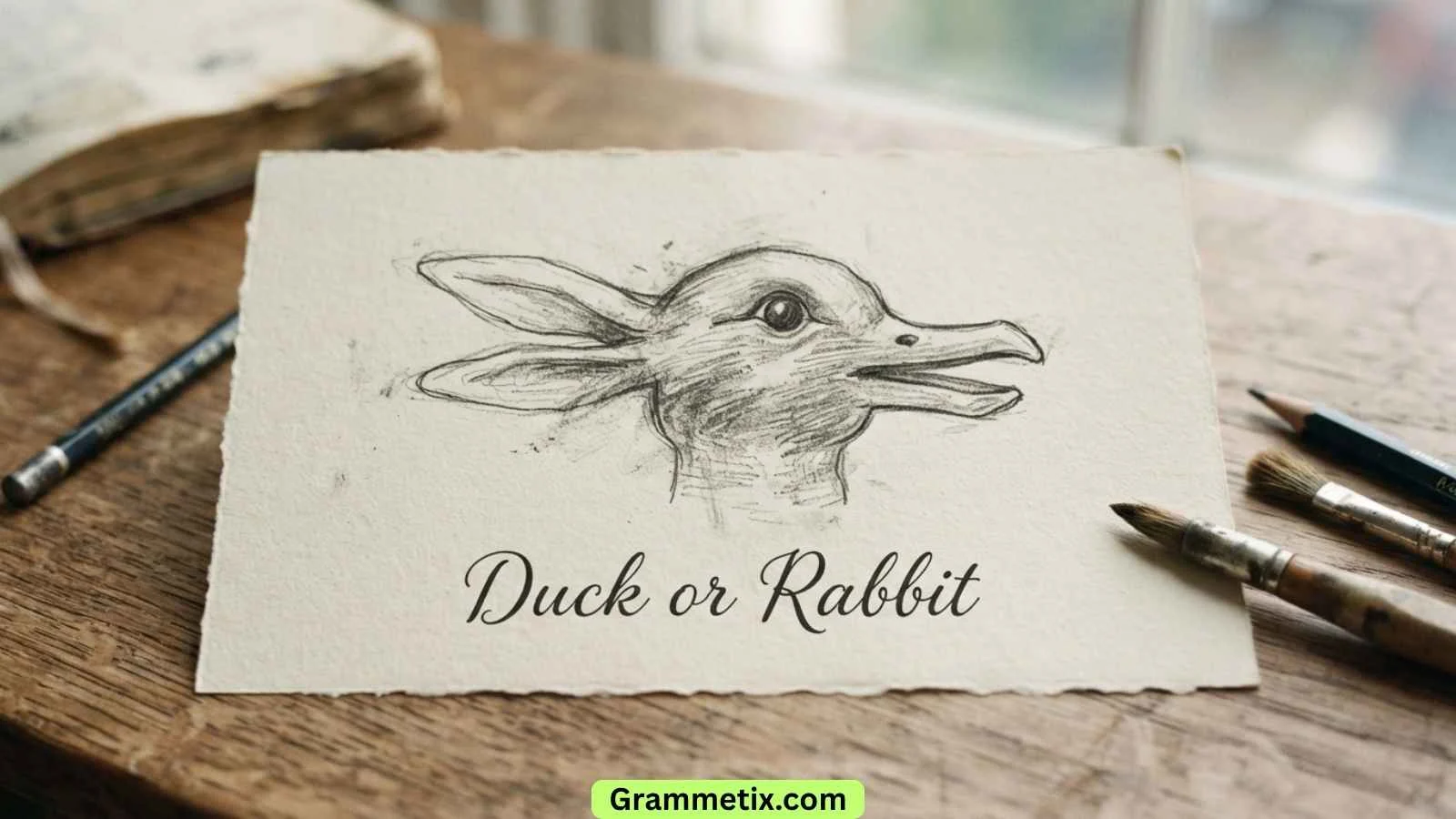
Have you ever looked at a picture and wondered if it shows a duck or rabbit? You are not alone. This famous image has confused people for more than 100 years.
Some people see a duck first, while others notice a rabbit. The interesting part is that both answers are correct. That is why so many people search for the duck or rabbit illusion online.
In this guide, you will learn what the duck or rabbit illusion is, where it came from, why people see different animals, and what it teaches us about the human brain.
You will also discover fun facts, simple examples, and easy explanations that anyone can understand.
Duck or Rabbit – Quick Answer
The duck or rabbit is a famous optical illusion that can look like either a duck or a rabbit. Neither answer is wrong. What you see first depends on how your brain interprets the same picture. With a little practice, most people can switch between seeing both animals.
What Is the Duck or Rabbit Illusion?
The duck or rabbit illusion is one of the world’s best-known optical illusions. It is a single drawing that can be seen in two different ways.
At first glance, you may notice a duck. If you look again, the same picture can become a rabbit. Nothing in the image changes. Only the way your brain understands it changes.
This makes the duck or rabbit illusion a great example of how our minds work.
How the Illusion Works
The picture contains shapes that match the features of both animals.
- The duck’s bill becomes the rabbit’s ears.
- The rabbit’s mouth becomes the duck’s head.
- The eye stays in the same place for both animals.
Your brain chooses one interpretation first. Once you know there are two possibilities, it becomes much easier to switch between them.
Why Is It Called an Optical Illusion?
An optical illusion is an image that tricks your eyes and brain into seeing something unexpected.
The duck or rabbit picture is called an optical illusion because the drawing never changes. Instead, your brain changes how it understands the image.
Unlike magic tricks, nothing is hidden. The illusion happens because your brain is always trying to make sense of what it sees.
Why Is This Illusion So Famous?
The duck or rabbit illusion has remained popular for many years because it is simple but surprising.
People enjoy sharing it with friends and family to see who notices each animal first. Teachers also use it in classrooms to explain how perception works.
Today, the image is still widely shared on websites, social media, and in psychology lessons around the world.
The History of the Duck or Rabbit Illusion
The duck or rabbit illusion has a long and interesting history.
The drawing first appeared in a German humor magazine in 1892. It was published as a fun picture that could be seen in two different ways.
A few years later, psychologists became interested in it. They realized the image could help explain how people understand what they see.
Over time, the illusion became one of the most famous examples used in psychology books and classrooms.
Today, students, teachers, artists, and scientists still use it to learn about perception and the human brain.
Who Created the Duck or Rabbit Illusion?
The exact artist is not known for certain. However, the illustration first appeared in the German magazine Fliegende Blätter in 1892.
Later, American psychologist Joseph Jastrow studied the picture in detail. He used it to show that what we see depends on how our minds process information, not only on what our eyes receive.
Because of his work, many people now refer to it as the Jastrow duck-rabbit illusion.
Why Do People See Different Animals?
One of the most interesting questions is why one person sees a duck first while another sees a rabbit.
The answer lies in how the brain processes visual information.
Everyone’s brain works in a similar way, but past experiences, expectations, and attention can influence what we notice first.
Your Brain Looks for Familiar Shapes
Your brain is always searching for patterns.
If the shape reminds you of a duck, your brain quickly labels it as a duck.
If it reminds you of a rabbit, your brain makes a different choice.
Both answers are correct because the drawing supports both ideas.
Experience Can Make a Difference
Sometimes what you recently saw or talked about can affect your answer.
For example:
- If you just visited a park with ducks, you may notice the duck first.
- If you recently watched a cartoon with rabbits, you may see the rabbit first.
This is called context, and it can influence how your brain understands the picture.
Attention Changes What You See
When someone tells you there are two animals in the picture, your brain begins looking for another answer.
After a few seconds, many people suddenly notice the second animal.
Once this happens, it becomes much easier to switch back and forth between the duck and the rabbit.
What Does the Duck or Rabbit Illusion Teach Us About the Brain?
The duck or rabbit illusion is more than a fun picture. It helps scientists understand how the brain works.
Your eyes send the same image to your brain every time. The picture does not change. However, your brain can give the image two different meanings.
This shows that seeing is not only about your eyes. Your brain also plays a big role in what you see.
Your Brain Fills in Information
Your brain works very fast.
It looks at shapes, lines, and patterns. Then it compares them with memories you already have.
For example:
- You know what a duck looks like.
- You also know what a rabbit looks like.
Because the drawing matches both animals, your brain can choose either one.
Perception Is Different from Vision
Many people think seeing and perception are the same.
They are actually different.
- Vision is what your eyes collect.
- Perception is how your brain understands what your eyes see.
The duck or rabbit illusion is one of the best examples of perception in action.
Your Brain Can Change Its Mind
One amazing thing about this illusion is that your brain can switch between two answers.
At first, you may only see a duck.
After someone points out the rabbit, you suddenly notice it too.
Then you can switch back and forth between both animals.
This ability is called perceptual switching.
It shows that our brains are flexible and always ready to find new ways to understand the same information.
Does the Duck or Rabbit Illusion Say Anything About Your Personality?
Many websites claim that the animal you see first reveals your personality.
For example, they may say:
- Seeing a duck means you are creative.
- Seeing a rabbit means you are logical.
These ideas are fun to read, but there is no strong scientific proof that the illusion can reveal someone’s personality.
Scientists use the duck or rabbit illusion to study perception, not personality.
So, if you see one animal before the other, it does not mean anything special about your character.
Instead, it simply shows how your brain interpreted the picture at that moment.
Psychology Studies on the Duck or Rabbit Illusion
The duck or rabbit illusion has interested psychologists for more than a century.
Researchers use it to learn how people recognize objects and make decisions.
Here are some important lessons from these studies.
The Brain Uses Past Experience
Your past experiences affect what you notice.
If you often see ducks, your brain may recognize the duck first.
If rabbits are more familiar, the rabbit may appear first.
This does not mean one person is smarter than another.
It simply means the brain uses previous knowledge to understand new information.
Expectations Matter
What you expect to see can change your answer.
Imagine someone asks,
“Can you find the rabbit?”
Your brain immediately starts looking for rabbit features.
The same happens if someone asks you to find the duck first.
This shows that expectations influence perception.
Context Can Change Perception
Researchers have found that what happens before you look at the picture can affect what you see.
For example:
- Looking at pictures of animals may influence your answer.
- Reading about birds may make the duck easier to notice.
- Reading about rabbits may make the rabbit appear first.
This is another example of how the brain uses context to understand the world.
Duck vs Rabbit: What’s the Difference?
Although the famous image is an illusion, ducks and rabbits are very different animals.
The table below compares some of their main features.
| Feature | Duck | Rabbit |
|---|---|---|
| Animal Type | Bird | Mammal |
| Body Covering | Feathers | Fur |
| Legs | Two | Four |
| Wings | Yes | No |
| Can Fly | Many species can | No |
| Habitat | Lakes, ponds, rivers | Fields, forests, gardens |
| Babies | Ducklings | Kits |
| Main Food | Plants, insects, seeds | Grass, vegetables, hay |
Quick Comparison
- Ducks are birds with feathers and bills.
- Rabbits are mammals with soft fur and long ears.
- Ducks often live near water.
- Rabbits usually live on land.
- Ducks can swim very well.
- Rabbits are excellent runners and jumpers.
Interesting Facts About Ducks
Ducks are fascinating birds found almost everywhere in the world.
Here are some fun facts.
Ducks Can Swim Soon After Birth
Many ducklings enter the water within a day after hatching.
Their mother stays nearby to keep them safe.
Ducks Have Waterproof Feathers
Ducks spread oil over their feathers using a special gland.
This keeps water from soaking into their feathers.
Not Every Duck Flies Long Distances
Some ducks migrate thousands of miles.
Others stay in the same area all year.
Ducks Communicate in Many Ways
People know ducks for their famous “quack.”
However, ducks also whistle, grunt, and make other sounds.
Different species communicate differently.
Interesting Facts About Rabbits
Rabbits are gentle mammals that live in many parts of the world.
They have several amazing abilities.
Rabbits Have Powerful Back Legs
Their strong legs help them jump high and run quickly.
This helps them escape from predators.
Their Teeth Never Stop Growing
Rabbit teeth continue growing throughout their lives.
Chewing hay helps keep their teeth healthy.
Rabbits Have Excellent Hearing
Their long ears can turn in different directions.
This helps them hear danger from far away.
Rabbits Are Social Animals
Many wild rabbits live in groups.
They communicate using body language, scents, and gentle sounds.
Why Is the Duck or Rabbit Illusion Still Popular Today?
The duck or rabbit illusion has stayed popular for more than 100 years. Even today, millions of people enjoy looking at it.
One reason is its simplicity. The drawing has only a few lines, yet it creates two different images.
Another reason is curiosity. People love asking friends, “What do you see first?” The answers often surprise everyone.
Teachers also use the illusion in science and psychology lessons. It helps students understand how the brain processes information.
On social media, the image is shared as a fun challenge. Many people enjoy testing whether others see the duck or the rabbit first.
The illusion reminds us that two people can look at the same picture and honestly see different things.
Can You Train Yourself to See Both Animals?
Yes! Most people can learn to see both the duck and the rabbit.
If you only see one animal, don’t worry. Try these simple tips.
Look at the Bill or the Ears
If you see a duck, focus on its bill.
Now imagine those same shapes as long rabbit ears.
Your brain may suddenly switch.
Turn the Picture Around
Some people find it easier after rotating the image.
A different angle can help your brain notice the second animal.
Take a Short Break
If you cannot see both animals, look away for a few seconds.
Then look back with fresh eyes.
Many people notice the second animal almost immediately.
Ask Someone Else
Another person may point out a feature you missed.
Once you see both animals, switching between them becomes much easier.
Fun Facts About the Duck or Rabbit Illusion
- The illusion first appeared in 1892.
- It is one of the world’s oldest famous optical illusions.
- The same picture never changes.
- Your brain changes its interpretation instead.
- It is often used in psychology classes.
- People of all ages enjoy trying it.
- Artists and designers use it to show how perception works.
- It remains one of the most shared optical illusions online.
FAQs
Is the duck or rabbit illusion real?
Yes. The illusion is real because the same drawing can be interpreted in two different ways. Your eyes see one picture, but your brain can understand it as either a duck or a rabbit.
What does seeing the duck first mean?
Seeing the duck first does not reveal your personality. It simply shows which interpretation your brain recognized before the other.
Can everyone see both animals?
Most people can. Some notice both immediately, while others need a little practice before they can switch between the two images.
Why is the duck or rabbit illusion important?
The illusion helps psychologists study perception, attention, and how the brain understands visual information. It is also a fun way to learn about human thinking.
Who created the duck or rabbit illusion?
The drawing first appeared in the German humor magazine Fliegende Blätter in 1892. Later, psychologist Joseph Jastrow made it famous by studying how people interpreted it.
Is the duck or rabbit illusion suitable for children?
Yes. It is safe, educational, and easy to understand. Many teachers use it to introduce children to optical illusions and critical thinking.
Related Topics You May Also Like
If you enjoyed learning about the duck or rabbit illusion, you may also like these topics:
- Optical illusions
- Visual perception
- Brain games
- Psychology for beginners
- Ambiguous images
- Gestalt psychology
- Eye and brain coordination
- Famous illusion pictures
These topics are excellent for learning more about how our minds understand the world.
Conclusion
The duck or rabbit illusion is a perfect example of how amazing the human brain can be. Although the picture never changes, your mind can see two completely different animals. That is why this simple drawing has fascinated people for generations.
Whether you noticed the duck first or the rabbit first, neither answer is wrong. The illusion teaches us that perception depends on how our brains interpret information, not just on what our eyes see.
It also reminds us to keep an open mind, because the same situation can sometimes be viewed in more than one way.
The next time someone asks, “Duck or rabbit?”, you’ll know the answer: it can be both.