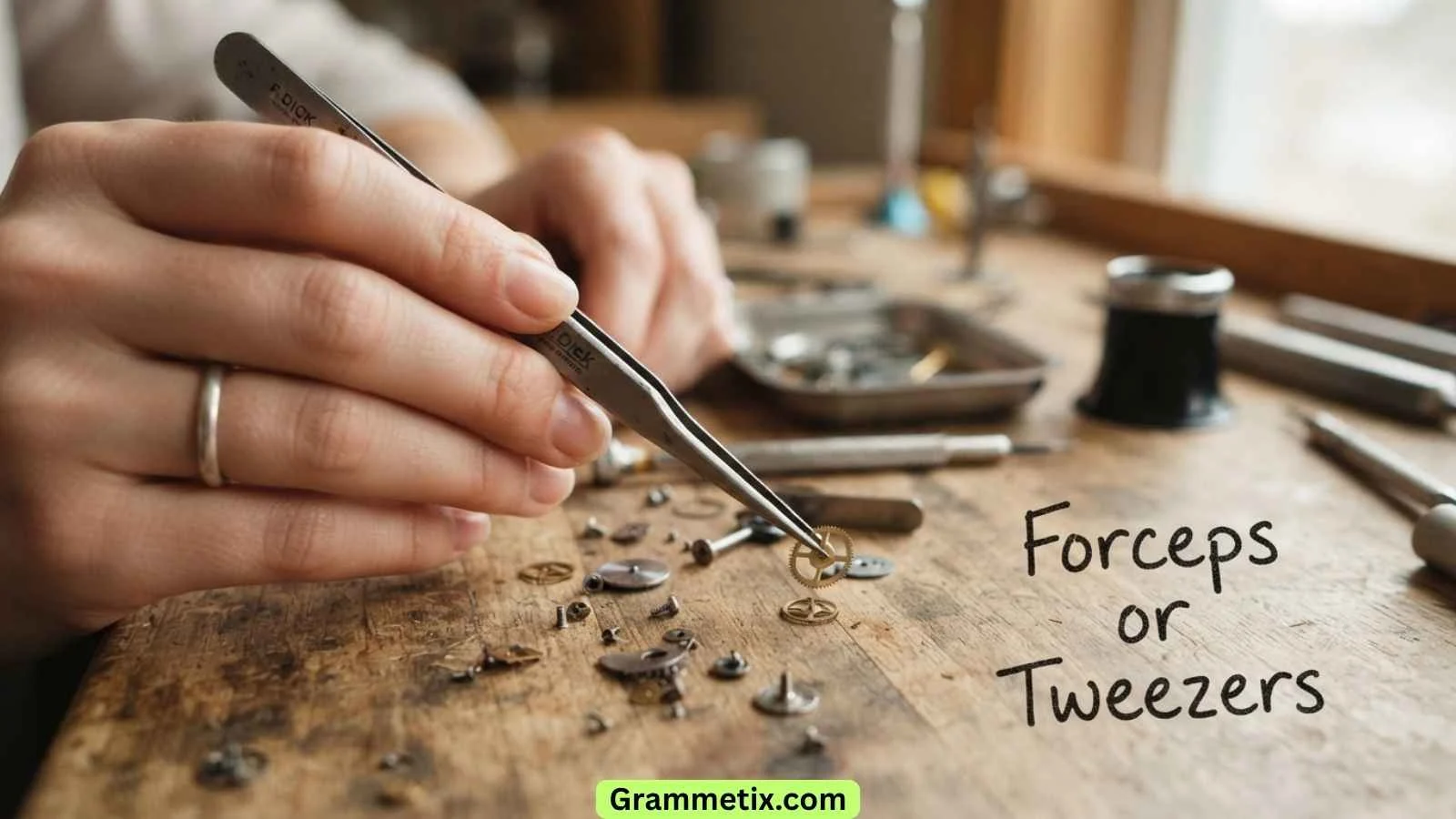
Forceps or tweezers may look alike, but they are made for different jobs. Many people search this topic because they are unsure which tool they need.
Some hear the word forceps at the doctor’s office, while others use tweezers at home every day. Since both tools grip small objects, they are often mistaken for each other.
Knowing the difference can help you choose the right tool, avoid mistakes, and stay safe.
In this guide, you will learn what forceps and tweezers are, how they differ, where each tool is used, and how to decide which one is best for your needs.
Forceps or Tweezers – Quick Answer
Forceps and tweezers are similar gripping tools, but they are not the same. Tweezers are mainly used for grooming, crafts, and everyday tasks. Forceps are designed for medical, dental, laboratory, and surgical work. The right choice depends on what you need to hold or remove.
Key Differences Between Forceps and Tweezers
Although they look similar, forceps and tweezers have different purposes.
- Tweezers are made for everyday personal use.
- Forceps are designed for medical and professional work.
- Some forceps include locking handles for a firm grip.
- Tweezers are usually smaller and easier to carry.
- Forceps provide better control during delicate procedures.
| Feature | Forceps | Tweezers |
|---|---|---|
| Main Purpose | Medical and laboratory work | Grooming and household tasks |
| Common Users | Doctors, nurses, dentists, scientists | Everyone |
| Grip Strength | Strong and precise | Light and precise |
| Locking Mechanism | Available on many types | Usually no |
| Common Material | Surgical-grade stainless steel | Stainless steel or coated metal |
| Typical Use | Surgery, wound care, research | Eyebrows, splinters, crafts |
What Are Forceps?
Forceps are handheld instruments designed to grip, hold, or move small objects with great accuracy. They are widely used in hospitals, clinics, laboratories, and veterinary practices.
Most forceps are made from high-quality stainless steel because they must stay strong, resist rust, and handle repeated sterilization.
Medical professionals rely on forceps because they allow careful handling without touching delicate tissues or sterile materials.
Common Uses of Forceps
Forceps are used for many professional tasks, including:
- Holding tissue during surgery
- Removing foreign objects
- Controlling bleeding
- Handling sterile medical supplies
- Collecting laboratory samples
- Dental procedures
- Veterinary treatments
Because of their precision, forceps are considered essential medical instruments.
Advantages of Forceps
Forceps offer several important benefits.
- Excellent precision
- Strong grip
- Easy sterilization
- Available in many designs
- Suitable for delicate procedures
These features make them reliable tools for healthcare professionals.
What Are Tweezers?
Tweezers are small handheld tools designed to pick up tiny objects or remove unwanted hair. Almost every home has a pair of tweezers because they are useful for many everyday jobs.
Unlike forceps, tweezers are mainly designed for personal care and light-duty work.
They are easy to carry, affordable, and available in many tip styles.
Common Uses of Tweezers
Tweezers are commonly used for:
- Shaping eyebrows
- Removing facial hair
- Pulling out splinters
- Picking up tiny craft pieces
- Handling jewelry
- Electronics repair
- Nail art
People also keep tweezers in first-aid kits for removing small objects from the skin.
Advantages of Tweezers
Tweezers are popular because they are:
- Small and lightweight
- Easy to use
- Affordable
- Highly portable
- Perfect for everyday tasks
For most household jobs, tweezers are the better choice.
Forceps vs Tweezers: When Should You Use Each?
Choosing the right tool depends on the job you need to perform.
Medical Procedures
Forceps are the best choice for medical work.
Doctors use them to hold tissues, remove objects, and perform delicate procedures. They are made to stay sterile and provide excellent control.
Tweezers should not replace medical forceps during professional treatment.
Beauty and Grooming
Tweezers are the clear winner for beauty care.
They easily remove unwanted hair and help shape eyebrows with precision.
Beauty salons and cosmetic brands almost always recommend tweezers for grooming.
Removing Splinters
Both tools can remove splinters.
For home first aid, tweezers usually work well.
In hospitals or emergency care, medical professionals often use sterile forceps to reduce the risk of infection.
Laboratory Work
Scientists often choose forceps.
Laboratory forceps safely handle delicate samples without contaminating them.
Some forceps are specially designed for handling glass slides, chemicals, or biological specimens.
Jewelry and Craft Projects
Tweezers are commonly used by jewelers and craft lovers.
They help pick up tiny beads, gemstones, stickers, and other small materials with ease.
Precision tweezers are especially popular for model building and electronics repair.
Can Tweezers Replace Forceps?
Sometimes they can, but not always.
For simple household tasks, tweezers often work perfectly. They can remove splinters, pick up tiny objects, or handle craft supplies without any problem.
However, tweezers should never replace forceps during medical procedures.
Medical forceps are designed to remain sterile, provide stronger grip, and handle delicate tissues safely.
Using ordinary tweezers during surgery or professional healthcare could increase the risk of contamination or injury.
If you need a tool for medical work, always choose the proper type of forceps.
Why Do People Confuse Forceps and Tweezers?
The confusion is very common.
The biggest reason is that both tools look almost identical.
Each has two narrow arms that meet at the tip and grip small objects.
People also see both words used online, in product listings, and in videos.
Some online stores even describe precision tweezers as forceps, adding more confusion.
Another reason is that many television medical dramas frequently use the word forceps. People then begin calling every similar tool by that name.
In reality, professionals use different names because each tool serves a different purpose.
Remember this simple idea:
- Tweezers are everyday tools.
- Forceps are professional medical instruments.
Types of Forceps
Not all forceps are the same.
Different medical jobs require different designs.
Here are some of the most common types.
Dressing Forceps
Dressing forceps help doctors and nurses handle bandages, gauze, and wound dressings.
They allow medical staff to keep wounds clean while avoiding direct contact.
Tissue Forceps
Tissue forceps are designed to hold body tissue during surgery.
Many have tiny teeth that provide a secure grip without slipping.
Surgeons use them during many delicate operations.
Hemostatic Forceps
Hemostatic forceps help stop bleeding.
Many include a locking handle that keeps blood vessels closed until treatment is complete.
These are common tools in operating rooms.
Obstetric Forceps
Obstetric forceps are specialized delivery instruments.
Doctors may use them during certain difficult childbirths when extra assistance is needed.
Because of their special purpose, only trained medical professionals use them.
Types of Tweezers
Tweezers also come in several styles.
Each type is designed for a different task.
Slant Tweezers
Slant tweezers have angled tips.
They are the most popular choice for eyebrow shaping because they grip hairs easily.
Most beauty experts recommend this style for beginners.
Pointed Tweezers
Pointed tweezers have very sharp tips.
They are excellent for removing tiny splinters or handling very small objects.
Because the tips are sharp, they should be used carefully.
Flat Tweezers
Flat tweezers have broad, straight tips.
They provide a strong grip on larger objects without causing damage.
People often use them for crafts, stamps, and light household tasks.
Precision Tweezers
Precision tweezers have very fine tips.
They are commonly used in electronics, watch repair, jewelry making, laboratories, and model building.
These tweezers offer excellent accuracy when working with extremely small parts.
Common Mistakes People Make
Many people use the words forceps and tweezers as if they mean the same thing. While they look alike, using the wrong term can cause confusion. Here are the most common mistakes.
Calling Medical Forceps Tweezers
Incorrect: The surgeon picked up the tweezers before the operation.
Correct: The surgeon picked up the forceps before the operation.
Explanation: Medical professionals use forceps because they are designed for surgical and clinical work.
Using Tweezers During Medical Procedures
Incorrect: Regular beauty tweezers are fine for surgery.
Correct: Sterile medical forceps should be used during surgery.
Explanation: Medical forceps are made for safe, sterile procedures. Household tweezers are not.
Choosing the Wrong Tool for Precision Work
Incorrect: I used large forceps to repair my watch.
Correct: I used precision tweezers to repair my watch.
Explanation: Precision tweezers are better for electronics, watches, and other tiny parts.
Ignoring Sterility Requirements
Incorrect: I used my eyebrow tweezers to remove a medical dressing.
Correct: I used sterile forceps to remove the dressing.
Explanation: Medical tasks require clean, sterile instruments to reduce the risk of infection.
Forceps and Tweezers in Everyday Examples
Seeing the words in real situations makes the difference much easier to understand.
In Hospitals
- The nurse handed the surgeon a pair of sterile forceps.
- Doctors used forceps to remove the small object safely.
- Every surgical tray contained several types of forceps.
At Home
- I used tweezers to remove a tiny splinter.
- She keeps tweezers in the bathroom cabinet.
- Tweezers helped pick up the small bead from the floor.
In Beauty Salons
- The beautician shaped my eyebrows with slant tweezers.
- Clean tweezers give better grooming results.
- Precision tweezers make eyebrow shaping easier.
In Science Labs
- The scientist moved the sample using forceps.
- Laboratory forceps prevented contamination.
- Forceps helped place the specimen under the microscope.
In Electronics Repair
- Precision tweezers held the tiny screw.
- Tweezers made it easier to install the small battery.
- Repair technicians often carry several kinds of tweezers.
How to Choose the Right Tool
Choosing the right tool becomes easy when you know your purpose.
Think About the Job
Ask yourself what you need to do.
If you are grooming your eyebrows or removing a splinter, choose tweezers.
If you are performing medical work or handling sterile materials, choose forceps.
Look at the Tip Shape
Different tip styles work better for different tasks.
- Slant tips work well for eyebrows.
- Pointed tips remove tiny splinters.
- Flat tips grip larger objects.
- Medical forceps come in many specialized tip designs.
Consider the Material
High-quality stainless steel lasts longer.
It also resists rust and is easier to clean.
Medical forceps are usually made from surgical-grade stainless steel.
Check the Grip
A comfortable grip makes every task easier.
Choose a tool that feels secure in your hand.
Better grip means better control and greater accuracy.
Buy Good Quality
Cheap tools often lose their alignment.
Well-made forceps and tweezers stay accurate for years with proper care.
Buying quality tools usually saves money over time.
Simple Rule to Remember
Remember these easy rules whenever you need to choose.
- Hospital = Forceps
- Laboratory = Forceps
- Beauty = Tweezers
- Home = Tweezers
If a doctor or scientist is using the tool, it is usually forceps.
If you are grooming, crafting, or doing small repairs, it is usually tweezers.
This simple trick helps you remember the difference in seconds.
Forceps vs Tweezers Around the World
The names do not change between countries. Instead, the difference depends on the industry and the task.
| Industry or Setting | Common Term |
|---|---|
| Hospitals | Forceps |
| Dental Clinics | Forceps |
| Veterinary Clinics | Forceps |
| Medical Laboratories | Forceps |
| Beauty Salons | Tweezers |
| Homes | Tweezers |
| Craft Workshops | Tweezers |
| Electronics Repair | Precision Tweezers |
No matter where you live, healthcare professionals almost always say forceps, while people at home usually say tweezers.
Related Articles
If you found this guide helpful, you may also like:
- Hemostats vs Forceps: What’s the Difference?
- Needle Nose Pliers vs Tweezers
- Types of Surgical Instruments Explained
- Best Tweezers for Eyebrow Shaping
- Common Medical Equipment Terms
These guides can help you learn more about tools used in healthcare, beauty, and everyday life.
FAQs
1. Are forceps and tweezers the same thing?
No. They are similar tools, but they are made for different purposes. Tweezers are mainly for personal and household use, while forceps are designed for medical, laboratory, and surgical work.
2. Can I use tweezers instead of forceps?
For simple tasks like removing a splinter or picking up small objects, yes. However, tweezers should never replace sterile medical forceps during healthcare procedures.
3. Why do doctors use forceps?
Doctors use forceps because they provide a secure grip and high precision. They are also made from materials that can be safely sterilized and reused.
4. Are eyebrow tweezers considered forceps?
No. Eyebrow tweezers are grooming tools. Although they work in a similar way, they are not classified as medical forceps.
5. What are surgical forceps used for?
Surgical forceps help doctors hold tissue, remove foreign objects, control bleeding, and handle sterile materials during medical procedures.
6. Which tool is more precise?
Both tools can be very precise. Forceps are generally more accurate for medical work, while precision tweezers are ideal for beauty, crafts, and electronics.
7. Can forceps be used at home?
Yes. Some first-aid kits include simple forceps for removing objects or handling dressings. However, most people find tweezers more practical for everyday household tasks.
Conclusion
Forceps and tweezers may look similar, but they are designed for different purposes.
Tweezers are the right choice for everyday jobs like grooming, removing splinters, crafts, and electronics. Forceps are specialized instruments used by doctors, dentists, veterinarians, and scientists because they offer greater precision and can be safely sterilized.
Before choosing a tool, think about the task you need to complete. If it is a medical or laboratory job, use forceps. If it is a household or beauty task, use tweezers.
Understanding this simple difference will help you choose the correct tool with confidence every time.