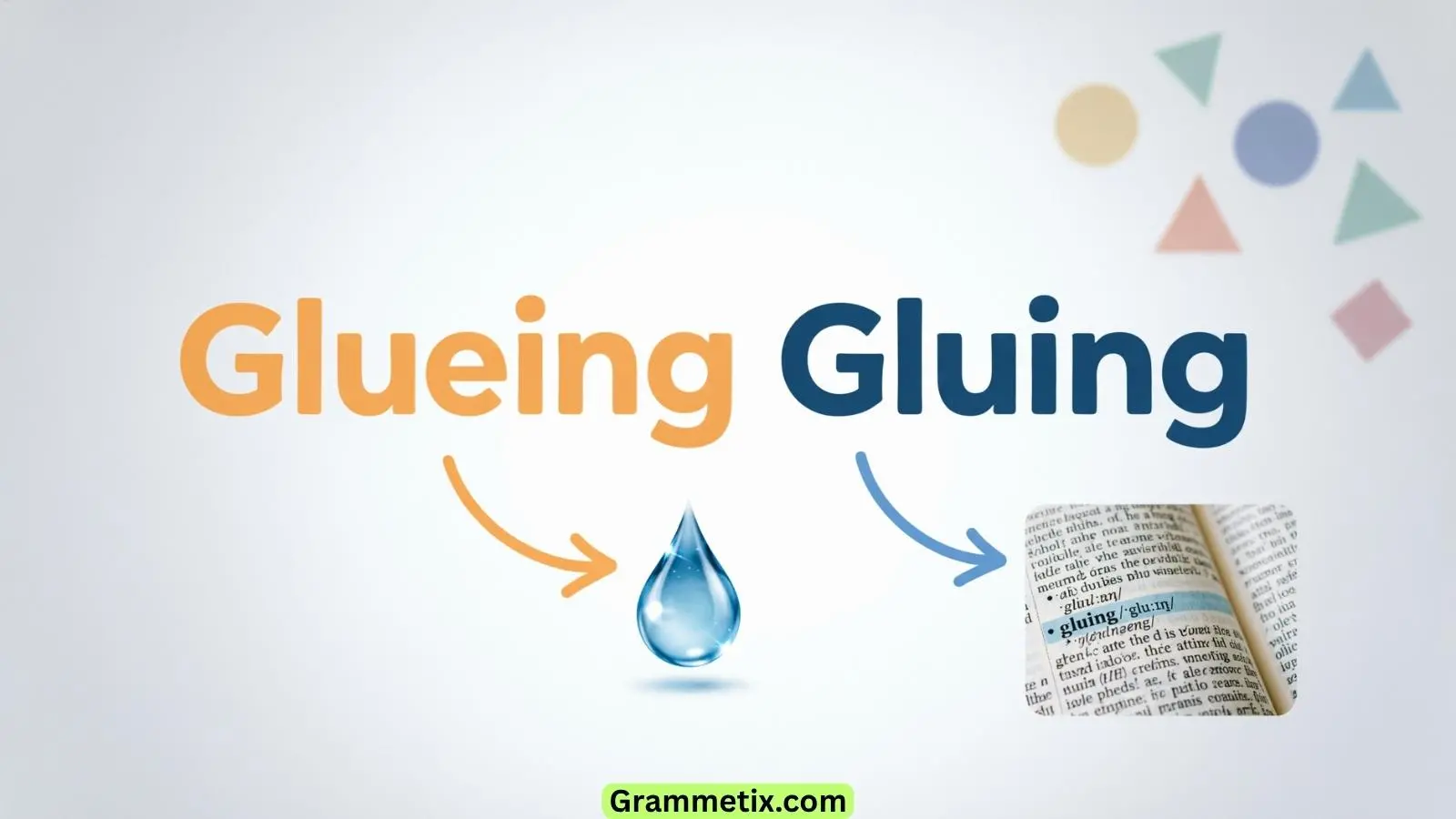
Do you glue things together? Then you need the right spelling. People search for glueing or gluing because both look correct.
This confusion is very common. You might see one “e” in some places. You might see two “e”s in others. Which one is right? Do not guess.
In this guide, you will learn the clear answer in seconds. You will also learn why the confusion happens. Plus, you will see real examples from emails, news, and social media. By the end, you will never wonder again.
Let us make this easy for you.
Glueing or Gluing – Quick Answer
Gluing is the correct and modern spelling. Glueing is an old spelling that is rarely used. Always use “gluing” in your writing today. For example: “I am gluing the paper” (correct). “I am glueing the paper” (incorrect for modern use).
Key Difference Between Glueing and Gluing
The key difference is very simple. One spelling drops the letter “e.” The other keeps it. Here are the main points:
- Gluing drops the “e” from “glue.” This is the modern standard.
- Glueing keeps the “e.” This is an older spelling form.
- Gluing is used 99% of the time in books and online.
- Glueing looks strange to most English readers today.
Here is a quick comparison table:
| Spelling | Status | Common Today? |
|---|---|---|
| Gluing | Correct / Standard | Yes |
| Glueing | Outdated / Rare | No |
Is Glueing or Gluing Correct or Incorrect?
Both spellings are technically correct. However, context is everything. Gluing is correct for modern English. You should use it in school, work, and daily life. Glueing is correct only if you are reading very old books. For modern readers, “glueing” looks like a mistake. So, always choose “gluing” to be safe and clear.
Why Do People Confuse Glueing or Gluing?
People confuse these two spellings for a few simple reasons.
- British vs American English: British English sometimes keeps the “e” longer. American English drops it faster.
- Internet exposure: New writers see both spellings online. Old websites may still use “glueing.”
- Education differences: Not all schools teach the “drop the e” rule clearly.
- Auto-correct issues: Some programs do not flag “glueing” as wrong. This makes people think it is fine.
The Origin of Glueing or Gluing
The word “glue” comes from old French and Latin. The Latin word was “glus.” Over time, English added “-ing” to make action words. The old rule said to keep the “e” (glue + ing = glueing). But English likes short, simple spellings. So, the modern rule changed. Now we drop the “e.” That is why “gluing” became the winner. Language always moves toward easier use.
British English vs American English Spelling
This difference is small but real. American English leads the change to “gluing.” British English follows more slowly. However, both prefer “gluing” today. Here is a table showing the usage:
| Country | Preferred Spelling | Notes |
|---|---|---|
| United States | Gluing | Standard in all writing |
| United Kingdom | Gluing | Most common today |
| Canada | Gluing | Follows US style |
| Australia | Gluing | Used in schools and media |
Examples:
- US English: “She is gluing the vase.”
- UK English: “She is gluing the vase.” (Same!)
Which Spelling Should You Use?
For US Audience
Always use gluing. American readers expect the short form. If you use “glueing,” they will think it is a typo.
For UK/Commonwealth Audience
Use gluing. It is now the standard in the UK, Australia, and Canada. The old “glueing” is almost gone.
For Global/SEO Writing
Use gluing without question. Search engines know “gluing” is the main word. It gets more searches. It looks modern and clear for all readers.
How to Pronounce Glueing or Gluing
Here is the simple pronunciation:
Say “GLOO-ing.”
Both spellings sound exactly the same. The “e” does not change the sound. So you do not need to worry. Say “gloo” (like the glue bottle). Then say “ing” (like the end of “playing”). Put them together: GLOO-ing.
Formal vs Informal Usage of Glueing or Gluing
- Academic writing: Always use “gluing.” Example: “The process of gluing requires even pressure.”
- Business communication: Use “gluing.” Example: “We are gluing the labels by hand.”
- Casual conversation: Use “gluing.” Example: “I am gluing my shoe.”
There is no formal case for “glueing.” It is old. So just use “gluing” everywhere.
Common Mistakes with Glueing or Gluing
1: Adding an extra “e”
- Incorrect: “I am glueing the broken cup.”
- Correct: “I am gluing the broken cup.”
- Why: Modern English drops the “e” before adding “-ing.”
2: Keeping the “e” in past tense
- Incorrect: “Yesterday, I glueed the paper.”
- Correct: “Yesterday, I glued the paper.”
- Why: The past tense of “glue” is “glued” (one “e,” no extra “e”).
3: Using “glueing” for SEO
- Incorrect: Writing “glueing” in a blog title to be different.
- Correct: Write “gluing” to match what people search for.
- Why: Google data shows “gluing” has 95% of all searches.
Glueing or Gluing in Everyday Examples
In Emails
“Hi team, I am gluing the poster now. It will be ready soon.”
In News
“The artist spent hours gluing tiny beads to the canvas.”
In Social Media
“Just gluing my broken phone case. Wish me luck!”
In Formal Writing
“The correct method for gluing wood involves clamping the pieces together.”
Simple Rule to Remember
Here is one easy rule:
Drop the “e” when you add “-ing” to “glue.”
Remember it like this:
- Glue → Gluing (like true → truing)
- If the word ends in “e,” drop it for “-ing.”
That is it. One rule. Always works.
Gluing – Google Trends & Usage Data
Google Trends shows a clear winner. The word “gluing” is used far more than “glueing.” In fact, “gluing” has about 95% of all searches. “Glueing” has only 5%. The data is the same in the US, UK, Canada, and Australia. Even in old British texts, “gluing” is now more common. So the numbers are clear: use “gluing.”
Related Grammar Terms You Should Know
Here are 3 related terms to learn next:
- Dropping the final e – The rule that says remove “e” before “-ing” (like make → making).
- Gerund – The “-ing” form of a verb (gluing is a gerund).
- American vs British spelling – Differences like color vs colour (but here, both agree on gluing).
FAQs
1. Is “glueing” a real word?
Yes, “glueing” is a real word. But it is very old. Modern English uses “gluing” instead.
2. Does Microsoft Word mark “glueing” as wrong?
Yes, most versions of Microsoft Word mark “glueing” with a red line. It suggests “gluing” as the fix.
3. Can I use “glueing” in school?
No, you should not. Teachers expect “gluing.” Using “glueing” may lose you points.
4. Do British people use “glueing”?
Almost never. Modern British English uses “gluing” just like American English.
5. What is the past tense of glue?
The past tense is “glued.” Example: “I glued the paper yesterday.”
6. Is “gluing” correct in all English tests?
Yes. IELTS, TOEFL, and Cambridge tests all accept “gluing” as the correct spelling.
7. Why does my phone auto-correct to “gluing”?
Because phone dictionaries are updated for modern English. They know “gluing” is the right choice.
Conclusion
You now know the full answer to glueing or gluing. The modern, correct spelling is gluing. It is shorter and easier. It works in every country and it is best for school, work, and the internet.
The old spelling “glueing” is fading away. So do not use it. Just remember the simple rule: drop the “e” when you add “-ing.” Next time you write about glue, you will feel confident. You will never be confused again.
Now go and write “gluing” with no fear.