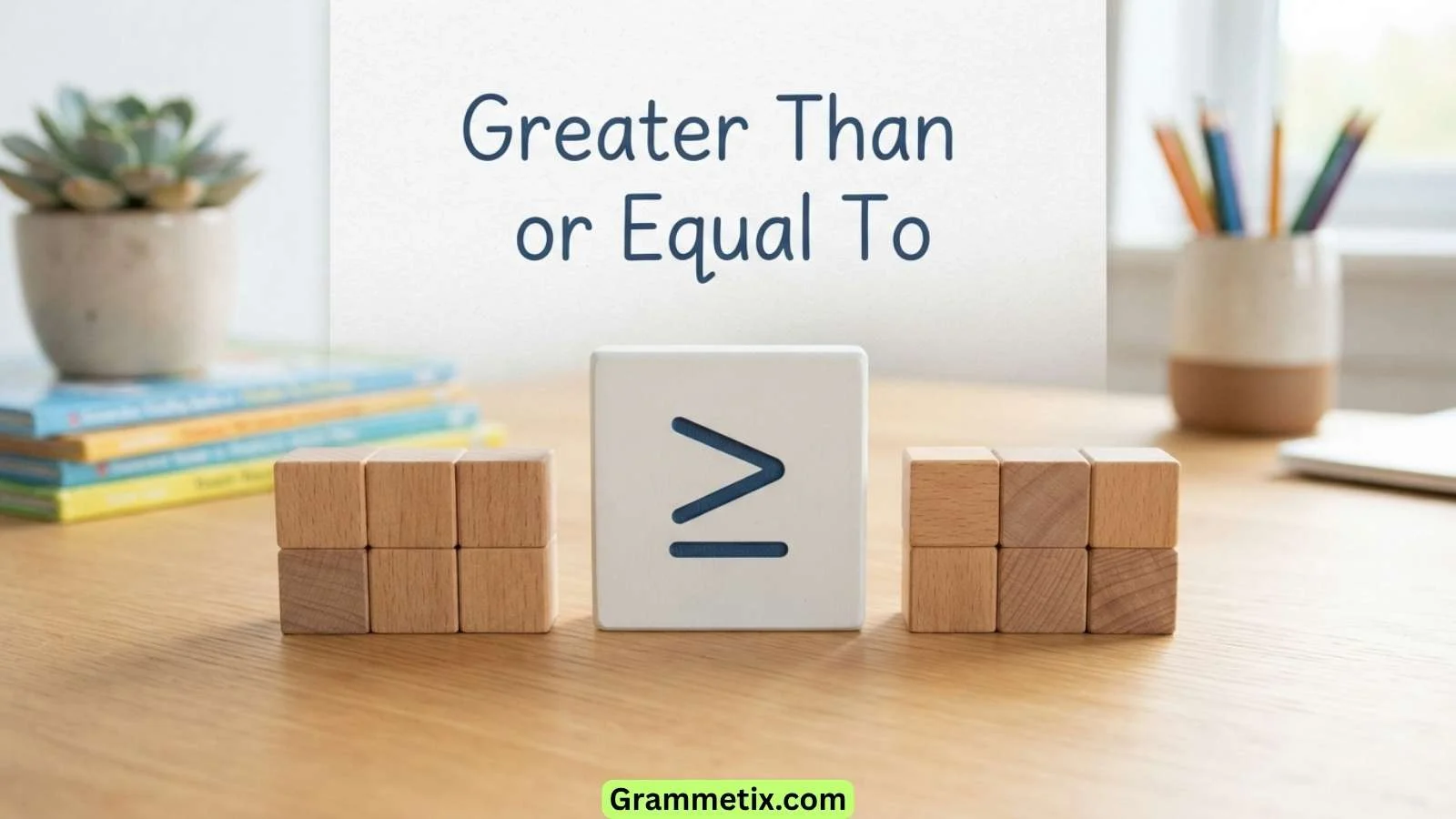
Greater than or equal to is one of the most useful math phrases. You see it in school, tests, charts, formulas, coding, and daily rules. Yet the idea can feel confusing at first.
Many learners know the > sign but struggle with ≥. Others are unsure whether the equal part includes the same number. Some also search for the phrase because they want to know how to type its symbol or use it in a sentence.
The good news is simple: greater than or equal to means a value can be bigger or exactly the same.
In this guide, you will learn the meaning, symbol, rules, examples, number-line use, common mistakes, and more. You will also learn the difference between >, ≥, <, and ≤.
Greater Than or Equal To – Quick Answer
Greater than or equal to means a number is larger than or equal to another number. Its symbol is ≥. For example, 8 ≥ 5 is true, and 5 ≥ 5 is also true. The phrase includes equality, so the two numbers may be the same.
Key Difference Between Greater Than or Equal To
The main idea is easy: ≥ allows two possible results.
- The first value can be larger.
- The first value can also be equal.
- The symbol is ≥.
- The equal line means the same value is allowed.
- It is different from >, which does not allow equality.
| Symbol or Phrase | Meaning | Example |
|---|---|---|
| > Greater than | Larger only | 9 > 4 |
| ≥ Greater than or equal to | Larger or the same | 9 ≥ 4 |
| = Equal to | The same value | 9 = 9 |
| < Less than | Smaller only | 4 < 9 |
| ≤ Less than or equal to | Smaller or the same | 4 ≤ 9 |
A simple way to understand ≥ is this:
greater than + equal to = ≥
For example:
10 ≥ 10 is true because both values are equal.
10 ≥ 7 is true because 10 is greater.
10 ≥ 12 is false because 10 is smaller.
Unicode identifies ≥ as U+2265, with the official name “GREATER-THAN OR EQUAL TO.”
Is Greater Than or Equal To Correct or Incorrect?
Greater than or equal to is the correct phrase.
There is no British or American spelling difference here. The phrase stays the same in standard English.
A common writing mistake is using too instead of to.
Correct:
The number must be greater than or equal to 50.
Incorrect:
The number must be greater than or equal too 50.
The second sentence is wrong because too does not fit the meaning.
It is also important to understand that greater than or equal to is not the same as greater than.
Compare these:
x > 5 means x must be more than 5.
x ≥ 5 means x can be 5 or more.
That small equal line changes the rule.
Why Do People Confuse Greater Than or Equal To?
People often confuse these symbols because they look very similar.
The Symbols Look Almost the Same
The signs > and ≥ both show a greater-than relationship.
The extra line under > tells you that equality is also allowed.
The Words Can Feel Long
“Greater than or equal to” is longer than simply saying “greater than.”
Students may know the symbol but forget what the extra line means.
People Learn Symbols Before Full Meanings
Many students first learn >, <, and =.
Later, they meet combined signs such as ≥ and ≤. This can make the new symbols harder to remember.
Online English Adds Another Confusion
People may also see phrases like “greater than or equal to 10” and “10 or higher.”
These can mean the same idea in simple contexts, even though they use different wording.
The Origin of Greater Than or Equal To
Modern mathematics uses symbols to make comparisons quick and clear.
The equal sign = was introduced by Robert Recorde in the 16th century. The greater-than and less-than symbols became part of mathematical notation later. Historical sources link the development of these relation symbols with early modern mathematics and Thomas Harriot’s work.
The symbol ≥ combines two ideas:
greater than
and
equal to
That makes the symbol useful when equality should be included.
Today, Unicode gives ≥ its own standard character code, U+2265. This helps computers and digital systems use the symbol consistently.
British English vs American English Spelling
There is no spelling difference between British English and American English.
Both use:
greater than or equal to
Both use:
≥
This is different from words such as colour/color.
The important spelling point is simply this:
to ✅
too ❌
| English Variety | Correct Phrase | Symbol | Example |
|---|---|---|---|
| American English | greater than or equal to | ≥ | x ≥ 10 |
| British English | greater than or equal to | ≥ | x ≥ 10 |
| Canadian English | greater than or equal to | ≥ | x ≥ 10 |
| Australian English | greater than or equal to | ≥ | x ≥ 10 |
| Global English | greater than or equal to | ≥ | x ≥ 10 |
So, you do not need a separate British spelling page for this phrase.
Which Spelling Should You Use?
For US Audience
Use greater than or equal to.
Do not write greater than or equal too.
For math work, you can also use ≥.
For UK/Commonwealth Audience
Use greater than or equal to.
The phrase does not change in British or Commonwealth English.
The symbol ≥ also stays the same.
For Global/SEO Writing
Use the full phrase when explaining the concept.
Then introduce the symbol:
greater than or equal to (≥)
This helps beginners and readers who search using either words or symbols.
How to Pronounce Greater Than or Equal To
You can pronounce it like this:
GRAY-ter than or EE-kwul too
The phrase sounds the same in normal British and American speech, although accents may change the exact sound.
When reading ≥ aloud, say:
“greater than or equal to.”
For example:
x ≥ 5
can be read as:
“x is greater than or equal to five.”
You may also hear:
“x is at least five.”
That shorter phrase can have the same meaning.
Formal vs Informal Usage of Greater Than or Equal To
Academic Writing
The phrase is common in math lessons, homework, exams, and textbooks.
Example:
The value must be greater than or equal to 20.
In a formula, the shorter symbol is often better:
x ≥ 20
Business Communication
Businesses may use the idea in rules, prices, ages, limits, and reports.
Example:
Orders greater than or equal to $100 receive free shipping.
A simpler version is:
Orders of $100 or more receive free shipping.
Casual Conversation
People often use simpler phrases when speaking.
For example:
You need a score of 80 or higher.
This means the same thing as:
Your score must be greater than or equal to 80.
The best wording depends on the audience.
Common Mistakes with Greater Than or Equal To
1: Writing “Too” Instead of “To”
Incorrect example:
The value is greater than or equal too 25.
Correct example:
The value is greater than or equal to 25.
Short explanation:
Use to in the mathematical phrase.
2: Treating ≥ Like >
Incorrect example:
5 ≥ 5 is false.
Correct example:
5 ≥ 5 is true.
Short explanation:
The equal line means the same value counts.
3: Forgetting the Equal Part
Incorrect example:
x > 10 allows x to equal 10.
Correct example:
x ≥ 10 allows x to equal 10.
Short explanation:
The sign > excludes 10. The sign ≥ includes 10.
4: Using ≥ When the Value Must Be Larger
Incorrect example:
A score of 70 is greater than 70.
Correct example:
A score of 70 is equal to 70.
Short explanation:
Greater than and equal to are different ideas.
5: Forgetting the Compared Value
Incorrect example:
The age must be greater than or equal.
Correct example:
The age must be greater than or equal to 18.
Short explanation:
The phrase needs a value to complete the comparison.
Greater Than or Equal To in Everyday Examples
In Emails
This phrase can explain simple rules and requirements.
Example:
Your attendance must be greater than or equal to 80 percent.
Another example:
Orders must be greater than or equal to $50.
A more natural everyday version could be:
Orders must be $50 or more.
In News
News writing may compare limits, ages, prices, or numbers.
Example:
The new rule applies to people aged 18 or older.
In mathematical language, that idea is:
Age ≥ 18
In Social Media
The symbol is useful when space is limited.
Examples include:
Score ≥ 90
Age ≥ 18
Price ≥ $50
These short forms are easy to scan.
In Formal Writing
Formal documents often use either words or symbols.
Example:
Applicants must have a score greater than or equal to 75.
A mathematical version is:
Score ≥ 75
Use the form that best fits the audience.
Simple Rules to Remember
Use these three rules:
1: ≥ means greater or equal.
2: The equal line means the same value counts.
3: Remember to, not too.
Here is an easy memory trick:
The extra line means “equal is okay.”
So:
> = greater only
≥ = greater or equal
That one idea solves many beginner mistakes.
Greater Than or Equal To – Google Trends & Usage Data
Google Trends shows relative search interest, not exact search counts. Google normalizes its results on a scale from 0 to 100, based on the share of searches for a term. A score of 100 represents the highest relative popularity for the selected time and place.
This means a lower regional score does not always mean fewer total searches. A region may have a smaller search population, which affects the comparison.
For this keyword, a more useful SEO view is to study the related searches around the main phrase. These include:
- greater than or equal to symbol
- greater than or equal to meaning
- greater than or equal to sign
- greater than vs greater than or equal to
- how to type greater than or equal to
These related phrases show different user needs.
| Region | Main Usage Context | Spelling Difference |
|---|---|---|
| United States | Math and education | None |
| United Kingdom | Math and education | None |
| Canada | Math and education | None |
| Australia | Math and education | None |
| New Zealand | Math and education | None |
| Global English | Math and technical content | None |
Google also provides international and US Google Trends datasets through BigQuery, with normalized and aggregated data.
The key SEO lesson is simple: do not create separate spelling pages for US and UK readers. The phrase is the same in both forms of English.
Related Grammar Terms You Should Know
These related terms can help you understand comparisons better:
Greater Than
The symbol > means one value is larger.
Example:
9 > 4
Less Than
The symbol < means one value is smaller.
Example:
4 < 9
Less Than or Equal To
The symbol ≤ means a value can be smaller or the same.
Example:
4 ≤ 4
Equal To
The symbol = means two values are the same.
Example:
8 = 8
Inequality Symbols
Inequality symbols compare values that may differ.
The main symbols are:
> , < , ≥ , ≤
These terms are useful choices for internal links.
FAQs
What does greater than or equal to mean?
It means one number is either larger than another number or exactly the same. For example, 7 ≥ 7 and 8 ≥ 7 are both true.
What is the symbol for greater than or equal to?
The symbol is ≥. Unicode identifies it as U+2265, named “GREATER-THAN OR EQUAL TO.”
Does greater than or equal to include the same number?
Yes, it does. For example, 10 ≥ 10 is true because both numbers are equal.
What is the difference between > and ≥?
> means greater than only. ≥ means greater than or equal to, so the same value is also allowed.
How do you use greater than or equal to in a sentence?
You can write, “The score must be greater than or equal to 70.” You can also write the shorter mathematical form, score ≥ 70.
Is “greater than or equal too” correct?
No, that form is incorrect. The correct phrase is greater than or equal to, using to.
What does x ≥ 5 mean?
It means x can be 5 or any number greater than 5. So values such as 5, 6, 7, and 10 all work.
Conclusion
Greater than or equal to means a value can be bigger or the same. Its symbol is ≥, and the equal line is the key part to remember. For example, 8 ≥ 5 is true, and 5 ≥ 5 is also true.
The phrase is written the same in British and American English. The common writing mistake is using too instead of to.
For beginners, focus on three ideas. > means greater only. ≥ means greater or equal. The extra line means equality is allowed.
Once you understand that rule, the symbol becomes easy. You can use it in math problems, schoolwork, emails, reports, charts, and technical writing.