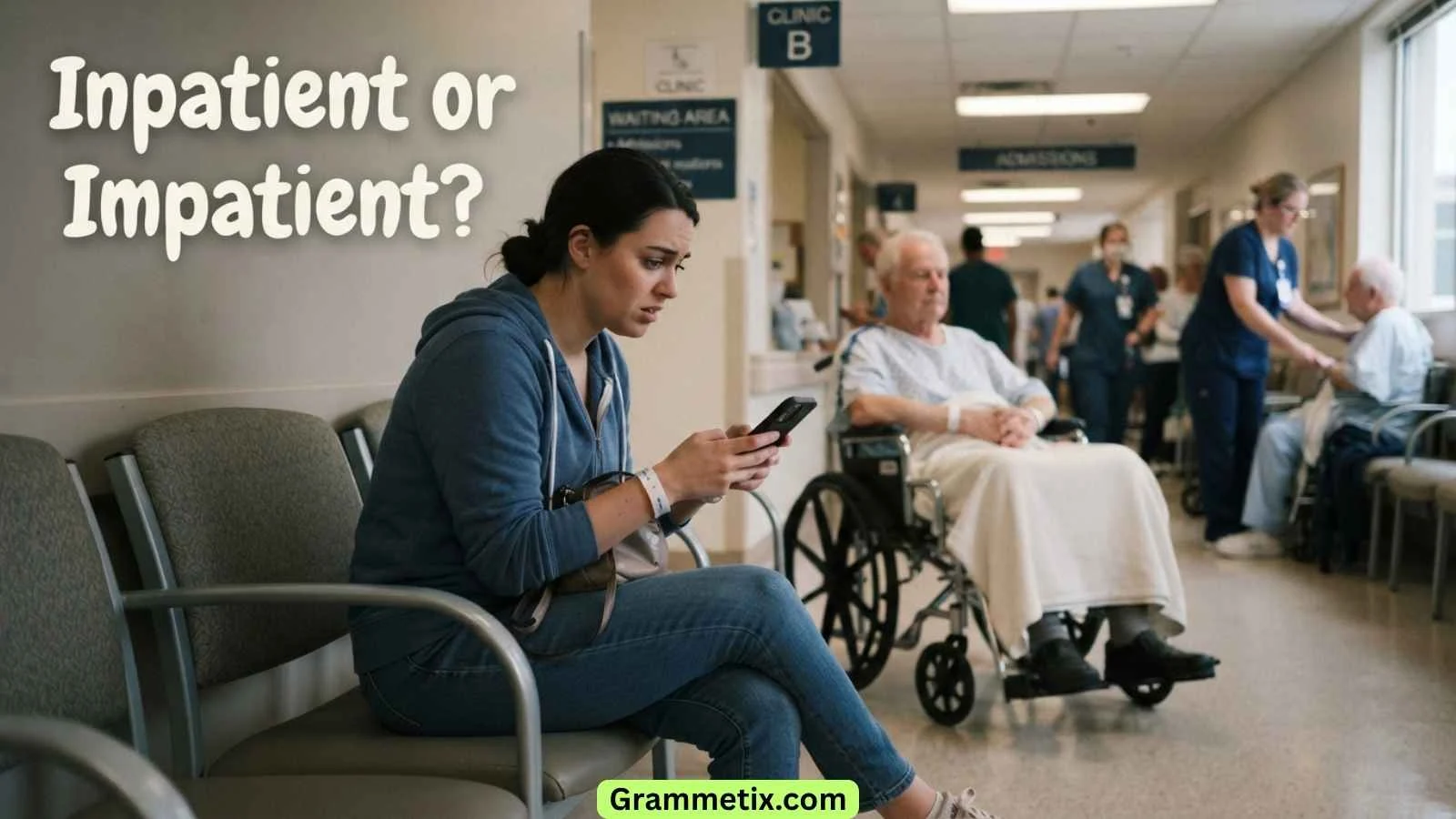
Do you ever stop and wonder if you should write inpatient or impatient? You are not alone. Many people search for this same answer.
The confusion is very common. These two words look almost the same. They sound almost the same. But they have very different meanings. This can make writing tricky.
This guide will make everything simple for you. We will explain the clear difference between inpatient and impatient. We will use very easy English. You will get many real-life examples. We will also share easy ways to remember which word to use.
By the end, you will feel confident. You will know exactly which spelling is correct for your situation. Let’s start and clear up this confusion forever .
Inpatient or Impatient – Quick Answer
Inpatient and impatient are both correct words. They are not the same. An inpatient is a person who stays in a hospital for treatment. Impatient is a feeling. It describes someone who gets annoyed when they have to wait .
Key Difference Between Inpatient and Impatient
The main difference is very simple. One word is about a person. The other is about a feeling.
- Inpatient is a noun. It is a person who stays in a hospital. It is about medical care.
- Impatient is an adjective. It is a feeling. It is about being restless or annoyed.
- One word uses “in.” The other uses “im.” This small change creates a big difference in meaning.
- Inpatient is the opposite of outpatient. An outpatient does not stay overnight .
- Impatient is the opposite of patient. A patient person can wait calmly .
Here is a quick comparison table to help you see the differences side-by-side.
Is Inpatient or Impatient Correct or Incorrect?
This is a common question. The answer is simple. Both spellings are correct. The trick is that they are used in different situations .
You use “inpatient” when you are talking about a hospital. You use “impatient” when you are talking about a feeling . Neither is wrong. You just need to know the context. Choosing the wrong one can confuse your reader. It can make your sentence sound silly . So, always think about what you are trying to say.
Why Do People Confuse Inpatient and Impatient?
There are a few good reasons why these words cause so much confusion.
- They Sound the Same: In spoken English, “inpatient” and “impatient” sound very similar. This is because the ‘n’ and ‘m’ can blend together . When you hear them, it can be hard to know which one was said.
- The Spelling is Very Close: They look almost identical. They only differ by one letter. This small difference is easy to miss when you are writing quickly .
- Both Start with Common Prefixes: “In-” and “im-” are both common word starters. It is easy to mix them up .
- Lack of Understanding: Many people do not know the exact definition of each word. If you are unsure what a word means, you might guess the spelling incorrectly.
The Origin of Inpatient and Impatient
Understanding where words come from can help you remember them. Both words have Latin roots.
Impatient comes from the Latin word impatiens. It is made of two parts. “Im-” means “not.” “Patiens” means “enduring” or “patient.” So, the word means “not patient” .
Inpatient also comes from Latin. It uses the prefix “in-.” This “in-” means “inside” or “within.” When you combine it with “patient,” you get a person who is inside a medical facility . So, the difference is simple. One word means “not patient.” The other means “patient inside.”
British English vs American English Spelling
Here is some good news. There is no difference in spelling between American and British English for these words. Both use “inpatient” and “impatient” the same way .
The table below shows a simple comparison.
| Word | American English | British English | Meaning |
|---|---|---|---|
| Inpatient | inpatient | inpatient | A hospital patient who stays overnight |
| Impatient | impatient | impatient | Someone who lacks patience |
Which Spelling Should You Use?
Choosing the correct spelling depends on your audience. But the main rule is always the context. Here is a simple guide.
For US Audience
Use “inpatient” for hospitals and “impatient” for feelings. This rule is the same everywhere . There is no difference.
For UK/Commonwealth Audience
The rule is exactly the same. Use “inpatient” for medical care and “impatient” for emotions . This rule is standard across all English-speaking countries.
For Global/SEO Writing
Always use the correct word based on its meaning. The context is the only thing that matters. Global readers will easily understand you if you use each word correctly.
How to Pronounce Inpatient and Impatient
The pronunciation is very similar. It is another reason for the confusion. But there is a very tiny difference.
Do you hear the difference? The first sound is “im” or “in.” It is very subtle. In fast speech, they sound almost the same. This is why context is very important when listening .
Formal vs Informal Usage of Inpatient and Impatient
These words are used differently in different settings.
- Academic Writing: You will mostly see “inpatient” in medical or scientific papers. “Impatient” might be used in psychology or sociology essays.
- Business Communication: You might use “impatient” to describe a client. “Inpatient” is only used in business if you work in healthcare.
- Casual Conversation: Both are very common in daily talk. You might call a friend “impatient.” You might say a family member is an “inpatient” at the hospital.
Common Mistakes with Inpatient and Impatient
Even native speakers make these mistakes. Using spellcheck is not enough because both words are correct. You have to think about the meaning.
1: Using “Impatient” for a Hospital Patient
- Incorrect example: “The doctor admitted him as an impatient.”
- Correct example: “The doctor admitted him as an inpatient.”
- Explanation: “Impatient” is a feeling. It does not describe a person in a hospital. You need a noun here.
2: Using “Inpatient” for a Feeling
- Incorrect example: “I get so inpatient when I have to wait for the bus.”
- Correct example: “I get so impatient when I have to wait for the bus.”
- Explanation: You are describing a feeling about waiting. You need the adjective “impatient.”
Inpatient and Impatient in Everyday Examples
Seeing words in action is the best way to learn. Here are some real-world examples.
In Emails
- Impatient: “I am getting impatient waiting for your reply. Please send the files.”
- Inpatient: “My father is an inpatient at St. Mary’s hospital. He is recovering well.”
In News
- Impatient: “Impatient investors are selling their shares. They want faster returns.”
- Inpatient: “The new hospital wing will add 50 inpatient beds. This will reduce wait times.”
In Social Media
- Impatient: “I am so impatient for the new season of my favorite show to start!”
- Inpatient: “My cousin is an inpatient at the clinic. Please send her well wishes.”
In Formal Writing
- Impatient: “The professor was impatient with the student’s constant lateness.”
- Inpatient: “Inpatient care is recommended for patients with severe symptoms.”
Simple Rule to Remember
Here are a few easy ways to remember the difference.
- The “Im” Rule for “I’m”: Think of the “im” in impatient as standing for “I’m.” “Impatient” = “I’m not patient.”
- The “In” Rule for “Inside”: Think of the “in” in inpatient as standing for “inside.” The patient is “in” the hospital .
- The “Feelings vs. Facility” Rule: Use “impatient” for feelings. Use “inpatient” for a facility or hospital.
Inpatient or Impatient – Google Trends & Usage Data
It is hard to say which word is more popular. Both are used frequently. “Impatient” is a common word used in daily life. “Inpatient” is a standard medical term. You will see “inpatient” used more often in medical contexts. You will see “impatient” used in all other contexts . There is no country that prefers one spelling over the other. The only thing that matters is the meaning you need.
Related Grammar Terms You Should Know
Understanding these related words can also help you. These are great topics for further reading.
- Patient vs. Impatient: Understanding the opposite can help you remember.
- Outpatient vs. Inpatient: These are opposites in a medical setting.
- Prefixes: Learning about prefixes like “in-” and “im-” will help you with many other words.
- Homophones: These are words that sound alike but have different meanings.
FAQs
1. What is the main difference between “inpatient” and “impatient”?
“Impatient” is a feeling of being restless or annoyed by waiting. An “inpatient” is a person who stays in a hospital for treatment. One is an emotion. The other is a person in a medical setting .
2. How can I remember the difference between “inpatient” and “impatient”?
Think of “impatient” as “I’m not patient.” Think of “inpatient” as someone who is “in” a hospital. This simple trick will always help you choose the correct word .
3. Is “impatient” ever used in medical contexts?
No. “Impatient” is never used to describe a hospital patient. It is always about behavior or emotion . If you are talking about healthcare, you almost always mean “inpatient.”
4. Are “inpatient” and “outpatient” related?
Yes. Both are medical terms. An inpatient stays overnight in a hospital. An outpatient receives treatment but goes home the same day .
5. Do American and UK English use these words differently?
No. Both countries use “inpatient” and “impatient” in the same way. The meaning is the same everywhere in the English-speaking world .
6. Is it “in patient” or “inpatient”?
“Inpatient” is the correct single word. You should not write it as “in patient.” They are always used together as one word .
7. What does it mean to be “impatient”?
To be “impatient” means you have trouble waiting calmly. You might get annoyed or restless . It is a very common human feeling.
Conclusion
Choosing between inpatient and impatient is easy now. You know they are both correct.
The key is to understand the context. Inpatient is for a person in a hospital. Impatient is for a feeling about waiting. Never mix them up again. Just remember our simple rule. “Im” for “I’m not patient.” “In” for “inside the hospital.”
You now have the knowledge to use these words perfectly. Your writing will be clear and professional .