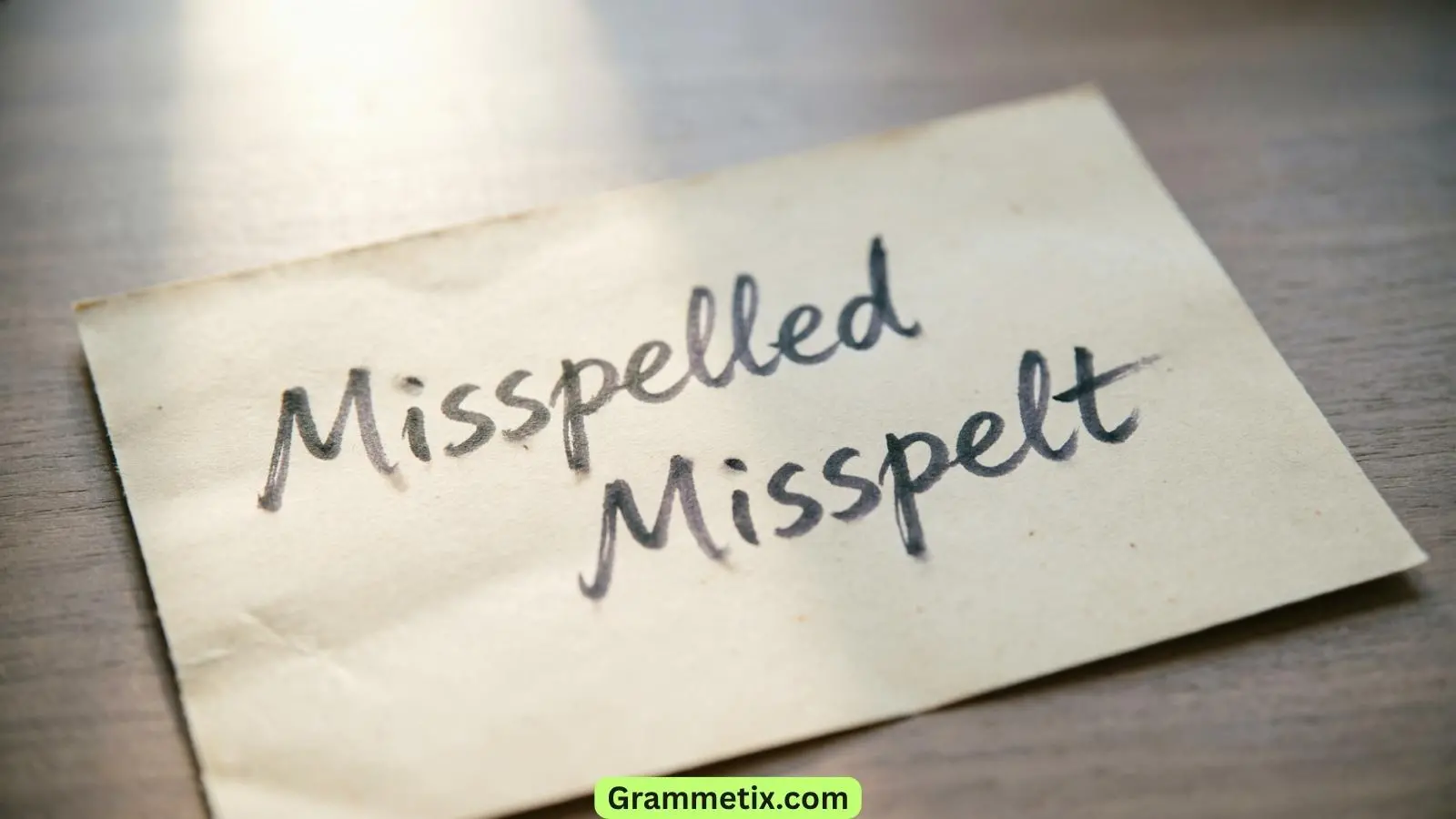
Do you write misspelled or misspelt?
Many people search for this keyword because they see both spellings online. This confuses them. They worry about making a mistake.
Do not worry. Both are often correct.
In this post, you will learn the simple difference. You will learn which spelling to use. You will also see real-life examples. Let us end the confusion now.
Misspelled or Misspelt – Quick Answer
Both spellings are correct. Use misspelled in American English. Use misspelt in British English. For example: “She misspelled her name.” (US). “He misspelt that word.” (UK).
Key Difference Between Misspelled and Misspelt
Here is the simple difference:
- Misspelled is the past tense of misspell. It is common in the US.
- Misspelt is also the past tense. It is common in the UK.
- Both words mean the same thing: to spell a word wrong.
- The only difference is where you live.
Comparison Table
| Feature | Misspelled | Misspelt |
|---|---|---|
| Type of English | American | British |
| Meaning | Spelled incorrectly | Spelled incorrectly |
| Example | You misspelled “color”. | You misspelt “colour”. |
| Common in | USA, Canada | UK, Australia, NZ |
Is Misspelled or Misspelt Correct or Incorrect?
Both are correct. Neither is wrong. It depends on your audience.
If you write for Americans, use misspelled. If you write for the British, use misspelt. Using the “wrong” one is not a real error. It is just a difference in style.
Do not let anyone tell you that one is a mistake. Both appear in famous dictionaries.
Why Do People Confuse Misspelled or Misspelt?
People get confused for three simple reasons.
British vs American English
American English likes “-ed” endings. British English keeps older “-t” endings. This happens with many words, not just this one.
Internet and Global Exposure
You see both spellings online. A British news site uses “misspelt”. An American blog uses “misspelled”. Your brain sees both and gets confused.
Education Differences
Schools teach one spelling based on location. If you move or read widely, you see the other. That creates doubt.
The Origin of Misspelled or Misspelt
The word “misspell” is old. It comes from “mis-” (meaning wrong) and “spell” (to write letters).
For hundreds of years, English had no fixed spelling rules. People wrote “spelled” or “spelt” freely. Over time, American English chose “-ed”. British English kept “-t”. That is why we have two forms today.
British English vs American English Spelling
British and American English have many spelling differences. Here is a simple table.
Comparison Table: Common Spelling Differences
| American English | British English |
|---|---|
| Misspelled | Misspelt |
| Learned | Learnt |
| Burned | Burnt |
| Dreamed | Dreamt |
| Smelled | Smelt |
Examples in Sentences
- American: The teacher said I misspelled “neighbor”.
- British: The teacher said I misspelt “neighbour”.
Which Spelling Should You Use?
This is the most important question. Here is your simple guide.
For US Audience
Use misspelled only. Americans see “misspelt” as strange or old. Stick with “-ed” for all past tense verbs.
For UK/Commonwealth Audience
Use misspelt. This is standard in the UK, Australia, New Zealand, and South Africa. It looks natural to them.
For Global/SEO Writing
Pick one and stay consistent. Most global content uses misspelled. It is more common online. But either works if you do not change.
Pro tip for SEO: Use the spelling your target country uses. Google shows local results first.
How to Pronounce Misspelled or Misspelt
Both words sound very similar. But there is a tiny difference.
- Misspelled: mis-SPELLD (two syllables)
- Misspelt: mis-SPELT (two syllables)
The “-ed” in “misspelled” sounds like a soft “d”. The “-t” in “misspelt” sounds like a clear “t”. In fast speech, most people cannot hear the difference.
Formal vs Informal Usage of Misspelled or Misspelt
Both spellings work in formal and informal writing. But the rules change by country.
Academic Writing
Use the spelling of your country. A US university wants misspelled. A UK university wants misspelt. Check your style guide.
Business Communication
Match your client or boss. An American client gets misspelled. A British client gets misspelt. When in doubt, ask.
Casual Conversation
Use either. No one will correct you. Text messages and chats are flexible. Say “You misspelled that” or “You misspelt that”. Both are fine.
Common Mistakes with Misspelled or Misspelt
Here are three common errors. Learn them now.
1: Mixing Spellings in One Document
- Incorrect: She misspelled “colour” and then misspelt “center”.
- Correct: She misspelled “color” and “center”. (US)
- Correct: She misspelt “colour” and “centre”. (UK)
Explanation: Pick one spelling style. Do not switch.
2: Using “Misspelt” for an American Audience
- Incorrect (US context): Your report misspelt the client’s name.
- Correct (US context): Your report misspelled the client’s name.
Explanation: Americans rarely use “misspelt”. It looks like an error to them.
3: Thinking One Is Always Wrong
- Incorrect thinking: “Only ‘misspelled’ is real English.”
- Correct thinking: Both are correct in different places.
Explanation: Language changes by region. Respect the difference.
Misspelled or Misspelt in Everyday Examples
Let us see both words in real life.
In Emails
- US: I think you misspelled “recommend” in your last email.
- UK: I think you misspelt “recommend” in your last email.
In News
- US Headline: Candidate misspelled “economy” in tweet.
- UK Headline: MP misspelt “economy” in tweet.
In Social Media
- US Tweet: I misspelled “embarrassing”. How ironic.
- UK Tweet: I misspelt “embarrassing”. How ironic.
In Formal Writing
- US Report: The document misspelled three key terms.
- UK Report: The document misspelt three key terms.
Simple Rule to Remember
Remember these three easy rules.
- See “-ed”? Think America.
- See “-t”? Think United Kingdom.
- Stay consistent. Do not switch inside one document.
A fun memory trick: “America has Everyone using -ed.” “Britain has Tea using -t.”
Misspelled or Misspelt – Google Trends & Usage Data
Google data shows clear patterns.
- United States: “Misspelled” is 95% of searches. “Misspelt” is almost invisible.
- United Kingdom: “Misspelt” is more common. But “misspelled” is growing due to US media.
- Australia & Canada: Both appear. Canada leans toward US spelling. Australia leans toward UK spelling.
Country Usage Table
| Country | Preferred Spelling | Notes |
|---|---|---|
| USA | Misspelled | Almost universal |
| UK | Misspelt | Traditional choice |
| Canada | Misspelled | US influence is strong |
| Australia | Misspelt | Follows UK rules |
| India | Misspelled | Often uses US spelling |
Related Grammar Terms You Should Know
Learning these three terms will help you understand spelling differences.
- Past tense: The form of a verb that shows a completed action. Example: “walk” becomes “walked”.
- Past participle: A verb form used with “have” or “has”. Example: “I have walked”.
- Regular vs irregular verbs: Regular verbs add “-ed”. Irregular verbs change form. “Misspell” can be regular (misspelled) or irregular (misspelt) depending on your English type.
FAQs
Is “misspelt” acceptable in American English?
No. American English uses “misspelled” only. If you use “misspelt” in the US, people will think it is an error.
Is “misspelled” acceptable in British English?
Yes, but it is less common. Some British writers use “misspelled” because of US influence. However, “misspelt” is still the traditional choice.
Which spelling is more common worldwide?
“Misspelled” is more common. US media and the internet spread it globally. But “misspelt” remains strong in the UK and Commonwealth.
Do “misspelled” and “misspelt” sound different?
Very slightly. “Misspelled” ends with a soft “d” sound. “Misspelt” ends with a clear “t” sound. In fast speech, they sound the same.
Can I use both spellings in the same document?
No. That confuses readers. Pick one spelling style (US or UK) and use it from start to finish.
What about “misspell” with an “s” or “c”?
Always use “misspell” with a double “s”. “Mispell” (one “s”) is always wrong in both US and UK English.
Does Grammarly mark “misspelt” as wrong?
It depends on your settings. If you set Grammarly to American English, it flags “misspelt”. If you set it to British English, it accepts “misspelt”.
Conclusion
You now know the full answer.
Misspelled and misspelt mean the same thing. The only difference is where you live. Use misspelled for American readers. Use misspelt for British readers.
Do not stress about this. Both are correct. Pick the one your audience expects. Then stay consistent.
The most important rule? Just spell “misspell” with two “s” letters. That is a real mistake.
Now you can write with confidence. Choose your spelling. Write your sentence. And never wonder again.