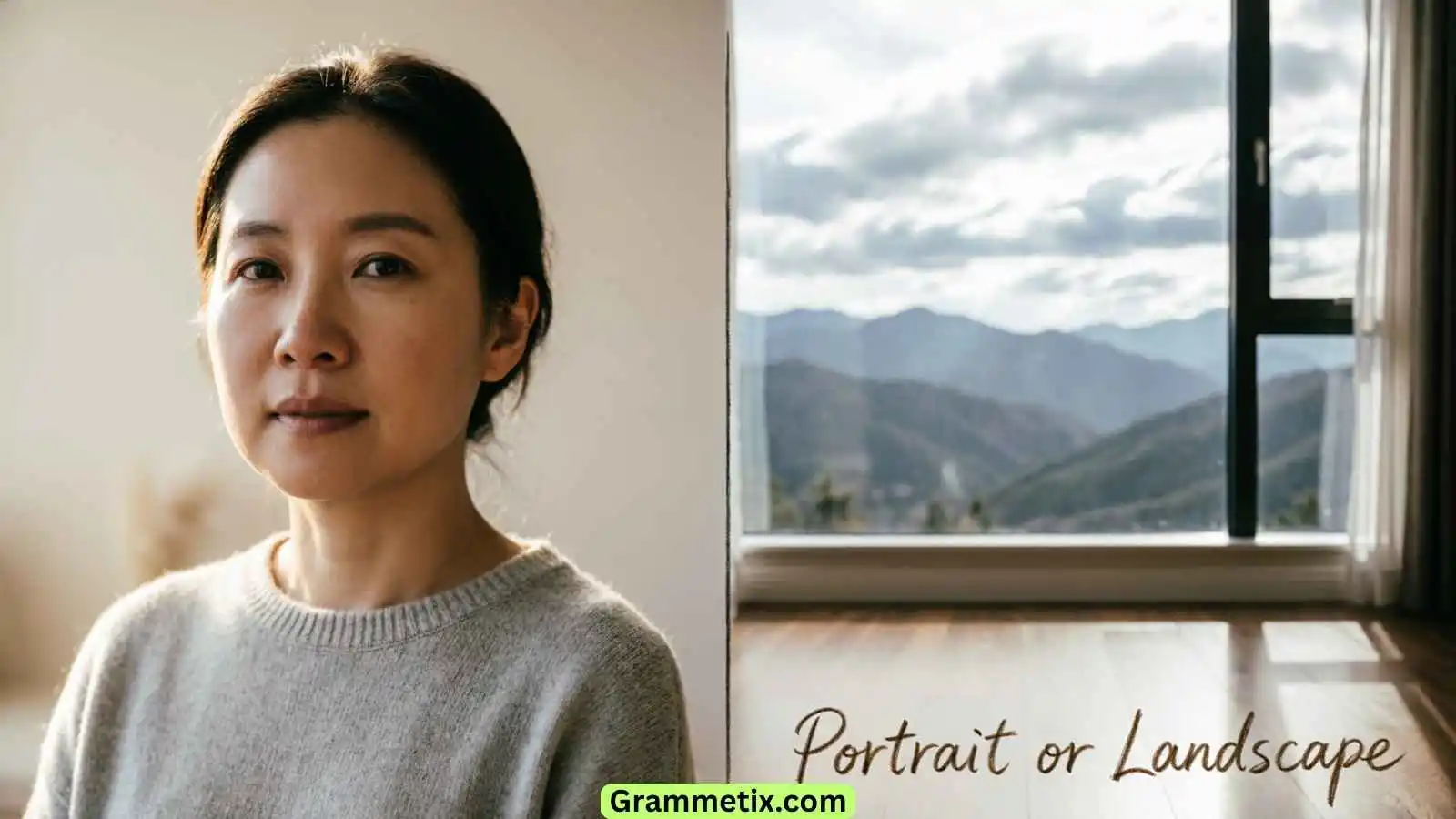
Portrait or landscape is a common question people ask when working with photos, documents, phones, cameras, and printing.
Many people get confused because both terms describe page or image orientation, but they look very different. Choosing the wrong option can make a photo look awkward or make a document harder to read.
The good news is that the difference is very simple. Once you understand the basic rule, you will never mix them up again.
In this guide, you will learn the meaning of portrait and landscape, their differences, when to use each one, and how to choose the right orientation for your needs.
Portrait or Landscape – Quick Answer
Portrait means the height is greater than the width. Landscape means the width is greater than the height. Use portrait for vertical layouts and landscape for horizontal layouts. For example, a phone photo is often portrait, while a computer screen is usually landscape.
Key Difference Between Portrait or Landscape
- Portrait is taller than it is wide.
- Landscape is wider than it is tall.
- Portrait works well for people and documents.
- Landscape works well for wide scenes and presentations.
- Both are correct depending on the purpose.
| Feature | Portrait | Landscape |
|---|---|---|
| Shape | Vertical | Horizontal |
| Height | Greater than width | Less than width |
| Common Use | Photos of people, letters | Screens, slides, scenery |
| Viewing Style | Up and down | Side to side |
Is Portrait or Landscape Correct or Incorrect?
Both portrait and landscape are correct.
They are not different spellings of the same word. Instead, they describe two different page or image orientations.
Use portrait when the layout is vertical.
Use landscape when the layout is horizontal.
The correct choice depends entirely on how the page, photo, or screen is positioned.
Why Do People Confuse Portrait or Landscape?
Many people learn these terms when printing documents or taking photos. That is often when confusion starts.
Similar Technology Settings
Printers, phones, and cameras often show both options together. New users may not know which one to select.
Different Learning Experiences
Some people learn through school. Others learn through work or technology. This creates different levels of understanding.
Internet Exposure
People see portrait and landscape used in photography, design, and printing. Different examples can make the meanings seem unclear.
Visual Similarity
Without examples, many people struggle to remember which term means vertical and which means horizontal.
The Origin of Portrait or Landscape
The word portrait comes from art. Artists often painted people standing upright. These paintings were usually taller than they were wide.
The word landscape also comes from art. Artists painted wide views of nature, mountains, and fields. These paintings were usually wider than they were tall.
Over time, these artistic terms became standard names for page and image orientation.
British English vs American English Spelling
Unlike many English words, portrait and landscape have the same spelling in both British English and American English.
There is no spelling difference between the two regions.
| English Version | Portrait | Landscape |
|---|---|---|
| American English | Portrait | Landscape |
| British English | Portrait | Landscape |
| Canadian English | Portrait | Landscape |
| Australian English | Portrait | Landscape |
Examples
- Please print the document in portrait mode.
- The presentation works better in landscape mode.
- The photo was taken in portrait orientation.
- The monitor uses a landscape layout.
Which Spelling Should You Use?
Since there are no spelling differences, your choice depends on orientation rather than location.
For US Audience
Use portrait for vertical layouts.
Use landscape for horizontal layouts.
These are the standard terms across the United States.
For UK/Commonwealth Audience
The same rule applies.
People in the UK, Canada, Australia, and New Zealand use the same words.
For Global/SEO Writing
Use the terms that correctly describe the orientation.
Search engines and readers understand both words worldwide.
How to Pronounce Portrait or Landscape
Portrait
Pronunciation: POR-trit
Simple phonetic spelling: POR-trit
Landscape
Pronunciation: LAND-skayp
Simple phonetic spelling: LAND-skayp
The words sound different and are easy to tell apart when spoken.
Formal vs Informal Usage of Portrait or Landscape
Academic Writing
Both terms are commonly used in research papers, reports, and educational materials.
Example:
“The page should be printed in landscape orientation.”
Business Communication
Businesses frequently use these terms in presentations, forms, and reports.
Example:
“Please save the chart in landscape format.”
Casual Conversation
People often use the terms when talking about photos or phone screens.
Example:
“Turn your phone to landscape mode.”
Common Mistakes with Portrait or Landscape
1: Choosing Portrait for Wide Images
Incorrect example: Print the wide chart in portrait mode.
Correct example: Print the wide chart in landscape mode.
Explanation: Wide content usually fits better in landscape orientation.
2: Choosing Landscape for Vertical Photos
Incorrect example: Save the full-body photo in landscape mode.
Correct example: Save the full-body photo in portrait mode.
Explanation: Tall subjects often fit better in portrait orientation.
3: Thinking One Is Better
Incorrect example: Landscape is always the correct choice.
Correct example: Choose the orientation that fits the content.
Explanation: Both options are useful in different situations.
Portrait or Landscape in Everyday Examples
In Emails
“Please send the document in landscape format.”
“Print the form in portrait mode.”
In News
“The image appeared in portrait orientation.”
“The newspaper published the chart in landscape layout.”
In Social Media
Many smartphone photos are uploaded in portrait mode.
Wide travel photos are often shared in landscape mode.
In Formal Writing
“The report should use landscape pages for large tables.”
“The cover page should remain in portrait format.”
Simple Rule to Remember
Here are three easy rules:
- Portrait = Person = Vertical
- Landscape = Land = Wide
- Tall means portrait, wide means landscape
These simple memory tricks help most people remember the difference instantly.
Portrait or Landscape – Google Trends & Usage Data
Both terms are searched worldwide because they are commonly used in technology, photography, and printing.
Portrait is often searched by people working with photos and mobile devices.
Landscape is often searched by people creating presentations, charts, and wide images.
| Country | Common Usage |
|---|---|
| United States | Portrait and Landscape |
| United Kingdom | Portrait and Landscape |
| Canada | Portrait and Landscape |
| Australia | Portrait and Landscape |
| India | Portrait and Landscape |
| Pakistan | Portrait and Landscape |
Both terms are internationally recognized and widely used.
Related Grammar Terms You Should Know
If you enjoy learning about English usage and terminology, these related topics may help:
- Affect vs Effect
- Toward vs Towards
- Practice vs Practise
- Color vs Colour
- Center vs Centre
These topics are useful for understanding language differences and common word confusion.
FAQs
What is the main difference between portrait and landscape?
Portrait is vertical and taller than it is wide. Landscape is horizontal and wider than it is tall.
Is portrait better than landscape?
Neither is better. The best choice depends on the type of content you are displaying or printing.
Why is it called portrait orientation?
The term comes from portrait paintings. Artists often painted people on tall, vertical canvases.
Why is it called landscape orientation?
The term comes from landscape paintings. These artworks often showed wide views of nature and scenery.
Do phones use portrait or landscape?
Phones commonly use portrait mode when held upright. They use landscape mode when rotated sideways.
Which orientation is best for presentations?
Landscape is usually best for presentations because screens are typically wider than they are tall.
Conclusion
Understanding portrait or landscape is easier than many people think. Portrait means a vertical layout where height is greater than width. Landscape means a horizontal layout where width is greater than height.
Both terms are correct and widely used around the world. The right choice depends on the content you want to display, print, or share. If the content is tall, choose portrait. If the content is wide, choose landscape.
Remember the simple rule: Portrait equals person, and landscape equals land. Once you know this trick, choosing the correct orientation becomes quick and easy every time.