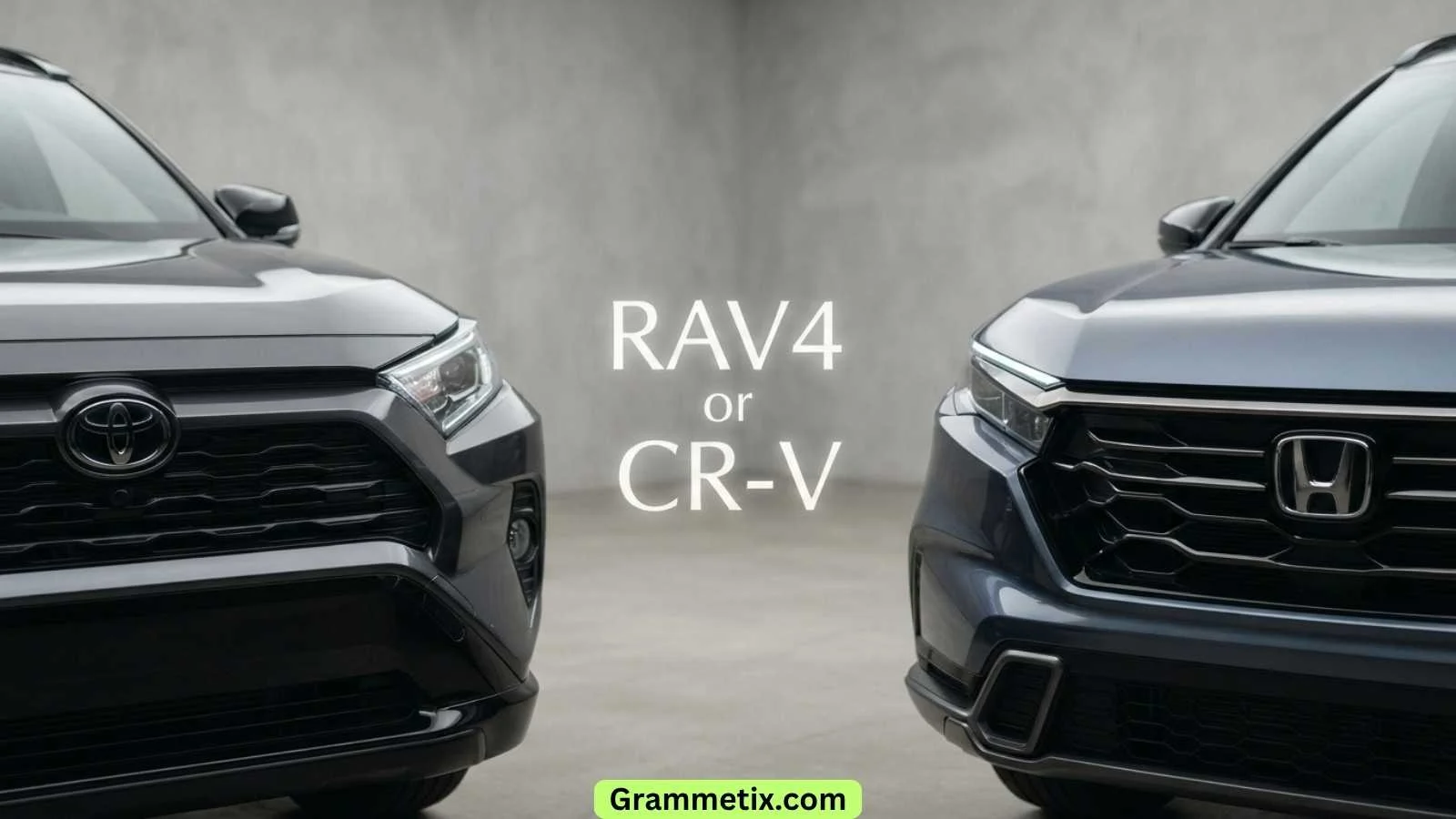
Choosing between RAV4 or CR-V is one of the biggest decisions for compact SUV buyers. Both vehicles are known for reliability, strong resale value, and modern safety features, making them top choices around the world.
Many people search for this comparison because they want to know which SUV offers better performance, fuel economy, comfort, and overall value.
While the Toyota RAV4 and Honda CR-V share many strengths, they also have important differences that can affect your driving experience and long-term ownership costs.
In this guide, you’ll discover those differences in simple English. By the end, you’ll know which SUV better fits your budget, lifestyle, and daily driving needs.
RAV4 or CR-V – Quick Answer
If you want a rugged SUV with excellent resale value and better light off-road ability, choose the Toyota RAV4. If you prefer a smoother ride, a roomier cabin, and outstanding family comfort, the Honda CR-V is the better choice. Both SUVs are reliable, safe, fuel-efficient, and among the best compact SUVs available today.
Key Differences Between RAV4 and CR-V
Although the Toyota RAV4 and Honda CR-V compete in the same class, they focus on different strengths.
- RAV4 feels more adventurous and sporty.
- CR-V delivers a smoother and quieter ride.
- RAV4 offers better off-road capability.
- CR-V provides more passenger and cargo space.
- Both have excellent hybrid models and advanced safety features.
RAV4 vs CR-V Comparison Table
| Feature | Toyota RAV4 | Honda CR-V | Winner |
|---|---|---|---|
| Driving Style | Sporty and rugged | Smooth and refined | Depends on preference |
| Ride Comfort | Very Good | Excellent | CR-V |
| Off-road Capability | Better | Limited | RAV4 |
| Passenger Space | Spacious | More spacious | CR-V |
| Cargo Space | Large | Slightly larger | CR-V |
| Fuel Economy (Hybrid) | Excellent | Excellent | Tie |
| Resale Value | Outstanding | Excellent | RAV4 |
| Reliability | Excellent | Excellent | Tie |
Quick Buying Advice
Choose the Toyota RAV4 if you:
- Enjoy outdoor adventures.
- Drive on gravel or snowy roads.
- Want stronger resale value.
- Prefer a firmer driving feel.
Choose the Honda CR-V if you:
- Drive mostly in cities.
- Travel with family often.
- Want a quiet and comfortable cabin.
- Need extra rear-seat space.
For many buyers, the decision comes down to comfort versus versatility rather than reliability, because both SUVs have proven track records.
Engine and Performance
Performance is one of the biggest differences between the RAV4 and the CR-V.
The Toyota RAV4 comes with a 2.5-litre four-cylinder petrol engine. It produces around 203 horsepower, giving it confident acceleration for motorway driving and overtaking. Hybrid versions combine petrol and electric power to improve both performance and fuel efficiency.
The Honda CR-V uses a turbocharged engine in some markets and a hybrid powertrain in others. Its hybrid system delivers smooth acceleration and quiet performance. Rather than feeling sporty, the CR-V focuses on comfort and easy everyday driving.
Engine Comparison
| Specification | Toyota RAV4 | Honda CR-V |
|---|---|---|
| Standard Engine | 2.5L 4-cylinder | 1.5L Turbo or Hybrid (market dependent) |
| Horsepower | Around 203 hp | Around 190–204 hp |
| Hybrid Available | Yes | Yes |
| All-Wheel Drive | Available | Available |
| Driving Feel | Sportier | Smoother |
Everyday Driving
The RAV4 feels more responsive when joining fast traffic. Its steering gives drivers more confidence on winding roads.
The CR-V shines during daily commuting. Its steering feels lighter, and its suspension absorbs bumps more effectively. Long journeys are often more relaxing because the cabin remains quieter.
Light Off-Road Driving
If you enjoy camping, hiking, or travelling on rough roads, the RAV4 has the advantage. Certain trims include driving modes for snow, mud, dirt, and uneven surfaces.
The CR-V can handle wet roads and light gravel, but it is mainly designed for paved streets rather than trails.
Towing Capacity
Many SUV buyers also need to tow small trailers or camping equipment.
| Capability | Toyota RAV4 | Honda CR-V |
|---|---|---|
| Maximum Towing Capacity* | Up to 3,500 lbs (selected trims) | Up to 1,500 lbs |
*Capacity varies by model year and trim.
Drivers who tow regularly will usually find the RAV4 more capable.
Long-Term Performance
Owners often praise both SUVs for dependable engines that can last well beyond 200,000 miles with regular servicing.
Toyota’s naturally aspirated engine has built a strong reputation for durability. Honda’s engines are also dependable, especially when maintenance schedules are followed.
Common Owner Feedback
Toyota RAV4
Pros
- Strong acceleration
- Confident motorway driving
- Excellent hybrid performance
Common Complaints
- Engine noise can increase during hard acceleration.
- Suspension feels slightly firm on rough roads.
Honda CR-V
Pros
- Smooth acceleration
- Quiet driving experience
- Comfortable steering
Common Complaints
- Less engaging to drive.
- Not designed for serious off-road use.
Winner: Engine and Performance
🏆 Toyota RAV4
The RAV4 wins for buyers who want stronger acceleration, better towing ability, and greater versatility. The Honda CR-V remains an excellent choice for drivers who value comfort over sporty performance.
Fuel Economy
Fuel economy is one of the biggest reasons people compare the RAV4 and CR-V.
Both SUVs offer efficient petrol and hybrid options. If you drive every day, either model can help reduce fuel costs over time.
Hybrid versions are especially popular because they combine a petrol engine with an electric motor. This improves efficiency in city traffic and during stop-and-go driving.
Fuel Economy Comparison
| Model | Estimated Combined Fuel Economy* |
|---|---|
| Toyota RAV4 Petrol | Around 30–35 mpg |
| Toyota RAV4 Hybrid | Around 40–41 mpg |
| Honda CR-V Petrol | Around 28–32 mpg |
| Honda CR-V Hybrid | Around 37–40 mpg |
*Figures vary by model year, drivetrain, and market.
Which Saves More Fuel?
The Toyota RAV4 Hybrid usually achieves slightly better fuel economy, especially during city driving. It has long been recognised as one of the most fuel-efficient compact SUVs.
The Honda CR-V Hybrid follows closely behind. Many drivers report excellent real-world fuel economy, particularly on longer journeys.
Annual Fuel Savings
For drivers covering many miles each year, even a small improvement in fuel economy can reduce annual fuel costs. Hybrid models from both manufacturers can save hundreds of pounds over several years compared with traditional petrol-only SUVs.
Which Hybrid Is Better?
Choose the RAV4 Hybrid if you want:
- Maximum fuel savings.
- Excellent city efficiency.
- Strong resale value.
Choose the CR-V Hybrid if you want:
- Smooth acceleration.
- Quiet operation.
- Comfortable everyday driving.
Winner: Fuel Economy
🏆 Toyota RAV4 Hybrid
The difference is small, but the RAV4 Hybrid generally offers slightly better fuel efficiency while maintaining strong performance.
Interior and Cargo Space
A comfortable cabin matters if you drive every day or travel with family. Both SUVs offer seating for five people, quality materials, and practical storage. However, the Honda CR-V provides a little more room for passengers and luggage.
Interior Space Comparison
| Feature | Toyota RAV4 | Honda CR-V | Winner |
|---|---|---|---|
| Seating Capacity | 5 | 5 | Tie |
| Front Headroom | Excellent | Excellent | Tie |
| Rear Legroom | Very Good | Excellent | CR-V |
| Cargo Space Behind Rear Seats* | Around 37.5 cu ft | Around 39.3 cu ft | CR-V |
| Maximum Cargo Space* | Around 69.8 cu ft | Around 76.5 cu ft | CR-V |
*Figures vary slightly by model year and trim.
Front Seats
The RAV4 offers supportive seats with a commanding driving position. Drivers enjoy a clear view of the road, making it easier to drive in traffic and park.
The CR-V also has comfortable front seats. Many owners say they remain comfortable during long journeys because they provide good back support.
Rear Seats
The CR-V has one of the largest rear seating areas in the compact SUV class. Adults have more legroom, and children have plenty of space for car seats.
The RAV4’s rear seats are comfortable too, but taller passengers may notice less legroom than in the CR-V.
Cargo Area
If you often carry shopping bags, sports equipment, luggage, or pushchairs, cargo space becomes important.
The Honda CR-V has a slightly larger luggage area, making it easier to carry bulky items.
The Toyota RAV4 still offers generous storage and has a wide cargo opening for loading heavy items.
Storage Around the Cabin
Both SUVs include practical storage such as:
- Large door pockets
- Cup holders
- Centre console storage
- USB charging ports
- Multiple small storage compartments
The CR-V makes slightly better use of its interior space, giving passengers more places to store everyday items.
Family Friendliness
Families usually look for:
- Easy child-seat installation
- Wide rear doors
- Plenty of rear-seat space
- Large boot capacity
The CR-V performs especially well in all these areas, making it a favourite among family buyers.
Winner: Interior and Cargo Space
🏆 Honda CR-V
The CR-V offers more passenger room, a larger cargo area, and a practical interior that works well for growing families.
Comfort and Ride Quality
Comfort is one of the Honda CR-V’s biggest strengths. It delivers a calm and relaxed driving experience, even on longer journeys.
The Toyota RAV4 focuses more on responsive handling. Its suspension feels firmer, which some drivers enjoy because it gives the SUV a sportier character.
Ride Quality Comparison
| Feature | Toyota RAV4 | Honda CR-V | Winner |
|---|---|---|---|
| Suspension Comfort | Very Good | Excellent | CR-V |
| Cabin Noise | Good | Excellent | CR-V |
| Long-Distance Comfort | Very Good | Excellent | CR-V |
| Steering Feel | Sportier | Lighter | Depends on preference |
Driving in the City
The Honda CR-V absorbs speed bumps and uneven roads very well. This creates a smoother ride during daily commuting.
The RAV4 remains comfortable, but drivers may notice more road feel on rough surfaces.
Motorway Driving
At higher speeds, both SUVs remain stable and easy to control.
The CR-V usually has less wind and road noise, making conversations easier during long trips.
The RAV4 stays composed on the motorway but can produce slightly more tyre noise on coarse road surfaces.
Driving on Rough Roads
If you often drive on gravel roads or country lanes, the RAV4 feels more confident. Some trims include features that improve traction on slippery or uneven surfaces.
The CR-V handles light gravel roads without problems but is mainly designed for paved roads.
Seat Comfort
Both SUVs offer supportive seats with available heating and ventilation on higher trims.
The CR-V’s seats are often praised for their softness, while the RAV4’s seats provide firmer support.
Winner: Comfort and Ride Quality
🏆 Honda CR-V
The CR-V delivers a quieter cabin, smoother suspension, and greater comfort for everyday driving and long family trips.
Technology and Infotainment
Modern buyers expect their SUV to keep them connected. Both the RAV4 and CR-V include useful technology, but the available features depend on the trim level.
Standard Technology
Most versions include:
- Apple CarPlay
- Android Auto
- Bluetooth connectivity
- USB charging ports
- Touchscreen display
- Voice controls
- Steering wheel controls
Technology Comparison
| Feature | Toyota RAV4 | Honda CR-V | Winner |
|---|---|---|---|
| Apple CarPlay | Yes | Yes | Tie |
| Android Auto | Yes | Yes | Tie |
| Wireless Smartphone Connection | Available | Available | Tie |
| Wireless Charging | Available | Available | Tie |
| Digital Driver Display | Available | Available | Tie |
| Premium Audio | Available | Available | Tie |
Ease of Use
Toyota has improved the RAV4’s infotainment system in recent years. Menus are simple, and the screen responds quickly.
Honda’s infotainment system is also easy to understand. Many drivers find the layout slightly more user-friendly because common controls are easy to reach.
Navigation
Built-in navigation is available on higher trims.
However, many owners prefer Apple CarPlay or Android Auto because they provide live traffic updates through smartphone apps.
Charging Devices
Both SUVs offer multiple USB ports for front and rear passengers.
Higher trims may also include:
- Wireless phone charging
- USB-C ports
- Extra charging outlets
Common Owner Feedback
Toyota RAV4
Pros
- Simple menus
- Fast touchscreen
- Reliable software
Common Complaints
- Lower trims have smaller screens.
- Some earlier model years feel less modern.
Honda CR-V
Pros
- Easy-to-use interface
- Clear display
- Responsive controls
Common Complaints
- Premium features require higher trims.
Winner: Technology and Infotainment
🏆 Tie
Both SUVs provide excellent technology for everyday use. Buyers are unlikely to be disappointed with either system.
Safety Features
Safety is one of the main reasons buyers choose these two SUVs. Both come with advanced driver assistance systems designed to help prevent accidents and protect passengers.
Standard Safety Features
Both models typically include:
- Automatic emergency braking
- Adaptive cruise control
- Lane-keeping assist
- Lane departure warning
- Blind-spot monitoring
- Rear cross-traffic alert
- Traffic sign recognition
- Rear-view camera
Safety Comparison
| Feature | Toyota RAV4 | Honda CR-V | Winner |
|---|---|---|---|
| Automatic Emergency Braking | Yes | Yes | Tie |
| Adaptive Cruise Control | Yes | Yes | Tie |
| Lane Keeping Assist | Yes | Yes | Tie |
| Blind Spot Monitoring | Yes | Yes | Tie |
| Rear Cross Traffic Alert | Yes | Yes | Tie |
Crash Protection
Both SUVs regularly receive excellent crash-test ratings in many markets.
Their strong body structures and advanced airbags help protect occupants during collisions.
Driver Confidence
These safety systems help with:
- Motorway driving
- Heavy traffic
- Parking
- Long-distance travel
They reduce driver stress and improve overall confidence behind the wheel.
Family Safety
Parents often choose these SUVs because they provide:
- Strong crash protection
- Easy child-seat installation
- Advanced driver assistance
- High reliability
Winner: Safety Features
🏆 Tie
Both the Toyota RAV4 and Honda CR-V are among the safest compact SUVs available today.
Reliability
Reliability is one of the biggest reasons these SUVs remain popular year after year. Toyota and Honda have earned strong reputations for building vehicles that last when maintained properly.
Many owners keep their RAV4 or CR-V for well over 200,000 miles, provided they follow the recommended service schedule.
Reliability Comparison
| Category | Toyota RAV4 | Honda CR-V | Winner |
|---|---|---|---|
| Engine Reliability | Excellent | Excellent | Tie |
| Hybrid Reliability | Excellent | Excellent | Tie |
| Long-Term Durability | Excellent | Excellent | Tie |
| Maintenance Costs | Low | Low | Tie |
| Resale Value | Outstanding | Excellent | RAV4 |
Typical Maintenance
Routine servicing includes:
- Engine oil changes
- Brake inspections
- Tyre rotations
- Air filter replacement
- Fluid checks
Following the service schedule helps reduce unexpected repair costs.
Common Long-Term Owner Feedback
Toyota RAV4
Owners often praise:
- Dependable engine
- Excellent resale value
- Low repair frequency
- Strong hybrid reliability
Common concerns include:
- Firmer ride quality
- Slightly higher cabin noise on some roads
Honda CR-V
Owners often praise:
- Comfortable daily driving
- Spacious cabin
- Reliable hybrid system
- Smooth engine performance
Common concerns include:
- Less capable on rough terrain
- Expensive features on higher trims
Which SUV Lasts Longer?
Both vehicles have excellent records for long-term ownership.
The RAV4 has a slight advantage in resale value and is often chosen by buyers who plan to keep their vehicle for many years.
The CR-V is equally dependable and continues to be one of the most trusted family SUVs on the market.
Winner: Reliability
🏆 Tie (Slight Edge to RAV4 for Resale Value)
Both SUVs are excellent long-term investments. If resale value is your highest priority, the RAV4 has a small advantage. If comfort matters more, the CR-V remains an outstanding choice.
Maintenance Costs
Maintenance costs are an important part of owning any SUV. Even if the purchase price fits your budget, regular servicing and repairs can affect your total ownership costs.
The good news is that both the Toyota RAV4 and Honda CR-V are known for affordable maintenance compared with many rivals.
Estimated Maintenance Comparison
| Cost Category | Toyota RAV4 | Honda CR-V | Winner |
|---|---|---|---|
| Routine Servicing | Low | Low | Tie |
| Oil Changes | Low | Low | Tie |
| Brake Replacement | Moderate | Moderate | Tie |
| Tyre Replacement | Moderate | Moderate | Tie |
| Parts Availability | Excellent | Excellent | Tie |
| Unexpected Repairs | Rare | Rare | Tie |
Costs vary by country, mileage, driving habits, and service provider.
Routine Maintenance
Both SUVs require similar routine maintenance, including:
- Engine oil and filter changes
- Tyre rotations
- Brake inspections
- Air filter replacement
- Coolant and transmission fluid checks
Keeping up with scheduled servicing helps both vehicles stay reliable for many years.
Long-Term Ownership Costs
Toyota has a long history of building vehicles with low repair rates. Many RAV4 owners report only routine maintenance during the first several years of ownership.
Honda also has an excellent reputation. The CR-V rarely needs major repairs when serviced on time.
Parts and Repairs
Replacement parts for both SUVs are widely available.
This helps keep repair costs reasonable and reduces waiting times if parts need replacing.
Which Costs Less to Own?
The difference is very small.
The RAV4 may cost slightly less over many years because of its excellent resale value.
The CR-V may save some owners money through lower insurance costs in certain markets.
Winner: Maintenance Costs
🏆 Tie
Both SUVs are inexpensive to maintain and offer excellent long-term value. Regular servicing is the key to keeping either model dependable.
Price and Value
The Toyota RAV4 and Honda CR-V are priced very closely. The exact price depends on the model year, trim level, drivetrain, and optional features.
Although the purchase price is similar, the value each SUV offers is slightly different.
Starting Price Comparison*
| Model | Approximate Starting Price | Winner |
|---|---|---|
| Toyota RAV4 | Similar to CR-V | Tie |
| Honda CR-V | Similar to RAV4 | Tie |
Prices vary by market, taxes, and model year.
What Do You Get for Your Money?
Even entry-level models include:
- Advanced safety features
- Smartphone connectivity
- Comfortable seating
- Automatic transmission
- Multiple USB ports
Higher trims add features such as:
- Leather seats
- Larger touchscreen
- Panoramic sunroof
- Premium sound system
- Heated and ventilated seats
- Wireless charging
Resale Value
One area where the RAV4 often stands out is resale value.
Toyota vehicles usually keep their value exceptionally well, making the RAV4 a smart choice for buyers who may sell or trade in their SUV later.
The Honda CR-V also has strong resale value but usually trails the RAV4 slightly.
Which Trim Offers the Best Value?
For many buyers:
- Toyota RAV4 XLE offers an excellent balance of features and price.
- Honda CR-V EX provides outstanding comfort and technology without moving into the most expensive trims.
These trims include many popular features while avoiding the highest prices.
Best Value for Different Buyers
| Buyer Type | Better Choice | Why |
|---|---|---|
| Budget Buyer | Tie | Similar pricing |
| Long-Term Owner | RAV4 | Excellent resale value |
| Comfort Seeker | CR-V | More refined cabin |
| Outdoor Driver | RAV4 | Better capability |
| Daily Commuter | CR-V | Smooth ride |
Winner: Price and Value
🏆 Toyota RAV4 (Slight Edge)
Both SUVs offer excellent value. The RAV4 earns a narrow win because its strong resale value helps reduce the total cost of ownership.
Which SUV Is Better for Families?
Families often have different priorities than solo drivers.
They usually need:
- Plenty of passenger space
- Large cargo capacity
- Easy child-seat installation
- Excellent safety
- Comfortable long-distance travel
Both SUVs perform well in these areas, but the Honda CR-V has a slight advantage.
Family Comparison
| Feature | Toyota RAV4 | Honda CR-V | Winner |
|---|---|---|---|
| Rear Legroom | Very Good | Excellent | CR-V |
| Child Seat Access | Easy | Very Easy | CR-V |
| Cargo Space | Large | Slightly Larger | CR-V |
| Ride Comfort | Very Good | Excellent | CR-V |
| Family Convenience | Excellent | Outstanding | CR-V |
Everyday Family Use
The CR-V’s larger rear doors make it easier to install child seats.
Extra rear-seat space also helps older children stay comfortable during longer trips.
The larger cargo area is useful for:
- Pushchairs
- Sports equipment
- School bags
- Weekly shopping
- Holiday luggage
The RAV4 also performs well, especially for active families who enjoy camping or outdoor activities.
Winner: Best Family SUV
🏆 Honda CR-V
The CR-V offers more passenger space, a smoother ride, and greater everyday practicality for most families.
Which SUV Is Better for City Driving?
Driving in busy towns and cities requires different strengths than motorway or rural driving.
A good city SUV should be:
- Easy to park
- Comfortable in traffic
- Fuel efficient
- Easy to manoeuvre
- Good visibility
City Driving Comparison
| Category | Toyota RAV4 | Honda CR-V | Winner |
|---|---|---|---|
| Parking Ease | Very Good | Excellent | CR-V |
| Steering | Responsive | Light | CR-V |
| City Comfort | Very Good | Excellent | CR-V |
| Hybrid Efficiency | Excellent | Excellent | Tie |
| Visibility | Very Good | Excellent | CR-V |
Daily Commuting
The CR-V’s light steering makes stop-and-go traffic less tiring.
Its softer suspension also handles potholes and speed bumps more comfortably.
The RAV4 remains easy to drive but feels slightly firmer on rough city roads.
Fuel Savings in the City
Hybrid versions of both SUVs perform especially well during city driving because the electric motor reduces fuel use in slow traffic.
Winner: City Driving
🏆 Honda CR-V
Its smooth steering, comfortable suspension, and quiet cabin make everyday commuting easier and more relaxing.
Which SUV Is Better for Long Trips?
If you often drive long distances, comfort becomes even more important.
Long journeys are easier when an SUV offers:
- Comfortable seats
- Quiet cabin
- Good fuel economy
- Advanced driver assistance
- Plenty of luggage space
Both the RAV4 and CR-V are excellent touring vehicles.
Long-Distance Comparison
| Feature | Toyota RAV4 | Honda CR-V | Winner |
|---|---|---|---|
| Seat Comfort | Very Good | Excellent | CR-V |
| Cabin Noise | Good | Excellent | CR-V |
| Cargo Space | Large | Slightly Larger | CR-V |
| Fuel Economy | Excellent | Excellent | Tie |
| Driver Assistance | Excellent | Excellent | Tie |
Motorway Comfort
The Honda CR-V stands out because of its quieter cabin.
Passengers can enjoy conversations or music without as much road noise.
The Toyota RAV4 provides excellent stability on motorways and gives drivers more confidence when roads become wet or uneven.
Holiday Travel
Both SUVs easily carry luggage for family holidays.
However, the CR-V’s extra cargo room makes packing slightly easier.
Winner: Long Trips
🏆 Honda CR-V
The CR-V offers outstanding comfort for long-distance travel, making it an excellent choice for families and frequent road trips.
Pros and Cons
Every SUV has strengths and weaknesses. Looking at both sides makes it easier to choose the model that best fits your needs.
Toyota RAV4
Pros
- Excellent reliability record
- Strong resale value
- Better light off-road capability
- Excellent hybrid fuel economy
- Confident handling
- Available all-wheel drive on many trims
- Higher towing capacity than the CR-V
Cons
- Ride feels firmer on rough roads
- Cabin can be noisier at motorway speeds
- Rear seat offers slightly less legroom
- Some trims can become expensive
Honda CR-V
Pros
- Spacious cabin with generous rear legroom
- Smooth and comfortable ride
- Quiet interior
- Large cargo area
- Excellent family SUV
- User-friendly technology
- Strong fuel economy, especially in hybrid models
Cons
- Less capable off-road
- Lower towing capacity
- Resale value is slightly lower than the RAV4
- Higher trims add significant cost
Category Winners
| Category | Winner |
|---|---|
| Performance | Toyota RAV4 |
| Fuel Economy | Toyota RAV4 Hybrid |
| Comfort | Honda CR-V |
| Interior Space | Honda CR-V |
| Cargo Space | Honda CR-V |
| Technology | Tie |
| Safety | Tie |
| Reliability | Tie |
| Resale Value | Toyota RAV4 |
| Family Friendliness | Honda CR-V |
| City Driving | Honda CR-V |
| Light Off-Road Driving | Toyota RAV4 |
Overall Score
| SUV | Score (Out of 10) |
|---|---|
| Toyota RAV4 | 9.3/10 |
| Honda CR-V | 9.5/10 |
The scores are close because both SUVs are excellent choices. The CR-V earns a slight edge thanks to its comfort, spacious cabin, and everyday practicality.
RAV4 vs CR-V: Side-by-Side Specifications
The table below highlights the most important specifications buyers compare before making a decision.
| Specification | Toyota RAV4 | Honda CR-V |
|---|---|---|
| Vehicle Type | Compact SUV | Compact SUV |
| Seating Capacity | 5 | 5 |
| Standard Engine | 2.5L 4-cylinder | 1.5L Turbo or Hybrid (market dependent) |
| Horsepower | Around 203 hp | Around 190–204 hp |
| Hybrid Available | Yes | Yes |
| All-Wheel Drive | Available | Available |
| Maximum Towing Capacity | Up to 3,500 lbs (selected trims) | Up to 1,500 lbs |
| Cargo Space (Behind Rear Seats) | Around 37.5 cu ft | Around 39.3 cu ft |
| Maximum Cargo Space | Around 69.8 cu ft | Around 76.5 cu ft |
| Fuel Economy (Hybrid) | Around 40–41 mpg | Around 37–40 mpg |
| Ride Quality | Firm and sporty | Smooth and comfortable |
| Off-Road Capability | Better | Limited |
| Safety Features | Excellent | Excellent |
| Reliability | Excellent | Excellent |
| Resale Value | Outstanding | Excellent |
Quick Summary
If you compare the specifications alone, both SUVs perform very well.
- The RAV4 leads in towing, hybrid efficiency, resale value, and off-road ability.
- The CR-V leads in passenger comfort, cargo space, and ride quality.
Neither SUV is a poor choice. Your lifestyle should decide the winner.
Which One Should You Buy?
Both the Toyota RAV4 and Honda CR-V rank among the best compact SUVs on the market. The right choice depends on how you plan to use your vehicle.
Buy the Toyota RAV4 If You:
- Enjoy camping or outdoor adventures.
- Need better towing capacity.
- Want stronger resale value.
- Prefer a sportier driving feel.
- Drive on snowy or gravel roads.
- Want one of the most fuel-efficient hybrid SUVs.
Buy the Honda CR-V If You:
- Travel with family often.
- Want the smoothest ride possible.
- Need extra passenger space.
- Carry lots of luggage or shopping.
- Spend most of your time driving in the city.
- Prefer a quieter cabin on long journeys.
Our Final Recommendation
If your priority is comfort, space, and daily driving, the Honda CR-V is the better choice for most buyers.
If your priority is versatility, hybrid efficiency, towing, and resale value, the Toyota RAV4 is the stronger option.
Editor’s Verdict
Choose the Honda CR-V if you want the best all-round family SUV.
Choose the Toyota RAV4 if you want a dependable SUV that can handle more adventurous driving and offers outstanding long-term value.
FAQs
Is the Toyota RAV4 more reliable than the Honda CR-V?
Both SUVs have excellent reliability records. Toyota has a slight advantage in resale value, while Honda matches it with dependable engineering. With regular maintenance, either vehicle can provide many years of reliable service.
Which SUV has better fuel economy?
The Toyota RAV4 Hybrid usually achieves slightly better fuel economy than the Honda CR-V Hybrid. However, both are among the most efficient compact hybrid SUVs available.
Which SUV is better for families?
The Honda CR-V is generally the better family SUV because it offers more rear-seat legroom, a larger cargo area, and a smoother ride. These features make everyday driving and long holidays more comfortable.
Is the RAV4 better for snow and rough roads?
Yes. The Toyota RAV4 offers better ground clearance and available all-wheel-drive systems designed for slippery or uneven conditions. It is the stronger choice for light off-road driving.
Which SUV has more cargo space?
The Honda CR-V provides slightly more cargo space than the Toyota RAV4. This makes it easier to carry luggage, sports equipment, or large shopping trips.
Which SUV costs less to maintain?
Both SUVs have low maintenance costs compared with many competitors. Routine servicing is affordable, and replacement parts are widely available. Overall ownership costs remain low for either model.
Should I buy the RAV4 or the CR-V?
Choose the RAV4 if you value performance, towing, hybrid efficiency, and resale value. Choose the CR-V if comfort, passenger space, and everyday practicality are your top priorities.
Conclusion
Choosing between the RAV4 or CR-V is easier once you understand their strengths. The Toyota RAV4 stands out with excellent hybrid fuel economy, stronger towing capability, better light off-road performance, and outstanding resale value.
The Honda CR-V impresses with its roomy cabin, smooth ride, quiet interior, and family-friendly design. Both SUVs offer advanced safety features, strong reliability, and modern technology, making either a smart long-term investment.
If you spend most of your time commuting or travelling with family, the Honda CR-V is likely the better fit. If you enjoy outdoor adventures or want maximum long-term value, the Toyota RAV4 is the stronger choice.
Whichever you choose, you’ll own one of the most trusted and capable compact SUVs available today.