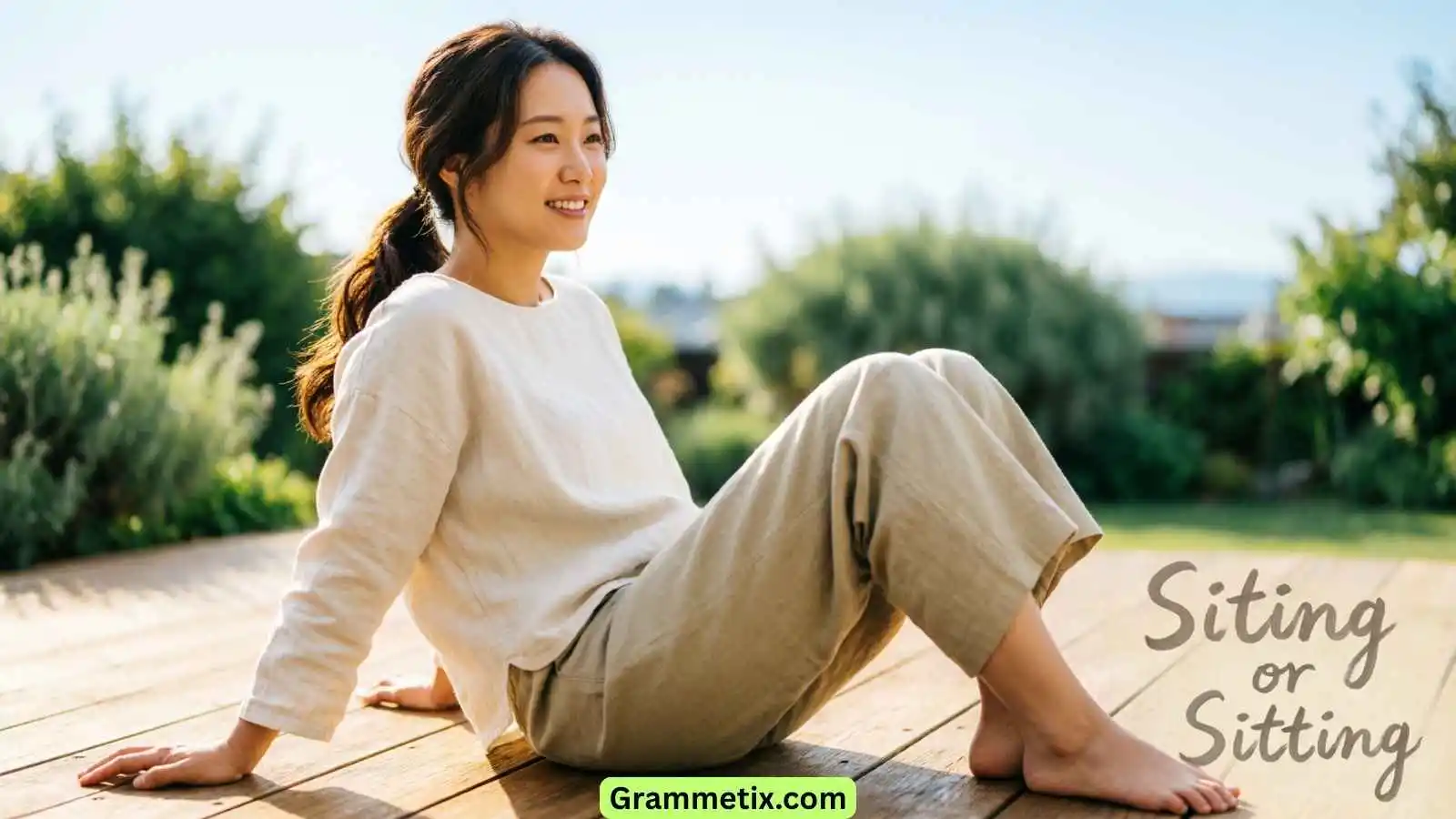
Do you get stuck between siting or sitting? You are not alone. This is a very common problem. The two words look almost the same. But they have different jobs.
One letter changes the meaning completely. That small mistake can confuse your reader. Do not worry. In this post, you will learn the fast answer. You will also see simple examples.
We will explain why people mix them up. You will learn which word to use for work, school, or casual talk. By the end, you will never guess again. You will know the right spelling every time.
Let us fix this now.
Siting or Sitting – Quick Answer
Sitting means resting on a surface. Siting means placing something in a location. Use sitting for people and animals. Use siting for objects and buildings.
Key Difference Between Siting and Sitting
Here are the main differences:
- Sitting uses your body. Siting uses a plan.
- Sitting is for people. Siting is for things.
- Sitting is common. Siting is rare.
- Sitting is an action. Siting is a decision.
Comparison Table
| Feature | Sitting | Siting |
|---|---|---|
| Meaning | To rest on a seat | To choose a location |
| Who uses it | People, animals | Companies, builders |
| Example | “She is sitting on a chair.” | “They are siting the new school.” |
| Common? | Yes, very common | No, not common |
Is Siting or Sitting Correct or Incorrect?
Both spellings are correct. It depends on your sentence. Sitting is correct for resting. Siting is correct for placing. You cannot swap them. That would be a mistake. Always check your meaning first.
Why Do People Confuse Siting and Sitting?
People confuse these words for three reasons.
First, the spelling is very close. Only one letter changes. The eye can miss this change.
Second, the internet shows both forms. People see siting rarely. But they assume it is a typo. They think sitting is always right. That is not true.
Third, schools teach sitting early. They rarely teach siting. So your brain learns one word well. The other word feels wrong. But both are real words.
The Origin of Siting and Sitting
Sitting is very old. It comes from Old English sittan. This word means “to be seated.” People have used it for 1000 years.
Siting is newer. It comes from the word site. A site is a place or location. In the 1800s, people made siting a verb. It means “to put something on a site.” Both words are correct. They just have different jobs.
British English vs American English Spelling
Good news. Both countries spell these words the same way. There is no difference. Sitting has two T’s everywhere. Siting has one T everywhere. No special rules for the UK or US.
Country Spelling Table
| Country | Sitting Spelling | Siting Spelling |
|---|---|---|
| United States | Sitting | Siting |
| United Kingdom | Sitting | Siting |
| Australia | Sitting | Siting |
| Canada | Sitting | Siting |
Which Spelling Should You Use?
You must choose based on your reader. Here is how to decide.
For US Audience
Use sitting for people. Use siting for buildings or projects. Most Americans know sitting better. But they understand siting in work emails.
For UK/Commonwealth Audience
Use the same rule. Sitting is for rest. Siting is for placement. British writers use siting in reports. They use sitting in daily life.
For Global/SEO Writing
Use sitting most of the time. It is 100 times more common. Only use siting for construction or real estate topics. Google sees sitting as the main word. So focus on sitting for most content.
How to Pronounce Siting and Sitting
Here is the simple pronunciation:
- Sitting = SIT + ing (say “SIT” then “ing”)
- Siting = SIGHT + ing (say “SIGHT” then “ing”)
Do they sound the same? No. They sound different. Sitting has a short “i” like in hit. Siting has a long “i” like in light. Say them out loud. You will hear the difference.
Formal vs Informal Usage of Siting and Sitting
Academic Writing
Use sitting for human posture. Use siting for research on locations. Example: “The study observed children sitting.” Or: “The siting of the lab was important.”
Business Communication
Use sitting for meetings. “We will be sitting in a conference room.” Use siting for new offices. “We are siting the new branch downtown.”
Casual Conversation
Only use sitting. People never say siting with friends. It sounds too formal. Say: “I am sitting on my couch.” Do not say: “I am siting my TV.”
Common Mistakes with Siting and Sitting
1: Using “siting” for resting
- Incorrect: “I am siting on this chair.”
- Correct: “I am sitting on this chair.”
- Why: Siting does not mean rest. It means location.
2: Using “sitting” for placement
- Incorrect: “We are sitting the new statue here.”
- Correct: “We are siting the new statue here.”
- Why: Sitting is for bodies. Statues do not sit. They are placed.
3: Doubling the T in “siting”
- Incorrect: “The committee is sitingting the park.”
- Correct: “The committee is siting the park.”
- Why: Site has one T. So siting has one T. Do not add more.
Siting and Sitting in Everyday Examples
In Emails
- Sitting: “I will be sitting in the lobby at 3 PM.”
- Siting: “We are siting the new vending machine near the stairs.”
In News
- Sitting: “The president was sitting during the speech.”
- Siting: “The city is siting a new homeless shelter.”
In Social Media
- Sitting: “Just sitting here drinking coffee ☕”
- Siting: (Rare) “The architects are siting the new tower. #construction”
In Formal Writing
- Sitting: “Participants remained sitting for 20 minutes.”
- Siting: “Proper siting of wind turbines increases efficiency.”
Simple Rule to Remember
Here are three easy rules:
- People sit. Things site. If a human does it, use sitting. If a plan does it, use siting.
- Two T’s for your bottom. One T for the spot. Your body needs two T’s (sitting). A location needs one T (siting).
- Say “SIGHT” for placement. If you can replace the word with locating, use siting. If not, use sitting.
Siting vs Sitting – Google Trends & Usage Data
Google data shows sitting is much more popular. It has nearly 100% of searches in most countries. Siting is only searched by professionals. These include architects and city planners.
Usage by Country Table
| Country | Sitting (search volume) | Siting (search volume) |
|---|---|---|
| United States | Very High | Very Low |
| United Kingdom | Very High | Very Low |
| India | High | Low |
| Australia | High | Very Low |
Siting is most common in the US and UK. But it is still rare. Only use siting for technical writing.
Related Grammar Terms You Should Know
Here are five related words for internal linking:
- Site vs Cite – Site is a place. Cite means to quote.
- Seated vs Sitting – Seated is more formal. Sitting is common.
- Laying vs Sitting – Laying needs an object. Sitting does not.
- Position vs Location – Both relate to siting.
- Present Participle – The -ing form of a verb (like sitting).
FAQs
1. Is “siting” a real word?
Yes, it is a real word. It means choosing a place for something. Builders and planners use it often.
2. Can I use “sitting” for objects?
No. Objects do not sit. People and animals sit. Objects are placed or sited.
3. Does autocorrect change “siting” to “sitting”?
Yes, most autocorrect tools do this. Be careful. Check your spelling when writing about locations.
4. Which is correct: “sitting down” or “siting down”?
Only sitting down is correct. Siting down has no meaning. Never use it.
5. Is “baby sitting” one word or two?
It is two words: baby sitting. Or one word: babysitting. Both use sitting with two T’s.
6. Do British people spell “sitting” differently?
No. Both the US and UK spell sitting the same way. No difference at all.
7. How do I teach this difference to a child?
Tell the child: “You sit on a chair. That is sitting. A builder picks a spot. That is siting.”
Conclusion
Now you know the difference between siting or sitting. Sitting is for resting on a chair. Sitting has two T’s. Siting is for placing something in a spot. Siting has one T.
Most people only need sitting. Use siting for work or school projects. Remember the rule: people sit, things site. You can now write both words with confidence.
No more confusion. Go and use your new skill today.