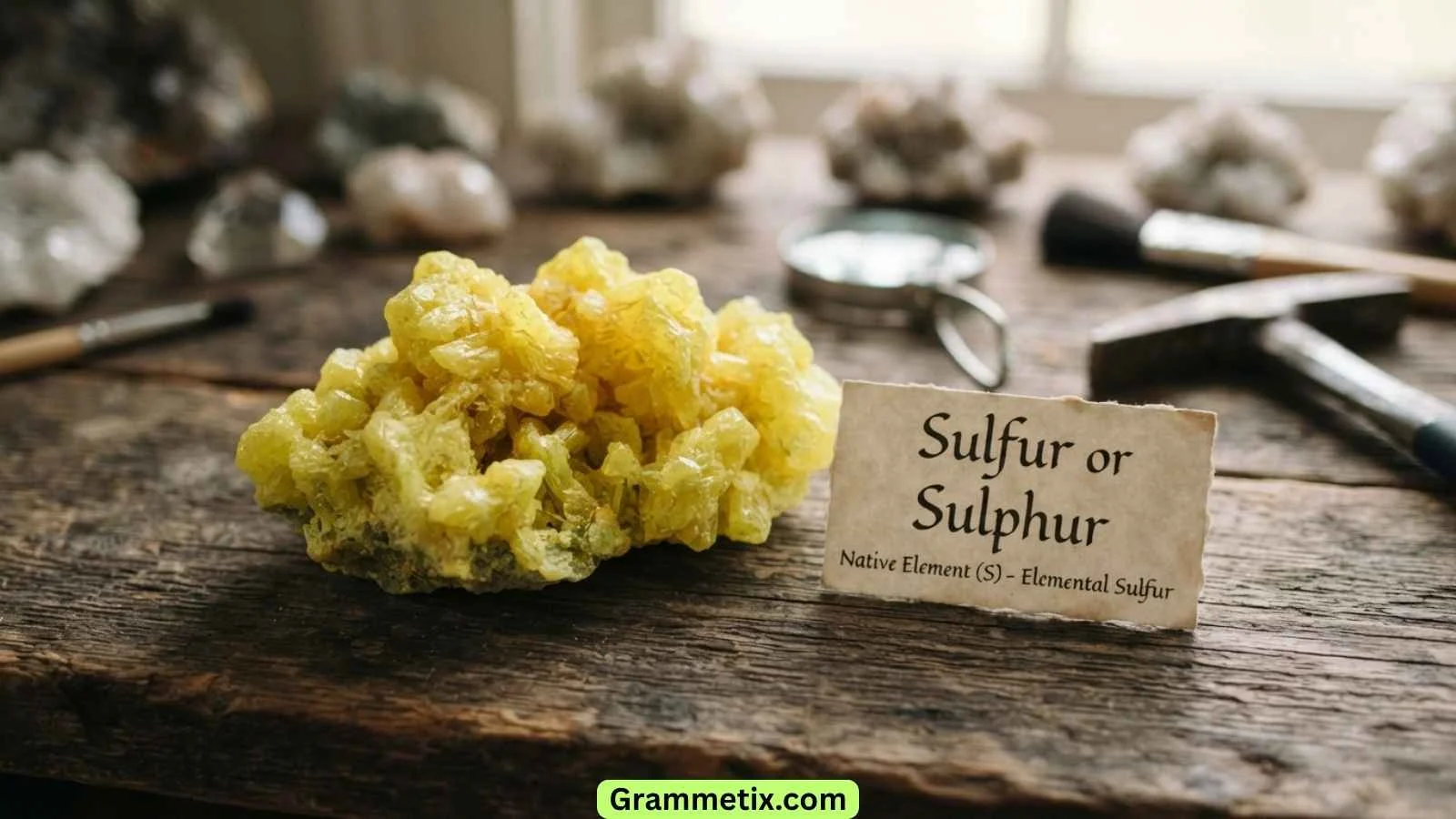
Sulfur or sulphur is a common spelling question for students, writers, and English learners. Both words refer to the same yellow chemical element, but many people wonder which spelling is correct.
Some books use sulfur, while others use sulphur, making the choice confusing. The difference mainly depends on the type of English you are using and modern scientific standards.
In this guide, you’ll learn the difference between these spellings, why both exist, where each is used, and how to choose the right one with confidence.
Sulfur or Sulphur – Quick Answer
Both Sulfur and sulphur mean the same chemical element. Sulfur is the official spelling used by modern science and American English. Sulphur is the traditional British spelling, although sulfur is now widely accepted in British scientific writing as well.
Key Difference Between Sulfur or Sulphur
The main difference is the spelling, not the meaning.
- Sulfur is the official scientific spelling worldwide.
- Sulfur is standard in American English.
- Sulphur is the traditional British spelling.
- Both words refer to the same chemical element.
- Modern scientific publications prefer sulfur.
Spelling Comparison Table
| Feature | Sulfur | Sulphur |
|---|---|---|
| Meaning | Chemical element (S) | Chemical element (S) |
| American English | ✅ Standard | ❌ Rare |
| Traditional British English | Accepted | ✅ Traditional |
| Scientific Standard | ✅ Official | Rarely used |
| Pronunciation | Same | Same |
Is Sulfur or Sulphur Correct or Incorrect?
Both sulfur and sulphur are correct spellings because they refer to the same chemical element.
However, the correct choice depends on your audience and purpose.
If you are writing for a scientific paper, textbook, or international audience, sulfur is the preferred spelling. It is the official spelling recognized by modern scientific organizations.
If you are reading older British books or historical documents, you may still see sulphur. It is not wrong, but it is less common today, especially in science.
In everyday writing, choosing one spelling and using it consistently is the best approach.
Why Do People Confuse Sulfur or Sulphur?
Many people become confused because both spellings appear in books, websites, and dictionaries.
British vs American English
American English has long preferred sulfur.
Traditional British English commonly used sulphur for many years.
Today, scientific writing in both regions mostly uses sulfur.
Internet and Global Exposure
People read content from many countries every day.
A British website may use sulphur, while an American website uses sulfur.
Seeing both spellings makes readers wonder which one is right.
Education Differences
Schools often teach the spelling that matches their country’s English.
Students in different countries may learn different spellings.
Science classes today usually teach sulfur because it is the international scientific standard.
The Origin of Sulfur or Sulphur
The word comes from the Latin word sulfur, which referred to the yellow mineral known since ancient times.
Over time, English developed different spelling styles. British English adopted sulphur, partly because many words with the “ph” combination came from Greek. Although sulphur became popular, it did not match the original Latin spelling.
To create one worldwide standard, international chemistry organizations later chose sulfur as the official spelling. Because of this decision, scientific books, research papers, and chemistry classrooms now use sulfur almost everywhere.
Even so, you may still find sulphur in older British books, newspapers, and historical documents. Both spellings describe the same element with the chemical symbol S, but sulfur is now the modern standard.
British English vs American English Spelling
The biggest difference between sulfur and sulphur is the type of English being used. The meaning never changes. Only the spelling does.
Today, sulfur is the official spelling in science around the world. American English has always preferred sulfur, while traditional British English often used sulphur. Many modern British publishers and scientists now also use sulfur.
Country and Usage Table
| Region | Preferred Spelling | Common Usage |
|---|---|---|
| United States | Sulfur | Standard in all writing |
| Canada | Sulfur | Most common |
| United Kingdom | Sulphur (traditional), Sulfur (scientific) | Both seen |
| Australia | Sulfur (scientific), Sulphur (traditional) | Both accepted |
| New Zealand | Sulfur (scientific), Sulphur (traditional) | Both accepted |
| International Science | Sulfur | Official standard |
Examples
- American English: The soil contains sulfur.
- British English (traditional): The mine produced sulphur.
- Modern scientific writing: Sulfur is an essential chemical element.
Which Spelling Should You Use?
The best spelling depends on who will read your writing.
For US Audience
Use sulfur.
It is the standard American spelling. Schools, newspapers, websites, and scientific publications all use sulfur.
Examples:
- Sulfur is used to make fertilizer.
- The volcano released sulfur gases.
- Sulfur is an important element.
For UK/Commonwealth Audience
Traditional British English often uses sulphur.
However, if you are writing about chemistry or science, sulfur is the better choice because it follows the international scientific standard.
Examples:
- Older books may mention sulphur mines.
- Modern science textbooks usually write sulfur.
- Research papers almost always use sulfur.
For Global/SEO Writing
Choose sulfur.
It is recognized around the world and matches scientific standards. It also helps keep your writing clear for an international audience.
If your readers are mainly interested in language differences, you can mention both spellings. Otherwise, use sulfur throughout the article for consistency.
How to Pronounce Sulfur or Sulphur
Both words are pronounced exactly the same.
Simple pronunciation:
SUL-fer
Phonetic pronunciation:
/ˈsʌl.fər/
The only difference is the spelling. Whether you write sulfur or sulphur, people say the word in the same way.
Example:
- Sulfur is found near volcanoes.
- Sulphur is found near volcanoes.
Both sentences are spoken with the same pronunciation.
Formal vs Informal Usage of Sulfur or Sulphur
The spelling you choose can depend on the type of writing.
Academic Writing
Always prefer sulfur.
Schools, universities, and scientific journals use sulfur because it is the official spelling.
Example:
“The experiment measured sulfur compounds.”
Business Communication
Use the spelling that matches your audience.
An American company should use sulfur. A British business may still use sulphur in non-scientific materials, although sulfur is becoming more common.
Example:
“Our factory produces sulfur-based products.”
Casual Conversation
Both spellings are understood.
People rarely notice the difference unless they are discussing language or chemistry.
Examples:
- I smelled sulfur near the hot spring.
- I read about sulphur in an old book.
Common Mistakes with Sulfur or Sulphur
1: Thinking One Spelling Is Wrong
❌ Incorrect: Sulphur is an incorrect word.
✅ Correct: Sulfur and sulphur are both correct spellings.
Explanation: Both spellings exist, but sulfur is the modern scientific standard.
2: Mixing Both Spellings in One Document
❌ Incorrect: Sulfur is useful. Sulphur is found in nature.
✅ Correct: Sulfur is useful. Sulfur is found in nature.
Explanation: Choose one spelling and use it consistently throughout your writing.
3: Using Sulphur in Scientific Research
❌ Incorrect: The laboratory tested sulphur compounds.
✅ Correct: The laboratory tested sulfur compounds.
Explanation: Scientific writing follows the official spelling sulfur, regardless of the country.
4: Assuming Pronunciation Changes
❌ Incorrect: Sulphur is pronounced differently from sulfur.
✅ Correct: Both words are pronounced exactly the same.
Explanation: The spelling changes, but the pronunciation does not.
Sulfur or Sulphur in Everyday Examples
Seeing both spellings in real life makes the difference easier to understand. The meaning stays the same. Only the spelling changes depending on the audience and writing style.
In Emails
For professional emails, use the spelling that matches your reader.
Examples:
- Please order more sulfur for the laboratory.
- The report mentions sulphur deposits in older British records.
- Our supplier follows the international spelling sulfur.
In News
News organizations usually follow their style guide.
American news outlets nearly always use sulfur. Some British newspapers may still use sulphur, especially in older articles.
Examples:
- Scientists discovered high levels of sulfur near the volcano.
- The museum opened a new exhibit about sulphur mining.
In Social Media
People often use whichever spelling they learned in school.
Both spellings are understood by readers.
Examples:
- The hot spring smells like sulfur!
- I never knew sulphur and sulfur meant the same thing.
- Learning English spelling differences is fun.
In Formal Writing
Formal writing should be clear and consistent.
Scientific reports, textbooks, and research papers almost always use sulfur.
Examples:
- Sulfur is an essential element in many chemical reactions.
- Sulfur compounds play an important role in agriculture.
- Sulfur is listed on the periodic table with the symbol S.
Simple Rule to Remember
Remember these easy rules whenever you write the word.
- Use sulfur for science, American English, and international writing.
- Use sulphur only when following traditional British spelling or quoting older texts.
- Never switch between both spellings in the same document.
Easy memory tip:
Science says “sulfur.” Traditional British writing may say “sulphur.”
Sulfur or Sulphur – Google Trends & Usage Data
Search trends show that sulfur is much more popular worldwide today.
This is mainly because international science, education, and online content use sulfur as the standard spelling.
Older books and some British publications still use sulphur, but its popularity has gradually declined.
Usage by Country
| Country/Region | Most Common Spelling | Notes |
|---|---|---|
| United States | Sulfur | Used in schools, media, and science |
| Canada | Sulfur | Standard spelling |
| United Kingdom | Sulphur (traditional), Sulfur (scientific) | Both appear |
| Australia | Sulfur in science | Traditional writing may use sulphur |
| New Zealand | Sulfur in science | Both spellings recognized |
| International Publications | Sulfur | Official scientific standard |
Overall, sulfur dominates modern websites, textbooks, chemistry journals, and educational resources.
Related Grammar Terms You Should Know
If you are learning English spelling differences, these topics can also help. They make excellent resources for further reading and internal linking.
- Color or Colour
- Center or Centre
- Fiber or Fibre
- Program or Programme
- Practice or Practise
These word pairs follow patterns similar to sulfur and sulphur, where the preferred spelling depends on the audience or regional English.
FAQs
1. Is sulfur or sulphur the correct spelling?
Both spellings are correct. However, sulfur is the official spelling used in modern science and American English. Sulphur is the traditional British spelling.
2. Why do scientists use sulfur instead of sulphur?
International scientific organizations chose sulfur as the official spelling to create one global standard. Today, chemistry books and research papers use sulfur almost everywhere.
3. Do sulfur and sulphur have different meanings?
No. Both words refer to the same chemical element with the symbol S. Only the spelling is different.
4. Is sulphur still used today?
Yes. You may still find sulphur in older British books, historical documents, and some traditional publications. It is much less common in modern scientific writing.
5. Which spelling is better for SEO and online writing?
Sulfur is usually the better choice because it is the modern international standard and appears more often in educational and scientific content. If your audience searches for both spellings, mentioning each once or twice is helpful.
6. Are sulfur and sulphur pronounced differently?
No. They have the same pronunciation: SUL-fer. The difference is only in the spelling.
Conclusion
Choosing between sulfur and sulphur is much easier once you know the difference. Both spellings describe the same chemical element, so neither changes the meaning. The main difference is regional preference and modern scientific standards.
If you are writing for an American audience, an international readership, or any scientific purpose, sulfur is the best choice. If you are reading older British books or historical documents, you may still see sulphur.
Understanding both spellings helps you read and write with confidence. For most modern writing, sulfur is the safest, clearest, and most widely accepted option.