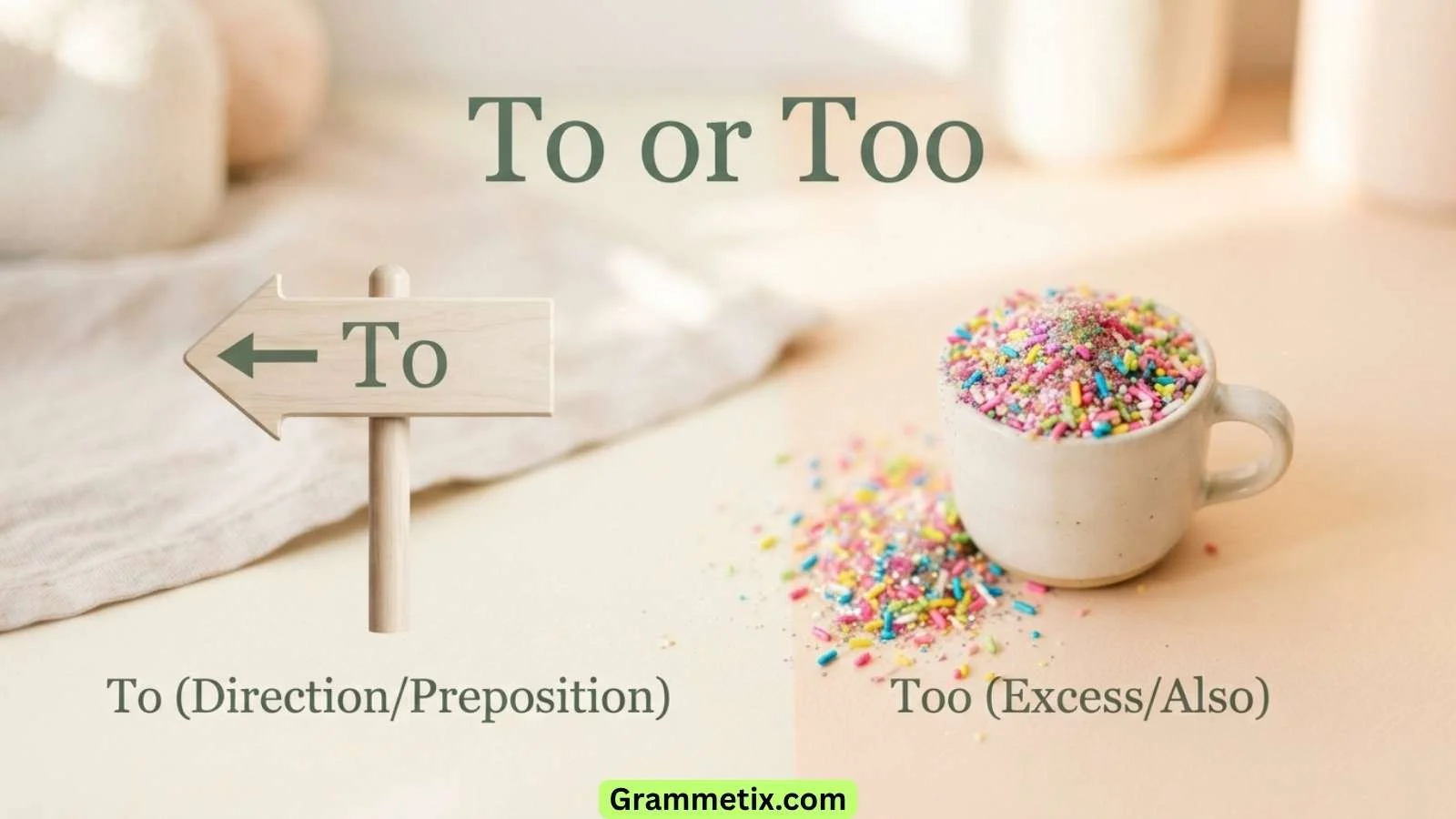
Are you confused about when to use to or too? You are not alone. Millions of people search for this exact question every single day.
These two tiny words sound identical, but they have completely different jobs. This small spelling mistake can make your writing look unprofessional. It can even change the meaning of your entire sentence.
Why is this so tricky? Because they are homophones, meaning they sound the same when spoken. But in writing, the extra letter “o” makes all the difference.
In this beginner-friendly guide, I will give you a clear and simple answer right away. You will learn a super easy trick to never mix them up again. You will also see real-life examples from emails, social media, and formal writing.
By the end, you will feel confident choosing the correct word every single time. Let’s end the confusion now!
To or Too – Quick Answer
Here is the quick answer. Use “to” to show direction or movement. Use “to” with verbs, like “to run.” Use “too” to mean “also” or to say “too much.” For example, go to the store. Ask your friend to come too. This coffee is too hot to drink. The quick rule is: If you can swap it with “also” or “overly,” use “too.” Otherwise, use “to.”
Key Difference Between To and Too
Here is the key difference in a nutshell. “To” is a preposition. “Too” is an adverb. This is the main grammar difference. But let’s make it even simpler.
- To is for direction, purpose, and the infinitive form of verbs.
- Too is for “also” and for “excessive” amounts.
- “Two” is a number, but we are focusing on “to” and “too.”
Let’s look at a simple comparison table to see the differences side-by-side.
Comparison Table: To vs Too
| Base of Comparison | To | Too |
| Part of Speech | Preposition / Infinitive Marker | Adverb |
| Main Meaning | Direction, purpose, or infinitive | Also, as well, or excessively |
| Example | We went to the park. | She wants to come, too. |
| Example | I like to read books. | The water is too cold. |
Is To or Too Correct or Incorrect?
Both “to” and “too” are correct words in English. They are both spelled correctly. The question is not if they are right or wrong. The question is if you are using the right word for the right context. Using “to” when you mean “too” is a mistake. It changes the meaning of your sentence. The word “too” means “also” or “excessively.” The word “to” shows direction. So, “I want to go too” is correct. “I want to go to” is incorrect. “I’m going to the store” is correct. “I’m going too the store” is incorrect. Context is the key.
Why Do People Confuse “To” and “Too”?
Many people find “to” and “too” confusing. There are a few simple reasons for this. Understanding why can help you stop making the same mistake.
- They are Homophones: They sound exactly the same when you say them. This is the biggest reason for the confusion.
- They are Short Words: As they are short and common, they are easy to mix up when typing fast.
- Education Differences: Not everyone learns the difference. Some people do not get clear explanations in school.
- Global Exposure: People learn English from many different places online. They see different examples and can get confused.
The Origin of “To” and “Too”
The history of these words is interesting. It explains why we have two spellings today. “To” is a very old English word. It comes from the West Germanic word “to” and meant “in the direction of” or “for the purpose of.” Later, a variant of “to” started to be used. This variant meant “in addition” or “in excess.” It was pronounced with a stressed “o.” The first recorded use of the “-oo” spelling was in 1590 to show this difference. This is how the spelling “too” was born. It helped show that the word had a different meaning from “to.”
British English vs American English Spelling
Here is some good news. There is no difference between British and American English for these words. Everyone spells them the same way. “To” and “too” are spelled the same in both dialects. Only “two” is always the number 2. The rules for using them are the same everywhere. There is no “British spelling” or “American spelling” for these words.
Country/Usage Table
| Word | Usage | Example | Common in |
| To | Direction, infinitive | I want to go home. | All English-speaking countries |
| Too | Also, excessive | It is too hot. | All English-speaking countries |
Which Spelling Should You Use?
Choosing the right spelling is easy if you follow a simple rule. The choice depends on what you want to say. It also depends on where your audience is from. Let’s break it down.
For US Audience
The rules are strict in the US. Use “to” for direction and verbs. Use “too” for “also” or “excessive.” If you are writing for an American audience, get this right. It shows you are a good writer.
For UK/Commonwealth Audience
The rules are the same in the UK, Australia, and Canada. There is no difference at all. Use “to” for direction. Use “too” for “also” or “excessive.” This rule is universal.
For Global/SEO Writing
For global SEO writing, correct spelling matters. Google knows the difference. Your readers know the difference. Use the correct word to be clear. Good spelling helps with SEO. It makes your content look professional and trustworthy.
How to Pronounce To or Too
This is a trick question. “To” and “too” are pronounced exactly the same way. They are both pronounced “too.” The phonetic pronunciation for both is /tuː/. It rhymes with “boo” and “zoo.” Because they sound the same, it is easy to see why people get confused. You have to think about the meaning to know the spelling. There is no difference in how you say them.
Formal vs Informal Usage of To or Too
Both words are used in all types of English. But how you use them can change depending on the situation. Let’s see how they fit into different settings.
Academic Writing
In academic writing, use “to” and “too” correctly. “Too” is used to show excess. “To” is used for direction and with verbs. For example, “The results are too complex to explain here.” Be careful. Overusing “too” can make your writing sound less formal.
Business Communication
In business, clarity is everything. Use “to” to show direction or purpose. Use “too” to mean “also” or “more than needed.” For example, “I would like to add my comments too.” You might say, “The project is taking too long.” This is clear and professional.
Casual Conversation
In casual conversation, people use both words naturally. For example, “I’m coming to the party, too!” This is very common. In text messages, people might make mistakes. But in good writing, you should always use the correct word.
Common Mistakes with To or Too
Many people make common mistakes with these words. Let’s look at three of the most frequent errors. We will explain how to fix them.
1: Using “To” Instead of “Too” for Excess
- Incorrect example: This movie is to boring.
- Correct example: This movie is too boring.
- Short explanation: When you say something is “too” something, you mean it is excessive. Use the one with the extra “o.”
2: Using “Too” Instead of “To” for Direction
- Incorrect example: We are going too the park.
- Correct example: We are going to the park.
- Short explanation: “To” shows movement or direction. You are moving towards the park. Use the word with only one “o.”
3: Forgetting the Second “o” for “Also”
- Incorrect example: I want to go, to.
- Correct example: I want to go, too.
- Short explanation: “Too” means “also” or “as well.” In this case, you are adding yourself to the plan. Use “too.”
“To” and “Too” in Everyday Examples
These words appear everywhere. Let’s look at common examples. This will show you how to use them in your own writing.
In Emails
In emails, you use these words a lot. For example, “I am writing to you about the project.” Or, “I would like to add my ideas too.” You might also write, “Please send the file to me.” Another example is, “I have too many tasks to finish today.”
In News
News articles use these words in a clear way. For example, “The president went to the disaster site.” Or, “The city is too crowded.” A headline might read, “Tolls rise to ten.” News writers must be clear and correct.
In Social Media
Social media is more informal. But the rules still apply. For example, “I’m going to the beach!” Another post might say, “I want to go too!” A meme might say, “This is too funny.” Even in short posts, the difference matters.
In Formal Writing
Formal writing uses these words accurately. For example, “The committee aims to reach a conclusion.” You might write, “The data is too limited.” Another example is, “The funds were allocated to the department.” Precision is very important here.
Simple Rules to Remember
Here is an easy rule to remember. This rule will help you every time. If you want to say “also” or “more than enough,” use “too.” Think of “too” as having “too many o’s.” For everything else, use “to.”
- 1: The “Also” Test: Can you replace the word with “also”? If yes, use “too.” For example, “I want to go, too.” You can say, “I want to go, also.” This works!
- 2: The “Excessive” Test: Is the word showing something is over the top? If yes, use “too.” For example, “This bag is too heavy.” The word “too” shows it is over a limit.
- 3: The “Direction” Rule: Is the word showing where you are going? If yes, use “to.” For example, “We are going to the store.” The word “to” shows direction.
To or Too – Google Trends & Usage Data
Let’s look at how these words are used. The word “to” is one of the most common words in English. It is used everywhere. The word “too” is also very common. There is no country that prefers one over the other. Everyone uses both.
The key is that confusion exists globally. People search for “to vs too” all over the world. This shows it is a universal problem. There is no geographic solution. It is about remembering the rule. The number of “o’s” is the only difference.
Related Grammar Terms You Should Know
To understand “to” and “too,” you can look at other grammar words. Here are some related terms. These are also very common and often confused.
- Two: This is the number 2. It is a homophone of “to” and “too.”
- Preposition: A word that shows direction or a relationship. “To” is a preposition.
- Adverb: A word that modifies a verb or adjective. “Too” is an adverb.
- Homophone: Words that sound the same but have different meanings. “To,” “too,” and “two” are homophones.
FAQs
1. When should I use “to” in a sentence?
You use “to” to show direction or to form the infinitive of a verb. For example, “I am going to the store.” Here, “to” shows direction. Another example is “I like to read.” Here, “to” makes the verb “read” into an infinitive.
2. When should I use “too” in a sentence?
You use “too” to mean “also” or “excessively.” For example, “I want to go, too.” This means “also.” Another example is “It is too hot.” This means it is more than a comfortable temperature.
3. What are some tricks to remember the difference?
The best trick is the “also” test. If you can replace the word with “also,” use “too.” Another good trick is to remember that “too” has “too many o’s.” The word “too” has an extra “o” for an extra meaning.
4. Can “to” and “too” ever be used interchangeably?
No, they can never be used interchangeably. They have different meanings. “To” is for direction and purpose. “Too” is for “also” and “excessively.” Mixing them up will change the meaning of your sentence. It will also look like a mistake.
5. Why do “to,” “too,” and “two” sound the same?
They sound the same because they are homophones. Homophones are words that have the same pronunciation but different meanings and spellings. The way we say them has changed over time. This is why we have different spellings for the same sounds.
6. Is “to” or “too” more common in English?
The word “to” is more common than “too.” It is one of the most used words in English. This is because “to” has many functions. It is used as a preposition and to make the infinitive. “Too” is also common but less frequent than “to.”
7. What is the difference between “too much” and “to much”?
“Too much” is the correct phrase. It means “more than is needed.” For example, “I ate too much cake.” “To much” is a common mistake. The word “to” cannot be used here to show excess. Always use “too” with “much” to say “overly.”
Conclusion
So, let’s review. The difference between “to” and “too” is simple but important. “To” is for direction and verbs. “Too” means “also” or “excessively.”
The key to remember is the number of “o’s.” If you mean “also,” use “too.” If you mean “too much,” use “too.” For everything else, use “to.” Don’t worry if it feels hard at first.
With practice, it will become easy. Use the “also” test. Use the trick of “too many o’s.” Soon, you will never mix these up again. You can now write with confidence!