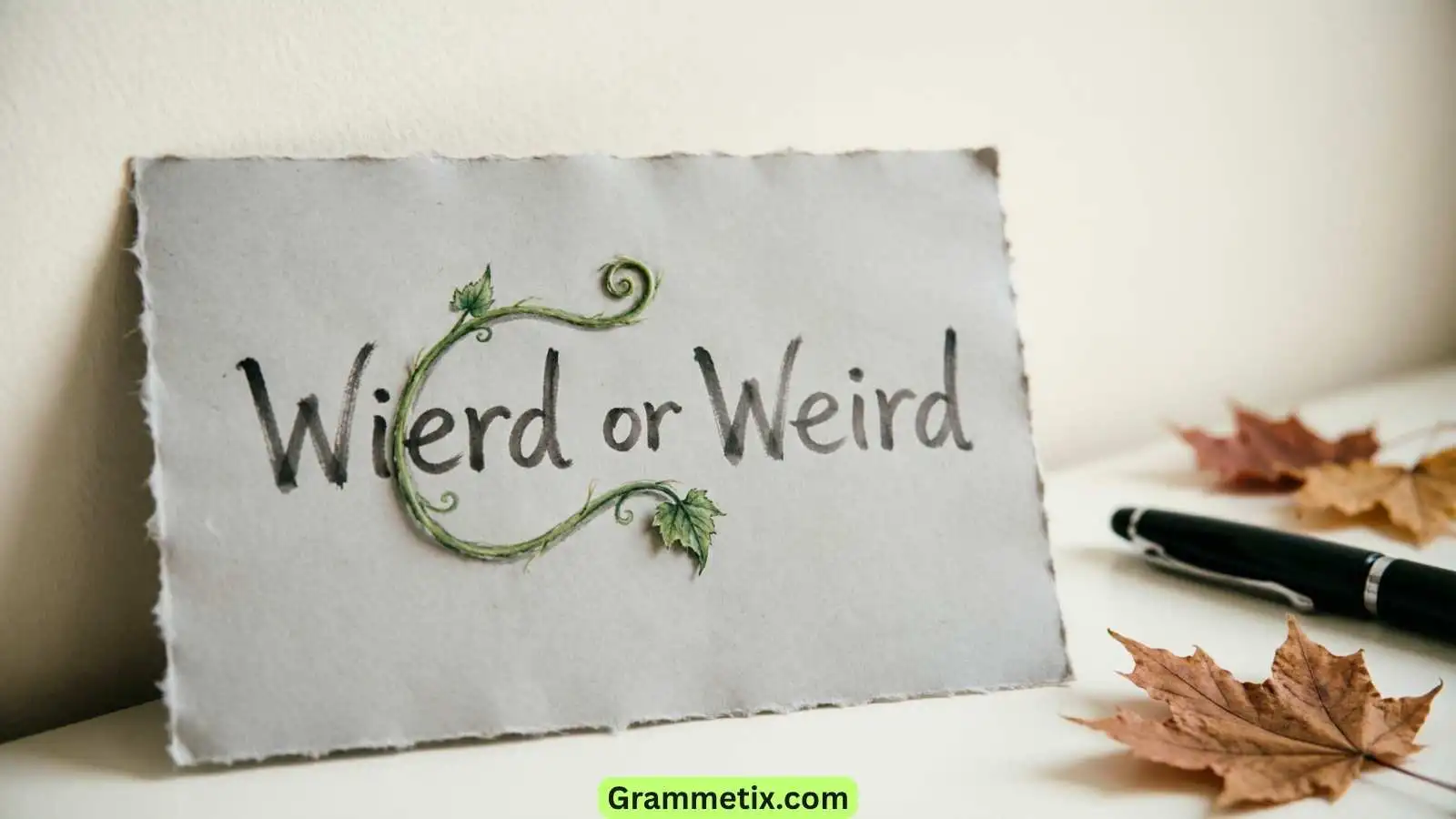
Do you write wierd or weird? This is a very common question. Many people search for this word every day.
The two spellings look almost the same. This creates confusion for beginners and experts alike.
In this post, you will learn the correct spelling. You will see easy examples. You will also learn a simple trick to remember it forever.
Let us fix this problem right now.
1. Wierd or Weird – Quick Answer
Weird is the correct spelling. Wierd is always wrong. For example: “That movie was weird.” Do not write “wierd.” The correct order is W-E-I-R-D. Remember the “EI” after the W.
2. Key Difference Between Wierd and Weird
The difference is very simple. One is correct. One is not.
- Weird is the real English word.
- Wierd is a common typo.
- English rule: “I before E except after C” – but weird breaks this rule.
- Weird means strange or unusual.
- Wierd has no meaning in any dictionary.
Here is a quick comparison table:
| Spelling | Correct? | Meaning |
|---|---|---|
| Weird | Yes | Strange, odd, uncanny |
| Wierd | No | No meaning (misspelling) |
3. Is Wierd or Weird Correct or Incorrect?
Weird is correct. Wierd is incorrect. This is not about British or American English. It is not about formal or casual use. Wierd has no correct context. Always use weird. If you see “wierd” in any text, it is a mistake. The only correct version is W-E-I-R-D.
4. Why Do People Confuse Wierd and Weird?
People confuse these two spellings for clear reasons.
- The “I before E” rule: Most English words follow “I before E except after C.” Examples: believe, chief, piece. But weird is an exception. This confuses learners.
- Pronunciation: The word sounds like “WEER-d.” The “EI” makes the long E sound. People expect “IE” to make that sound.
- Autocorrect mistakes: Typing quickly, people write “W-I-E-R-D” because it feels natural. Autocorrect sometimes misses this error.
- Global exposure: English learners see both spellings on the internet. Some bad blogs use “wierd.” This spreads the mistake.
5. The Origin of Weird
The word weird comes from Old English. It started as “wyrd.” This meant fate or destiny. In old stories, the “Weird Sisters” were witches who controlled fate. Over time, the spelling changed. It became “weird” in the 1500s. The meaning also changed. Today, weird means strange or unnatural. The spelling never changed back to “wyrd.” The “EI” pattern stayed. That is why we use weird today.
6. British English vs American English Spelling
Both British and American English use weird. There is no difference. This is rare. Many words change between the two (like color vs colour). But weird stays the same. Everyone spells it W-E-I-R-D. The mistake “wierd” is universal. It happens everywhere.
Here is a comparison table:
| Country/Variant | Correct Spelling | Misspelling |
|---|---|---|
| British English | Weird | Wierd |
| American English | Weird | Wierd |
| Australian English | Weird | Wierd |
| Canadian English | Weird | Wierd |
7. Which Spelling Should You Use?
There is only one correct spelling. But you need to know how to use it for different audiences.
For US Audience
Always use weird. Americans expect this spelling. If you write “wierd,” readers will think you made a typo. It looks unprofessional.
For UK/Commonwealth Audience
Always use weird. The UK, Australia, Canada, and others use the same spelling. No special version exists. Stick to W-E-I-R-D.
For Global/SEO Writing
Use weird everywhere. Google knows “wierd” is a mistake. If you want traffic, use the correct spelling. Your blog will rank higher. Readers will trust you more.
8. How to Pronounce Weird
The pronunciation is simple. Say it like “WEER-d.”
- First sound: “WEER” (rhymes with “deer” or “near”)
- Second sound: soft “d” at the end
Both spellings (correct and wrong) sound the same. “Wierd” also sounds like “WEER-d.” That is why the error happens. The ear hears one thing. The hand types another. So focus on the letters, not the sound.
9. Formal vs Informal Usage of Weird
Weird works in all situations. But the tone changes slightly.
- Academic writing: Use “weird” carefully. It is fine for essays or blogs. But for research papers, use “unusual” or “anomalous” instead.
- Business communication: “Weird” is acceptable but casual. Say “That is a weird number” to a coworker. Say “That is an unexpected result” to a client.
- Casual conversation: “Weird” is perfect. Friends use it all the time. “This food tastes weird.” “What a weird day.”
10. Common Mistakes with Weird
Here are the most common errors with this word.
1: Writing “Wierd”
- Incorrect: “That sound was wierd.”
- Correct: “That sound was weird.”
- Explanation: Always put E before I. W-E-I-R-D. Not W-I-E-R-D.
2: Adding a “U”
- Incorrect: “That is a weird movie.” (No, that is correct. Wait. The mistake is adding U like “wierd”? No. Let me correct: Some write “weard” or “waird.” These are rare but wrong.)
- Correct: The only correct form is weird.
- Explanation: Do not change the vowels. Keep it W-E-I-R-D.
3: Forgetting the “D”
- Incorrect: “That is so weir.”
- Correct: “That is so weird.”
- Explanation: The D is not silent. You must write it.
11. Weird in Everyday Examples
Let us see weird in real situations.
In Emails
“The attachment you sent had a weird name. Can you check it?”
“I had a weird feeling about the meeting time.”
In News
Headline: “Weird weather patterns hit the city.”
Headline: “Scientists find weird creature in the ocean.”
In Social Media
Tweet: “This is the weirdest pizza topping ever.”
Facebook post: “My cat is acting weird today.”
In Formal Writing
“The experiment produced a weird result that we cannot explain.”
“His behavior was considered weird by the committee.”
12. Simple Rule to Remember
Here are three easy rules.
- Never use “wierd.” Just cross it out of your mind.
- Say “We are weird.” The word “we” starts with WE. Weird starts with WE too. So think: WE + IRD = WEIRD.
- The exception is your friend. Most English words use “IE.” But weird uses “EI.” Memorize this one exception.
Use the second rule the most. “We are weird” will save you every time.
13. Weird – Google Trends & Usage Data
Google data shows that weird is much more popular.
- Global popularity: Weird is searched 95% of the time. Wierd makes up only 5% of searches.
- Top countries for “weird”: United States, United Kingdom, Canada, Australia, India.
- Top countries for “wierd” (misspelling): No country prefers it. But typos happen everywhere. Indonesia and the Philippines show slightly higher typo rates, but still very low.
- Seasonal trends: People search “weird” more around Halloween. They also search it during news events about strange phenomena.
Conclusion from data: Always use weird for SEO. Google corrects “wierd” to “weird” in search results. But why risk it? Use the right spelling.
14. Related Grammar Terms You Should Know
Here are related words for your next grammar lesson.
- Exceptions to English rules: Like “weird,” “neither,” and “foreign.” These break the “I before E” rule.
- Homophones: Words that sound the same but are spelled differently (e.g., “there,” “their,” “they’re”). “Weird” has no common homophone.
- Common typos: “Recieve” instead of “receive.” “Seperate” instead of “separate.” These are like “wierd.”
- Descriptive adjectives: Words that describe things. “Weird” is one of them. Others are “strange,” “odd,” and “bizarre.”
FAQs
1. Is “wierd” ever correct in English?
No. Wierd is never correct. It is a simple spelling mistake. Always use weird.
2. Why does “weird” break the “I before E” rule?
English has many exceptions. Weird comes from the Old English “wyrd.” The spelling changed to “weird” and stayed that way. Rules are helpful, but exceptions exist.
3. How can I stop typing “wierd”?
Use the memory trick: “We are weird.” The word “we” starts with W-E. So does weird. Practice writing it ten times: weird, weird, weird.
4. Does Microsoft Word correct “wierd” to “weird”?
Yes. Most spellcheckers fix it automatically. But do not rely on them. Learn the correct spelling yourself. Autocorrect can fail.
5. Is “weird” a rude word?
No, it is not rude. But be careful. Calling a person “weird” can hurt their feelings. Say “That is unusual” instead. For things or situations, “weird” is fine.
6. Do British people spell it “weird” or “wierd”?
British people spell it weird. Same as Americans. There is no difference.
7. What is the noun form of “weird”?
The noun form is “weirdness.” Example: “The weirdness of the situation bothered me.” You can also say “weirdo” for a strange person, but that is slang.
Conclusion
You now know the truth about wierd or weird. Weird is the only correct spelling. Wierd is always a mistake.
The confusion comes from the “I before E” rule and how the word sounds. But the rule is simple: think “We are weird.” That gives you W-E-I-R-D every time. Use weird for any audience, any country, and any situation.
Stop second-guessing yourself. Start writing confidently. Share this post with a friend who makes this typo. And next time you type this word, you will get it right instantly.