Do you know when to use border or boarder? Many people search for this keyword because these two words sound exactly the same. This confusion leads to embarrassing mistakes in writing.
The good news is that the difference is very simple to learn. In this guide, I will clearly explain the difference between border and boarder.
You will learn which word to use for a boundary and which one to use for a person. I will also share easy memory tricks and real-life examples. By the end of this post, you will never second-guess yourself again.
Let us clear up this confusion once and for all.
Border or Boarder – Quick Answer
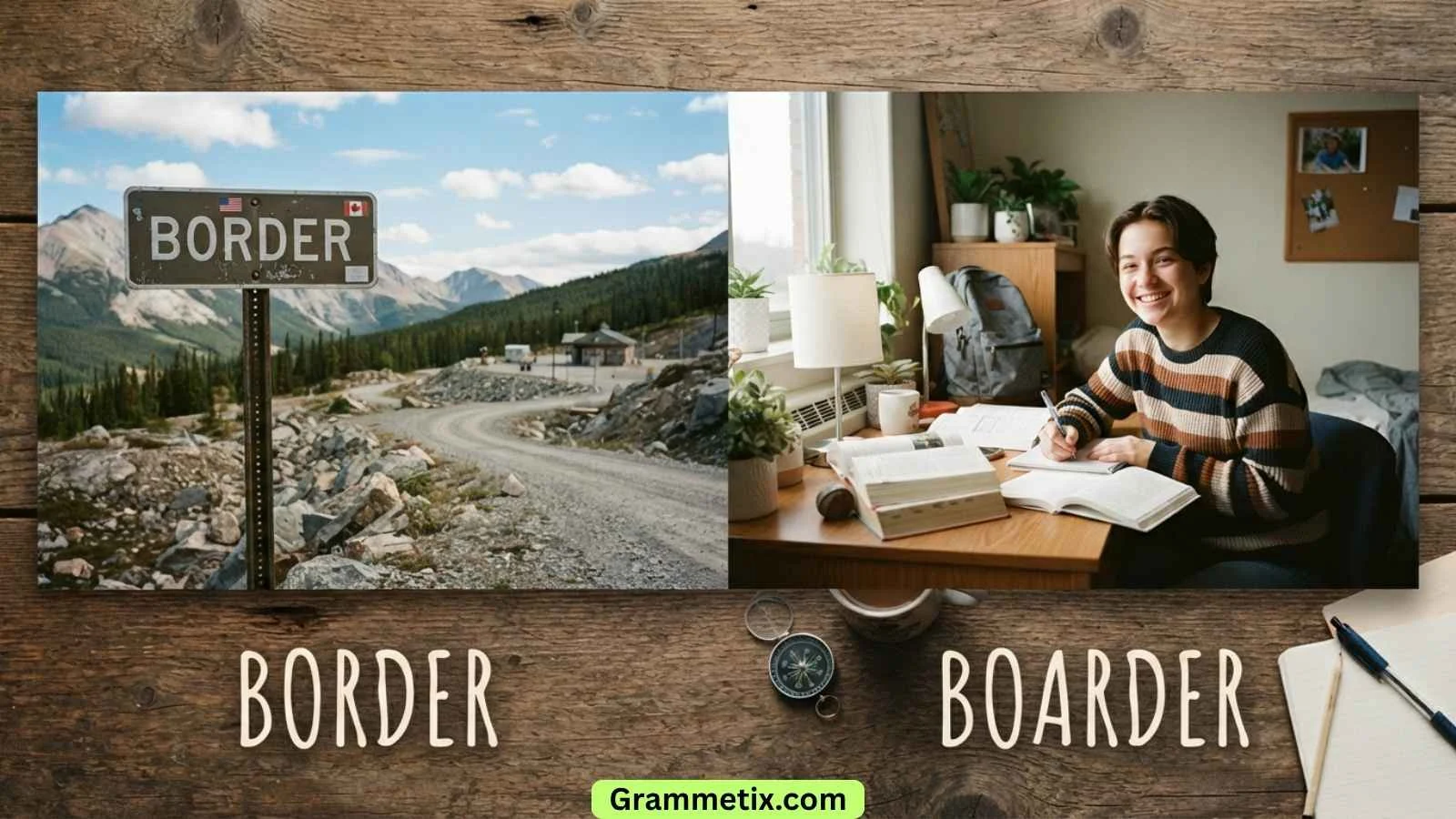
Border and boarder are both correct spellings, but they are used in different contexts. Use border when you are talking about an edge or a boundary, like a country’s border. Use boarder when you are talking about a person who pays to live and eat somewhere, like a student at a boarding school .
Key Difference Between Border or Boarder
The main difference between these two words is their meaning. One is about a place or a line. The other is about a person.
- Border refers to a physical edge or a boundary line .
- Boarder refers to a person who pays for lodging and meals .
- Border can be a noun or a verb. Boarder is always a noun .
- Border relates to geography or design. Boarder relates to people and housing .
Spelling Comparison Table
| Word | Part of Speech | Meaning | Example |
|---|---|---|---|
| Border | Noun or Verb | An edge or boundary line | We crossed the border into Canada. |
| Boarder | Noun | A person who rents a room and gets meals | The old house has one boarder. |
Is Border or Boarder Correct or Incorrect?
Both border and boarder are correct words. Neither is a misspelling of the other . However, a word is only correct if it is used in the right context.
- Using “border” when you mean a person is incorrect.
- Using “boarder” when you mean a boundary is incorrect.
The spelling you choose must match the meaning you want to express . So, it is not about right or wrong spelling, but about using the right word for your situation.
Why Do People Confuse Border or Boarder?
People mix up border and boarder for a few simple reasons. The biggest reason is that they are homophones. This means they sound exactly the same when you say them out loud .
- They Sound the Same: The pronunciation is identical, so it is easy to get confused when writing quickly.
- One-Letter Difference: The words look very similar. The only difference is the “a” in “boarder” . This small visual difference can be missed.
- Not a Common Word: The word “boarder” is less common in everyday conversation today, so many people are less familiar with its spelling .
The Origin of Border or Boarder
The word border comes from an Old French word meaning “a colorful band that goes around a shield” . Over time, it came to mean any edge or boundary.
The word boarder is related to the word “board,” as in a wooden plank . This meaning changed over time. “Board” came to mean a table. If you eat at someone’s table, you are a “boarder” . So, the word’s history is linked to sharing meals at a table.
British English vs American English Spelling
There is a common myth that some words are spelled differently in British and American English (like “color” vs. “colour”). This is not the case for border and boarder.
The spelling and meaning of these words are the same in both British and American English . A border is a boundary in London just as it is in New York. A boarder is someone who pays for room and board in Sydney just as they do in Toronto. This confusion is not about geography, but about word meaning.
Country and Usage Data
| Country | Common Usage of “Border” | Common Usage of “Boarder” |
|---|---|---|
| USA | Boundary between states, e.g., Texas border | Person renting a room, e.g., a college boarder |
| UK | National boundary, e.g., the English border | Student living at a boarding school |
| Australia | Edge or boundary of a property | Someone who pays for a room and meals |
| Canada | Boundary line between provinces or countries | A person living in a boarding house |
Which Spelling Should You Use?
The right spelling depends on who you are writing for and what you are writing about.
For US Audience
Use border for any geographic or physical edge . Use boarder for a person who pays for a room . American readers will expect the correct usage for these clear meanings.
For UK/Commonwealth Audience
The rule is the same. Use border for boundaries . Use boarder for a person, especially in the context of “boarding school” . UK readers will also know the difference.
For Global/SEO Writing
For writing that is meant for an international audience, always choose the word based on your meaning.
- If the topic is a line on a map, use border.
- If the topic is a person renting a room, use boarder.
This clarity will help all your readers understand you perfectly.
How to Pronounce Border or Boarder
Both border and boarder are pronounced exactly the same way.
A simple way to think of it is “BOR-der.” The first part rhymes with “door” or “more,” and the second part sounds like “der.” Because they are homophones, you cannot tell which word someone is using just by hearing it. You must understand the context of the sentence .
Formal vs Informal Usage of Border or Boarder
Academic Writing
In academic writing, both words are used formally. Border is used in geography, history, and political science . Boarder might be used in sociology or historical research about housing or schools. Both are acceptable and formal.
Business Communication
Border is very common in business, especially in logistics and trade. You might discuss border crossing for shipping goods. Boarder is less common in business but might be used if your company manages a property with tenants .
Casual Conversation
In everyday talk, border is a common word. “The garden has a flower border.” Boarder is less common but might be used to describe a roommate situation. “We are getting a boarder to help with the mortgage.”
Common Mistakes with Border or Boarder
1: Using “Boarder” for a Boundary
- Incorrect: “We need a passport to cross the boarder.”
- Correct: “We need a passport to cross the border.”
- Explanation: A country has a boundary, which is a “border” .
2: Using “Border” for a Person
- Incorrect: “The school has many international borders.”
- Correct: “The school has many international boarders.”
- Explanation: The school has students who live there, so they are “boarders” .
3: Using “Boarder” for a Decorative Edge
- Incorrect: “The invitation has a beautiful floral boarder.”
- Correct: “The invitation has a beautiful floral border.”
- Explanation: The edge of the paper has a decorative design, which is a “border” .
Border or Boarder in Everyday Examples
Border in Emails
“Please check the report. The graph’s border should be a solid line, not a dotted one.”
“I will be late for the meeting. There is a long line at the border crossing.”
Boarder in News
“The family decided to take in a boarder to help pay their rising bills.”
“The boarding school has strict rules for all its young boarders.”
Border in Social Media
“Just crossed the border into the Netherlands! #Travel”
“I love the lace border on this vintage tablecloth.”
Boarder in Formal Writing
“The contract states that the boarder is responsible for keeping their room clean.”
“All boarders must be back in the dormitory by 10 p.m.”
Simple Rule to Remember
Here is a simple trick to help you remember the difference. Think about the extra “a” in boarder.
- Border = Boundary. They both start with “B” and have five letters.
- Boarder = A person who eats at a table. Think of the word “board” as a table where people eat. The “a” is for “accommodation” .
Another trick is to remember “room and board.” If you are talking about a person who pays for this, they are a boarder .
Border or Boarder – Google Trends & Usage Data
The word border is much more popular on Google than boarder . This is because “border” is a common word used in news, travel, and politics.
Boarder has a much lower search volume. It is a more specific word. It is most often searched for in the context of “boarding school,” “renting a room,” or “snowboarder.” However, the word “boarder” is also used by skaters and snowboarders .
Related Grammar Terms You Should Know
Here are some other commonly confused words like border and boarder. They are a great topic for your next grammar lesson.
- Complement vs. Compliment
- Principal vs. Principle
- Stationary vs. Stationery
- Advise vs. Advice
- Its vs. It’s
FAQs
Is it “cross the border” or “cross the boarder”?
It is “cross the border.” A border is a boundary line that separates countries or regions. A boarder is a person, and you do not “cross” a person.
Does “boarder” mean the same as “tenant”?
A boarder is a type of tenant, but not all tenants are boarders. A boarder pays for both a room and meals . A tenant usually just pays for a room or apartment without meals.
Is “border” used as a verb?
Yes, border can be a verb. It means to be located next to something else. For example, “Canada borders the United States to the north” .
What does “room and board” mean?
“Room and board” is a phrase that means a place to sleep (room) and food to eat (board). A person who pays for this is a “boarder” .
Can “boarder” refer to a skateboarder?
Yes, in informal use, a boarder can be a short term for a person who rides a skateboard, snowboard, or surfboard . This is another usage for a person.
Is “boarding” related to “border”?
No, boarding is the act of living in a place or getting on a vehicle. It comes from the same root as “boarder.” It is not related to “border,” which is about edges .
What is a “border” in a document?
In a document, a border is a line or decorative design that goes around the edge of the page or a text box . It is a visual edge.
Conclusion
In short, the difference between border and boarder is clear. A border is an edge, a line, or a boundary. Think of a map, a garden, or a decorative line. A boarder is a person. Think of someone who pays to live and eat in a house or a school.
The secret to using these words correctly is knowing the context of your sentence. If you are talking about a place or a line, choose “border.” If you are talking about a person, choose “boarder.”
Remember the simple trick: the extra “a” in “boarder” is for “a person.” Now you have the confidence to use these words correctly every time.