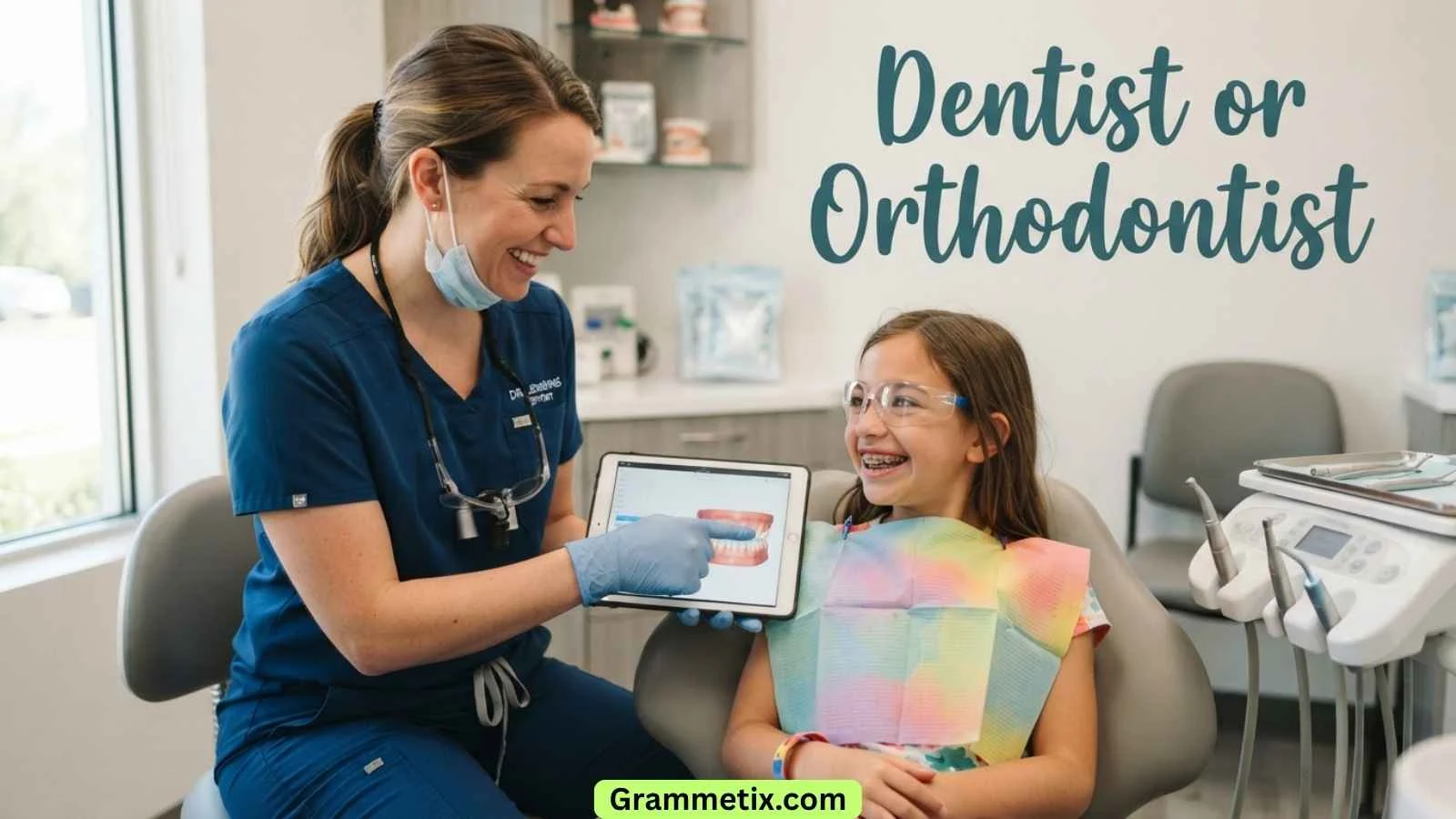
Dentist or orthodontist is a common question for anyone with a dental problem. Many people think these two professionals do the same job. They both care for your teeth, but their work is different.
Choosing the right one can save time, money, and stress. Some problems need a general dentist, while others need an orthodontist with special training.
In this guide, you will learn the simple differences between them. You will also discover who treats braces, crooked teeth, cavities, and other common dental issues.
By the end, you will know exactly which professional to visit.
Dentist or Orthodontist – Quick Answer
A dentist provides general dental care, such as cleanings, fillings, crowns, and cavity treatment. An orthodontist is a dental specialist who fixes crooked teeth and bite problems using braces, clear aligners, and other orthodontic treatments. Visit a dentist for routine care and an orthodontist for teeth alignment.
Key Differences Between a Dentist and an Orthodontist
Although both professionals help improve oral health, their jobs are not the same.
Main Differences
- Dentists provide general dental care for people of all ages.
- Orthodontists specialize in straightening teeth and correcting bites.
- Dentists can detect many dental problems during regular checkups.
- Orthodontists complete several extra years of specialist training.
- Most patients visit a dentist regularly and an orthodontist only when needed.
Dentist or Orthodontist Comparison Table
| Feature | Dentist | Orthodontist |
|---|---|---|
| Main Job | General oral care | Teeth and bite alignment |
| Education | Dental school | Dental school + orthodontic specialty training |
| Treats Cavities | ✅ Yes | ❌ No |
| Performs Teeth Cleaning | ✅ Yes | ❌ No |
| Fits Braces | Sometimes (limited cases) | ✅ Yes |
| Uses Clear Aligners | Some dentists do | ✅ Yes, specialist |
| Treats Gum Disease | ✅ Yes | ❌ No |
| Best For | Regular dental care | Crooked teeth and bite issues |
What Does a Dentist Do?
A dentist is your primary dental healthcare provider. Most people visit a dentist every six months for checkups and cleanings.
Dentists help keep your teeth and gums healthy. They also find problems early before they become serious.
Common Treatments a Dentist Provides
Teeth Cleaning
Dentists remove plaque and tartar from your teeth. This helps prevent cavities and gum disease.
Filling Cavities
If tooth decay creates a hole, a dentist removes the damaged area and fills it with a strong dental material.
Tooth Extractions
Sometimes a damaged tooth cannot be saved. A dentist can safely remove it.
Crowns and Bridges
Dentists restore damaged or missing teeth using crowns, bridges, or other dental restorations.
Root Canal Treatment
When the inside of a tooth becomes infected, a dentist may perform a root canal to save the tooth.
Gum Disease Treatment
Dentists diagnose and treat early gum disease before it becomes more severe.
Preventive Care
Regular checkups, fluoride treatments, sealants, and oral health advice help prevent future dental problems.
Common Reasons to Visit a Dentist
Visit a dentist if you have:
- Tooth pain
- A cavity
- Bleeding gums
- Bad breath
- Broken teeth
- Tooth sensitivity
- Regular dental checkups
- Dental cleaning needs
For most people, the dentist is the first professional to visit for any dental concern.
What Does an Orthodontist Do?
An orthodontist is a dentist who has completed extra specialist training in correcting the position of teeth and jaws.
Their main goal is to improve how your teeth fit together and create a healthy, attractive smile.
Orthodontists treat children, teenagers, and adults.
Common Treatments an Orthodontist Provides
Braces
Traditional metal braces slowly move teeth into better positions.
Ceramic Braces
These braces work like metal braces but blend with the natural tooth color.
Clear Aligners
Clear aligners gradually straighten teeth without using metal brackets.
Bite Correction
Orthodontists fix bite problems such as:
- Overbite
- Underbite
- Crossbite
- Open bite
- Deep bite
Retainers
After braces or aligners, retainers help keep teeth in their new positions.
Jaw Alignment
Some orthodontists also help guide jaw growth in younger patients to improve bite function.
Common Reasons to Visit an Orthodontist
You may need an orthodontist if you have:
- Crooked teeth
- Crowded teeth
- Large gaps
- Bite problems
- Difficulty chewing
- Teeth that do not line up properly
- Speech issues caused by tooth alignment
Many patients are referred to an orthodontist by their regular dentist.
Education and Training Differences
One of the biggest differences between these professionals is their education.
Dentist Education
A dentist completes:
- A bachelor’s degree (required in many countries).
- Four years of dental school.
- Licensing exams before treating patients.
After graduation, they can begin practicing general dentistry.
Orthodontist Education
Every orthodontist starts as a dentist.
After dental school, they complete an additional 2–3 years of advanced orthodontic training.
During this specialist program, they learn how to:
- Move teeth safely
- Correct bite problems
- Plan orthodontic treatments
- Use braces and clear aligners
- Guide jaw development
This extra education makes orthodontists experts in teeth alignment.
Education Comparison Table
| Qualification | Dentist | Orthodontist |
|---|---|---|
| Dental School | ✅ Yes | ✅ Yes |
| Licensed Dentist | ✅ Yes | ✅ Yes |
| Specialist Orthodontic Training | ❌ No | ✅ Yes |
| Expert in Braces | Limited | ✅ Yes |
| Expert in Bite Correction | Limited | ✅ Yes |
| Routine Dental Care | ✅ Yes | ❌ No |
When Should You Visit a Dentist?
A dentist should be your first choice for most dental problems. They help keep your teeth and gums healthy. Regular visits also prevent small problems from becoming bigger ones.
Many dentists can spot issues early and recommend treatment before you feel pain.
Visit a Dentist If You Have:
- Toothache
- A cavity
- Bleeding or swollen gums
- Bad breath that does not go away
- A chipped or broken tooth
- Tooth sensitivity
- Loose fillings or crowns
- Mouth sores
- Regular dental checkups
- Professional teeth cleaning
Most dental experts recommend visiting a dentist every six months for a routine exam and cleaning.
Real-Life Example
Sarah feels pain when eating ice cream. She visits her dentist. The dentist finds a small cavity and fills it before it becomes worse.
When Should You Visit an Orthodontist?
An orthodontist focuses on straightening teeth and fixing bite problems. They improve both the appearance and function of your smile.
You do not need to visit an orthodontist unless you have alignment or bite concerns. Your dentist may also recommend one after a routine checkup.
Visit an Orthodontist If You Have:
- Crooked teeth
- Crowded teeth
- Teeth with large gaps
- An overbite
- An underbite
- A crossbite
- An open bite
- Teeth that overlap
- Difficulty biting or chewing because of tooth position
- Jaw alignment concerns
Real-Life Example
Ahmed notices his front teeth overlap. His dentist refers him to an orthodontist. After treatment with clear aligners, his teeth become straight and easier to clean.
Can a Dentist Do Braces?
The answer is yes, sometimes.
Some general dentists offer braces or clear aligners after receiving additional training. However, orthodontists receive years of extra education that focuses only on moving teeth and correcting bites.
For simple cases, a dentist may provide treatment successfully.
For moderate or complex cases, an orthodontist is usually the better choice.
Who Should Handle Braces?
| Situation | Best Choice |
|---|---|
| Mild spacing | Dentist or Orthodontist |
| Simple clear aligners | Dentist or Orthodontist |
| Crooked teeth | Orthodontist |
| Severe crowding | Orthodontist |
| Bite correction | Orthodontist |
| Jaw alignment problems | Orthodontist |
If you are unsure, begin with your dentist. They can examine your teeth and recommend the right specialist.
Common Dental Problems and Who Treats Them
Many people are unsure which professional to call. This simple guide makes the decision easier.
| Dental Problem | Dentist | Orthodontist |
|---|---|---|
| Cavities | ✅ | ❌ |
| Tooth pain | ✅ | ❌ |
| Gum disease | ✅ | ❌ |
| Teeth cleaning | ✅ | ❌ |
| Root canal | ✅ | ❌ |
| Broken tooth | ✅ | ❌ |
| Crooked teeth | ❌ | ✅ |
| Crowded teeth | ❌ | ✅ |
| Bite problems | ❌ | ✅ |
| Braces | Sometimes | ✅ |
| Clear aligners | Sometimes | ✅ |
| Retainers | ❌ | ✅ |
Easy Rule
If your problem is about tooth health, visit a dentist.
If your problem is about tooth position, visit an orthodontist.
Cost Comparison: Dentist or Orthodontist
The cost depends on your location, treatment, and dental clinic. Routine dental care usually costs much less than orthodontic treatment.
Typical Dentist Costs
| Treatment | Typical Cost |
|---|---|
| Dental exam | Low |
| Teeth cleaning | Low |
| Filling | Low to moderate |
| Crown | Moderate |
| Root canal | Moderate to high |
Routine dental visits are usually affordable and may be covered by dental insurance.
Typical Orthodontic Costs
| Treatment | Typical Cost |
|---|---|
| Orthodontic consultation | Low or sometimes free |
| Metal braces | High |
| Ceramic braces | High |
| Clear aligners | High |
| Retainers | Low to moderate |
Orthodontic treatment often lasts between one and three years, making it a larger investment.
Does Insurance Cover Both?
Many dental insurance plans cover preventive dental care, including:
- Regular checkups
- Teeth cleanings
- X-rays
- Fillings
Orthodontic treatment is different.
Some insurance plans cover part of the cost of braces or aligners, especially for children. Adult orthodontic coverage is less common and depends on your policy.
Always check your insurance benefits before starting treatment.
Can You Visit Both a Dentist and an Orthodontist?
Yes. In fact, many people do.
If you wear braces or clear aligners, you should still visit your dentist for regular cleanings and exams.
The two professionals often work together to keep your smile healthy.
Example
Emma wears braces from her orthodontist. Every six months, she also visits her dentist for a cleaning and cavity check. This keeps her teeth healthy while they are being straightened.
Signs You May Need an Orthodontic Evaluation
You should consider seeing an orthodontist if you notice any of these signs:
- Teeth overlap each other.
- Your bite feels uneven.
- You struggle to chew food.
- Your jaws make clicking sounds when biting.
- Your child loses baby teeth very early or very late.
- Your teeth continue shifting over time.
- You feel unhappy with your smile because of crooked teeth.
Early treatment can sometimes make future treatment easier and shorter.
Dentist or Orthodontist: Which One Should You Choose?
The right choice depends on your dental problem.
If your goal is healthy teeth and gums, visit a dentist. They can treat cavities, clean your teeth, and check for oral diseases.
If your teeth are crooked or your bite feels wrong, an orthodontist is the better choice. They have extra training to move teeth safely and improve your bite.
For many people, the best approach is to see both professionals. Your dentist keeps your mouth healthy, while your orthodontist improves the position of your teeth.
Quick Decision Guide
| Your Problem | Best Professional |
|---|---|
| Toothache | Dentist |
| Cavities | Dentist |
| Teeth cleaning | Dentist |
| Broken tooth | Dentist |
| Gum disease | Dentist |
| Crooked teeth | Orthodontist |
| Crowded teeth | Orthodontist |
| Braces | Orthodontist |
| Clear aligners | Orthodontist |
| Bite problems | Orthodontist |
| Jaw alignment | Orthodontist |
| Unsure about your problem | Dentist first |
A dentist can examine your mouth and refer you to an orthodontist if needed.
Tips for Choosing the Right Professional
Finding the right dental professional is just as important as choosing the right treatment.
Here are a few simple tips.
Check Their Qualifications
Make sure the professional is licensed and qualified.
If you need braces or bite correction, confirm that the provider is an orthodontist.
Read Patient Reviews
Online reviews can help you learn about patient experiences.
Look for comments about friendly staff, clear communication, and successful treatment.
Ask About Experience
Experience matters, especially for orthodontic treatment.
Ask how often they perform the treatment you need.
Understand the Treatment Plan
A good dentist or orthodontist explains:
- Your dental problem
- Available treatment options
- Expected results
- Treatment time
- Estimated costs
You should feel comfortable asking questions before treatment begins.
Compare Costs
Do not choose a provider based only on price.
Quality treatment often saves money by preventing future problems.
FAQs
1. Is an orthodontist better than a dentist?
Not necessarily. They have different jobs. A dentist provides general oral care, while an orthodontist specializes in straightening teeth and correcting bite problems.
2. Should I visit a dentist before an orthodontist?
Yes. A dentist should usually be your first visit. They can check your overall oral health and refer you to an orthodontist if specialized treatment is needed.
3. Can an orthodontist treat cavities?
No. Orthodontists focus on tooth alignment and bite correction. Cavities, gum disease, and tooth infections are treated by dentists.
4. Can adults visit an orthodontist?
Yes. Orthodontic treatment is not only for children and teenagers. Many adults choose braces or clear aligners to improve their smiles and bite.
5. Do I still need a dentist if I wear braces?
Yes. Braces make cleaning teeth more difficult. Regular dental checkups help prevent cavities, gum disease, and other oral health problems during orthodontic treatment.
6. Which professional is more specialized?
An orthodontist is more specialized in tooth movement and bite correction. Every orthodontist is a dentist first, but not every dentist becomes an orthodontist.
Conclusion
Choosing between a dentist and an orthodontist is easier once you understand what each professional does. A dentist helps keep your teeth and gums healthy through regular checkups, cleanings, and treatments for common dental problems.
An orthodontist focuses on straightening teeth and correcting bite issues with braces, clear aligners, and other specialized treatments.
If you are unsure where to start, book an appointment with a dentist. They can examine your teeth, treat general dental concerns, and refer you to an orthodontist if needed.
By choosing the right professional, you can protect your oral health and enjoy a healthier, more confident smile.