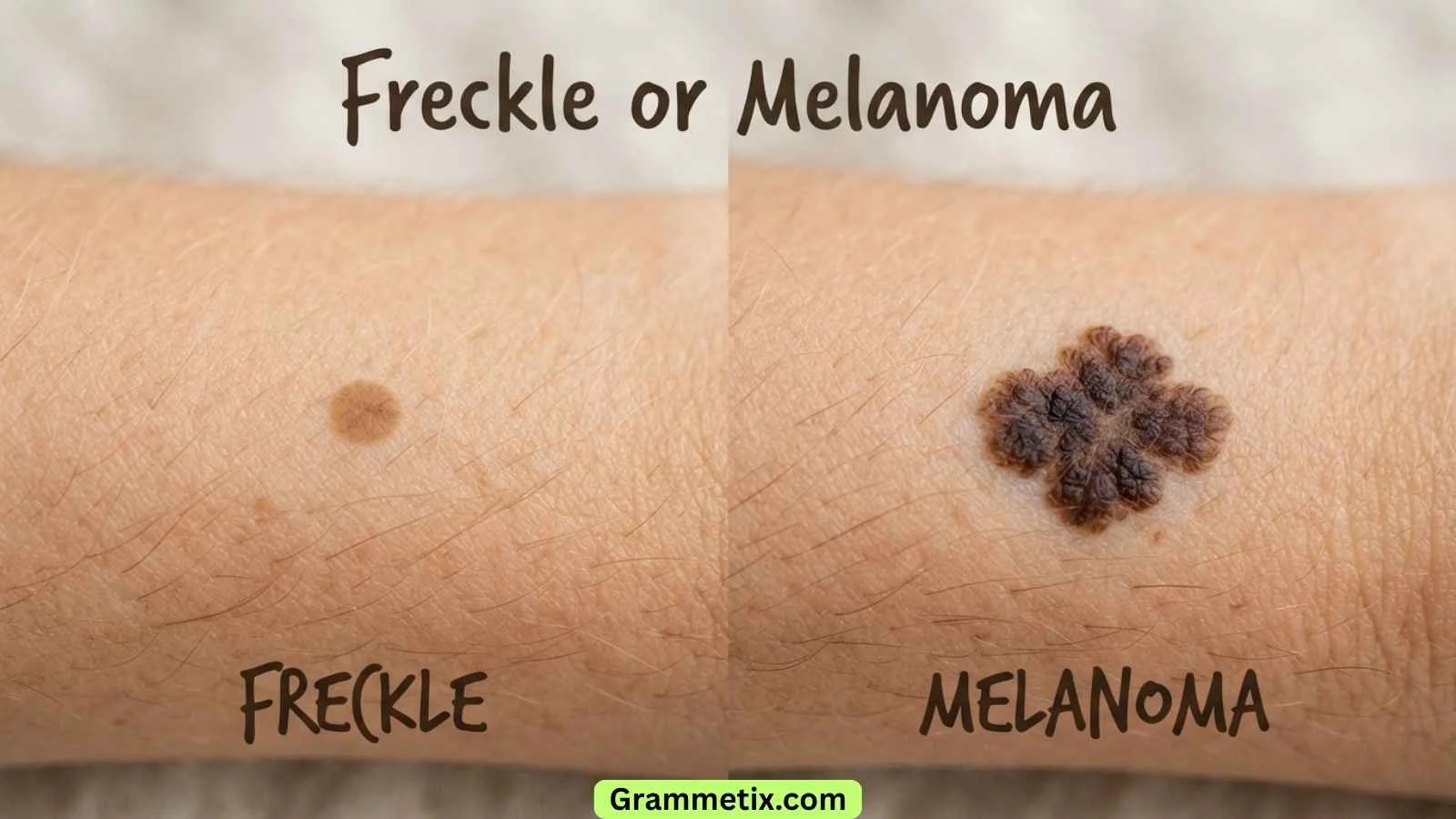
Freckle or melanoma is a question many people ask after finding a new brown spot on their skin. Most freckles are harmless and are simply part of your natural skin. Melanoma, however, is a serious type of skin cancer that needs early treatment.
At first, a freckle and melanoma can look similar. This makes many people feel worried or confused. The good news is that there are clear warning signs you can learn.
Knowing these signs can help you decide when a spot is likely harmless and when it should be checked by a doctor.
In this guide, you will learn what freckles and melanoma are, their key differences, the warning signs of skin cancer, and simple ways to protect your skin. Everything is explained in easy English so anyone can understand it.
Freckle or Melanoma – Quick Answer
A freckle is a small, flat, harmless brown spot caused by extra melanin in the skin. Melanoma is a dangerous form of skin cancer that often changes in color, size, shape, or border. If a spot looks different from your other marks or keeps changing, arrange a medical examination without delay.
Quick Takeaway:
- Freckles are usually harmless.
- Melanoma is a type of skin cancer.
- New or changing spots should always be checked by a healthcare professional.
What Is a Freckle?
A freckle is a small, flat spot that appears on the skin.
It is usually light brown, tan, or dark brown. Freckles develop because certain skin cells produce extra melanin, the natural pigment that gives skin its color.
Freckles are very common. Many people first notice them during childhood. They often become darker in summer because sunlight increases melanin production. During winter, they may fade and become harder to see.
Freckles are not cancer. They are a normal skin feature for millions of people around the world.
Common Features of a Freckle
Most freckles have these features:
- Small and flat
- Light or medium brown
- Smooth, even edges
- One consistent color
- Usually less than 5 millimeters wide
- Often appear in groups
- Become darker after sun exposure
- Usually stay the same shape for many years
Because freckles are harmless, they rarely need treatment.
Where Do Freckles Usually Appear?
Freckles often develop on skin that gets the most sunlight.
Common areas include:
- Face
- Nose
- Cheeks
- Shoulders
- Arms
- Neck
- Upper back
These areas receive more ultraviolet (UV) rays from the sun.
Who Is More Likely to Have Freckles?
Anyone can have freckles, but they are more common in people who have:
- Fair or light-colored skin
- Red or blonde hair
- Blue or green eyes
- A family history of freckles
- Frequent sun exposure
Having freckles does not mean you have skin cancer.
However, people with fair skin should still protect themselves from too much sunlight because UV rays can increase the risk of skin damage.
Do Freckles Change Over Time?
Most freckles remain very similar for years.
Normal changes include:
- Becoming darker during sunny months
- Fading during winter
- Becoming slightly lighter with age
These changes happen because sunlight affects melanin production.
A freckle that suddenly becomes much larger, develops several colors, starts bleeding, or changes shape should be examined by a healthcare professional.
Can New Freckles Appear?
Yes.
New freckles can appear after spending time in the sun, especially during childhood or young adulthood.
People often notice new freckles after:
- Summer vacations
- Outdoor sports
- Beach trips
- Sunny weather
These freckles usually appear slowly rather than overnight.
If you suddenly develop a single dark spot that looks different from your other freckles, it is wise to have it checked.
What Is Melanoma?
Melanoma is a serious type of skin cancer.
It begins in special skin cells called melanocytes. These cells produce melanin, the pigment that gives your skin its natural color.
Unlike freckles, melanoma is dangerous because cancer cells can grow deeper into the skin and spread to other parts of the body if they are not treated early.
The good news is that melanoma is highly treatable when found in its early stages.
That is why doctors encourage everyone to watch for new or changing spots.
What Does Melanoma Look Like?
Melanoma does not always look the same.
It may appear as:
- A new dark spot
- A changing mole
- A patch with several colors
- A raised or flat mark
- A sore that does not heal
- A spot that looks different from every other mole
Some melanomas are brown or black.
Others can be pink, red, white, blue, or even skin-colored.
This is why color alone cannot tell you whether a spot is harmless.
Early Signs of Melanoma
Many melanomas begin with small changes that are easy to miss.
Watch for:
- A spot getting larger
- Uneven edges
- More than one color
- Itching
- Bleeding
- Crusting
- Pain
- A new mole appearing in adulthood
These signs do not always mean cancer.
However, they should never be ignored.
Who Is Most at Risk?
Some people have a higher chance of developing melanoma.
Risk factors include:
- Fair skin
- Frequent sunburns
- Heavy UV exposure
- Using tanning beds
- A family history of melanoma
- Having many moles
- A weakened immune system
- Previous skin cancer
Having one or more risk factors does not mean you will get melanoma.
It simply means regular skin checks are especially important.
Why Early Detection Matters
Melanoma is one of the most treatable skin cancers when found early.
If it spreads deeper into the body, treatment becomes more difficult.
Learning the warning signs and checking your skin every month can help you notice changes sooner.
Even if a spot turns out to be harmless, getting it examined provides peace of mind.
Expert Tip: Dermatologists recommend becoming familiar with your own skin. If you notice a spot that is new, changing, or unlike your other freckles or moles, arrange a professional skin examination rather than trying to diagnose it yourself.
Key Differences Between a Freckle and Melanoma
At first glance, a freckle and melanoma may seem alike. Both can appear as brown or dark spots on the skin. However, there are several important differences.
A freckle is usually harmless and stays the same over time. Melanoma is a type of skin cancer that often changes as it grows.
Learning these differences can help you know when a spot should be checked by a healthcare professional.
Quick Comparison
| Feature | Freckle | Melanoma |
|---|---|---|
| What is it? | A harmless pigmented skin spot | A serious type of skin cancer |
| Color | Usually one shade of brown | May have two or more colors |
| Shape | Round or oval | Often uneven or irregular |
| Border | Smooth and clear | Ragged, blurry, or uneven |
| Size | Usually small | May grow over time |
| Change over time | Usually stays the same | Often changes in color, shape, or size |
| Pain or itching | Rare | Sometimes itchy, painful, or tender |
| Bleeding | No | May bleed or crust |
| Medical attention | Usually not needed | Should be checked as soon as possible |
Quick Tip: If a spot is changing, do not assume it is “just a freckle.” Arrange a skin examination.
Freckle vs. Melanoma at a Glance
Here are the biggest differences:
- Freckles are harmless.
- Melanoma is skin cancer.
- Freckles usually have one even color.
- Melanoma may have several colors.
- Freckles keep the same shape.
- Melanoma often changes over time.
- Freckles have smooth edges.
- Melanoma often has uneven borders.
These differences make melanoma easier to recognize, but only a healthcare professional can make a diagnosis.
Can Melanoma Look Like a Freckle?
Yes.
Early melanoma can sometimes look like a small brown freckle. This is one reason melanoma is difficult to spot in its early stages.
Some melanomas begin as:
- A tiny brown dot
- A flat dark mark
- A spot that looks like a new freckle
- A mole that slowly changes
This is why doctors recommend paying attention to change, not just appearance.
A spot that keeps growing or changing deserves medical attention.
Why People Mistake Melanoma for a Freckle
Many people delay seeing a doctor because melanoma may seem harmless at first.
Common reasons include:
- It starts small.
- It may not hurt.
- It can be flat.
- It may look similar to nearby freckles.
- It develops slowly in some people.
Never rely only on appearance to decide whether a spot is safe.
The “Ugly Duckling” Sign
Dermatologists often use something called the Ugly Duckling Sign.
The idea is simple.
Most of your freckles and moles probably look similar.
If one spot looks very different from all the others, it deserves attention.
For example:
- It is much darker.
- It is much lighter.
- It is larger.
- It has an unusual shape.
- It keeps changing while your other spots stay the same.
Even if it does not match every melanoma warning sign, an “ugly duckling” spot should be examined.
Can a Freckle Turn Into Melanoma?
This is one of the most common questions people ask.
The answer is:
A normal freckle does not usually turn into melanoma.
Freckles are simply areas with extra pigment.
They are not cancer.
However, melanoma can:
- Develop near a freckle.
- Appear where a freckle already exists.
- Look very similar to a freckle during its early stages.
Because of this, it is important to watch for changes.
When Should You Be Concerned?
Most freckles remain harmless throughout life.
You should arrange a skin examination if a spot:
- Grows quickly
- Changes color
- Develops uneven edges
- Starts bleeding
- Becomes painful
- Begins itching without a clear reason
- Looks very different from your other spots
These changes do not always mean melanoma.
However, they should always be checked.
Common Signs That Suggest a Harmless Freckle
A freckle is more likely to be harmless if it:
- Has one even color
- Is flat
- Has smooth borders
- Does not itch
- Does not bleed
- Stays the same size
- Has been there for years
Many people have freckles like these throughout their lives.
Common Signs That Suggest Melanoma
Melanoma often has one or more warning signs.
These include:
- Several colors in one spot
- A changing shape
- Uneven or blurry borders
- Rapid growth
- Bleeding
- Crusting
- Persistent itching
- A sore that does not heal
One sign alone does not confirm melanoma.
The more warning signs present, the more important it is to seek medical advice.
What If You Are Not Sure?
It is normal to feel unsure.
Many harmless freckles can look unusual.
Likewise, some melanomas appear very small and simple.
If you cannot tell the difference, do not try to diagnose yourself using internet photos.
Instead:
- Take a clear photo of the spot.
- Note today’s date.
- Watch for changes.
- Arrange an appointment with a dermatologist or healthcare professional.
A professional skin examination is the safest way to know whether a spot is harmless.
Risk Factors Comparison
Some people are more likely to develop freckles, while others have a higher risk of melanoma.
| Freckles Are More Common In | Melanoma Risk Is Higher In |
|---|---|
| Fair skin | Fair skin |
| Red or blonde hair | Frequent sunburns |
| Children | Heavy UV exposure |
| Family history of freckles | Family history of melanoma |
| Regular sun exposure | Tanning bed users |
| Young people | People with many moles |
Having freckles does not mean you will develop melanoma.
However, protecting your skin from UV rays is important for everyone.
The ABCDE Rule for Spotting Melanoma
The ABCDE Rule is one of the easiest ways to check your skin for possible signs of melanoma.
It does not diagnose skin cancer. Instead, it helps you notice changes that should be checked by a healthcare professional.
Many dermatologists recommend using this rule during monthly skin checks.
A – Asymmetry
A harmless freckle or mole is often even on both sides.
With melanoma, one half may look different from the other.
Healthy Spot
- Round or oval
- Both sides look similar
Warning Sign
- One side is larger
- One side has a different shape
Example:
Imagine folding the spot in half.
If the two sides do not match, it needs attention.
B – Border
Look closely at the edges.
Freckles usually have smooth, clear borders.
Melanoma often has uneven edges.
Healthy Border
- Smooth
- Easy to see
- Well defined
Warning Border
- Ragged
- Blurry
- Notched
- Uneven
If the edge looks irregular, arrange a skin examination.
C – Color
Most freckles have one even shade of brown.
Melanoma often contains several colors.
These may include:
- Light brown
- Dark brown
- Black
- Red
- White
- Blue
- Pink
The more color changes you see, the more important it is to have the spot checked.
D – Diameter
Many melanomas grow larger over time.
Doctors often use 6 millimeters as a guide.
This is about the size of a pencil eraser.
However, remember:
Some melanomas are smaller than 6 mm.
Do not ignore a small spot if it is changing.
E – Evolving
This is often the most important warning sign.
Ask yourself:
- Has it changed color?
- Has it grown?
- Has the border changed?
- Does it itch?
- Does it bleed?
- Has it become raised?
A changing spot deserves medical attention, even if it is small.
Remember the ABCDE Rule
| Letter | What to Look For |
|---|---|
| A | Asymmetry |
| B | Uneven Border |
| C | Multiple Colors |
| D | Diameter growing or unusual size |
| E | Evolving or changing |
If you notice one or more of these signs, arrange a professional skin examination.
The Ugly Duckling Sign
The ABCDE Rule is very helpful.
However, dermatologists also use another simple method called the Ugly Duckling Sign.
The idea is easy.
Most of your freckles and moles look similar.
If one spot looks very different from the rest, it may need attention.
For example, imagine you have twenty small light-brown freckles.
Then one new spot appears that is:
- Much darker
- Much larger
- Different in shape
- Different in color
That unusual spot is called the Ugly Duckling.
It should be checked by a healthcare professional.
How to Check Your Skin at Home
A monthly skin check only takes a few minutes.
It can help you notice changes early.
1: Stand in Good Lighting
Natural daylight works best.
Use a full-length mirror if possible.
2: Check Your Entire Body
Look at:
- Face
- Neck
- Chest
- Arms
- Hands
- Legs
- Feet
- Back
- Scalp
- Behind your ears
Ask someone to help with hard-to-see areas.
3: Look for Changes
Ask yourself:
- Is this spot new?
- Has it changed?
- Does it look different from my other spots?
Take your time.
4: Take Photos
Photos make it easier to compare spots over time.
Use the same lighting whenever possible.
Do not rely on memory alone.
5: Contact a Healthcare Professional
If you notice anything unusual, book an appointment.
It is always better to check early than wait.
When Should You See a Doctor?
Many skin spots are harmless.
Still, some warning signs should never be ignored.
Arrange a medical examination if you notice:
- A new mole after adulthood
- A spot that changes quickly
- Bleeding
- Crusting
- Persistent itching
- Pain
- A sore that does not heal
- Several colors in one spot
- Rapid growth
- A spot that looks very different from your others
Even if the spot turns out to be harmless, getting it checked can provide reassurance.
How Doctors Diagnose Melanoma
If your doctor is concerned about a spot, several simple steps may follow.
Skin Examination
The doctor first looks closely at the spot.
They also examine nearby skin.
Dermatoscope Examination
A dermatologist may use a dermatoscope.
This handheld tool magnifies the skin.
It helps reveal details that are difficult to see with the naked eye.
Skin Biopsy
If the spot looks suspicious, the doctor may remove part or all of it.
This is called a biopsy.
The sample is sent to a laboratory.
A specialist examines the cells under a microscope.
This is the only way to confirm whether melanoma is present.
Additional Tests
If melanoma is confirmed, more tests may be needed.
These help determine:
- Whether the cancer has spread
- How deep it is
- The best treatment
Not everyone needs additional testing.
It depends on the stage of the melanoma.
Who Has a Higher Risk of Melanoma?
Anyone can develop melanoma.
However, some people have a higher risk.
Fair Skin
People with lighter skin have less natural protection from UV rays.
Frequent Sunburns
Repeated sunburns increase skin damage over time.
Too Much UV Exposure
Long hours in strong sunlight increase risk.
Outdoor workers should use sun protection every day.
Tanning Beds
Artificial UV light is also harmful.
Avoid tanning beds whenever possible.
Family History
Your risk may be higher if a close family member has had melanoma.
Tell your doctor about your family history.
Many Moles
People with a large number of moles have a greater chance of developing melanoma.
Regular skin checks become even more important.
Weakened Immune System
Some medical conditions and treatments reduce the body’s ability to fight abnormal cells.
These people may need more frequent skin examinations.
Quick Checklist: Do You Need a Skin Check?
Answer Yes or No.
- Do you have a new spot?
- Has a mole changed recently?
- Does a spot itch or bleed?
- Does one spot look different from all the others?
- Have you had several serious sunburns?
- Do you use tanning beds?
- Do you have many moles?
- Has anyone in your close family had melanoma?
If you answered Yes to one or more questions, consider arranging a skin examination with a qualified healthcare professional.
Melanoma Treatment Options
If melanoma is found early, treatment is often very successful.
The right treatment depends on:
- How deep the melanoma is
- Whether it has spread
- Your overall health
- Your doctor’s advice
The earlier melanoma is treated, the better the outcome.
1. Surgery
Surgery is the most common treatment for early melanoma.
A doctor removes the melanoma along with a small area of healthy skin around it. This helps lower the chance of cancer cells remaining.
For many people with early-stage melanoma, surgery is the only treatment needed.
2. Immunotherapy
Immunotherapy helps your immune system find and destroy cancer cells.
Doctors often recommend it when melanoma has spread or has a higher risk of returning.
Not everyone needs immunotherapy. Your doctor will decide if it is right for you.
3. Targeted Therapy
Some melanomas have specific gene changes.
Targeted therapy uses medicines that attack cancer cells with these changes while causing less damage to healthy cells.
Testing the melanoma helps doctors decide whether this treatment is suitable.
4. Radiation Therapy
Radiation uses high-energy rays to destroy cancer cells.
It may be used when:
- Surgery cannot remove all the cancer
- Melanoma has spread
- Cancer returns after treatment
Radiation is not needed for every patient.
5. Chemotherapy
Chemotherapy is used less often today because newer treatments are available.
However, it may still be helpful in certain situations.
Your healthcare team will explain the best treatment plan for your condition.
Can Melanoma Be Cured?
Yes.
When melanoma is found early and removed before it spreads, many people are treated successfully.
This is why checking your skin regularly is so important.
Waiting too long allows melanoma more time to grow.
Early action can make a big difference.
How to Help Prevent Melanoma
You cannot prevent every case of melanoma.
However, you can lower your risk with simple daily habits.
Wear Sunscreen Every Day
Choose a broad-spectrum sunscreen with SPF 30 or higher.
Apply it to exposed skin before going outside.
Reapply every two hours, especially after swimming or sweating.
Stay Out of Strong Midday Sun
The sun’s rays are strongest between 10 a.m. and 4 p.m.
Whenever possible:
- Stay in the shade.
- Plan outdoor activities earlier or later.
- Use an umbrella at the beach or park.
Wear Protective Clothing
Covering your skin provides extra protection.
Good choices include:
- Long-sleeved shirts
- Long trousers
- Wide-brimmed hats
- UV-blocking sunglasses
Protective clothing works together with sunscreen.
Avoid Tanning Beds
Tanning beds expose your skin to harmful ultraviolet (UV) light.
Even one session can increase your risk of skin damage.
A natural skin tone is healthier than a tan from UV exposure.
Protect Children From the Sun
Children’s skin is especially sensitive.
Help them by:
- Applying sunscreen
- Wearing hats
- Encouraging shade during peak sunlight
- Dressing them in protective clothing
Healthy sun habits started early can last a lifetime.
Monthly Skin Self-Check Checklist
Checking your skin once a month helps you notice changes sooner.
Use this simple checklist.
- Check your face.
- Look behind your ears.
- Examine your scalp with a mirror or ask for help.
- Check your neck and shoulders.
- Look at your chest and stomach.
- Examine your back using a mirror.
- Examine your back using a mirror.
- Check both arms and hands.
- Look between your fingers.
- Check your legs and feet.
- Look between your toes.
- Check the soles of your feet.
- Examine areas that rarely see the sun.
If you notice anything new or changing, arrange a medical examination.
Everyday Examples
These examples show how the words freckle and melanoma are used in everyday life.
In Everyday Conversation
“My freckles always become darker during summer.”
“My doctor examined a changing spot to rule out melanoma.”
In a Medical Clinic
“The dermatologist measured the mole before deciding on a biopsy.”
“The healthcare professional explained the ABCDE warning signs.”
In the News
“Doctors encourage regular skin checks to help detect melanoma early.”
“Health experts remind people to use sunscreen during hot weather.”
On Social Media
“I booked a skin check because one spot looked different.”
“Don’t ignore a changing mole. Early detection matters.”
In Schools
“Students learned why sunscreen helps protect skin.”
“The science class discussed how UV rays damage skin.”
Common Myths About Freckles or Melanoma
Many myths cause unnecessary worry.
Let’s separate facts from fiction.
1: Every Brown Spot Is Melanoma
Fact:
Most brown spots are harmless freckles, moles, or sunspots.
Only a medical examination can determine whether a spot is melanoma.
2: Melanoma Always Hurts
Fact:
Many melanomas are painless, especially in the early stages.
Do not wait for pain before seeing a healthcare professional.
3: Only Older Adults Get Melanoma
Fact:
Melanoma can develop at almost any age.
Although it becomes more common with age, younger adults can also be affected.
4: People With Dark Skin Cannot Get Melanoma
Fact:
People of every skin color can develop melanoma.
The risk may differ, but no one is completely protected.
5: If a Spot Is Small, It Cannot Be Cancer
Fact:
Some melanomas are very small when they first appear.
Small does not always mean harmless.
6: Internet Photos Can Diagnose Skin Cancer
Fact:
Online images can help you learn, but they cannot confirm a diagnosis.
Only a qualified healthcare professional can determine whether a spot is melanoma.
Practical Sun Safety Tips
These simple habits protect your skin every day.
- Wear sunscreen all year, not only in summer.
- Reapply sunscreen after swimming.
- Wear sunglasses with UV protection.
- Avoid getting sunburned.
- Drink plenty of water during hot weather.
- Check your skin every month.
- Teach children healthy sun habits.
- Book regular skin checks if you have many moles or a family history of melanoma.
Small habits today can protect your skin for years to come.
FAQs
1. How can I tell if a freckle is melanoma?
It is not always possible to tell by looking alone. A harmless freckle usually stays the same size, shape, and color. Melanoma often changes over time and may have uneven borders or several colors. If you notice a changing spot, arrange a skin examination with a qualified healthcare professional.
2. Can melanoma look exactly like a freckle?
Yes. Early melanoma can sometimes look like a small brown freckle. This is why doctors recommend watching for changes instead of judging a spot by its appearance alone.
3. Can a freckle become melanoma?
A normal freckle does not usually turn into melanoma. However, melanoma can develop near a freckle or resemble one in its early stages. Any new or changing spot should be checked.
4. Are freckles dangerous?
No. Freckles are a normal skin feature caused by extra melanin. They are usually harmless and do not require treatment.
5. Does melanoma always have many colors?
No. Some melanomas have several colors, while others may have only one. This is why doctors look at all the warning signs, including changes in size, shape, and border.
6. Can children get melanoma?
Melanoma is uncommon in children, but it can happen. Parents should protect children’s skin from too much sun and have unusual or changing spots checked by a healthcare professional.
7. Should I remove a harmless freckle?
Most freckles do not need treatment. Some people choose cosmetic removal for personal reasons, but it is important to have a healthcare professional examine the spot first to make sure it is harmless.
8. When should I see a dermatologist?
You should arrange an appointment if a spot:
- Changes in size, shape, or color
- Bleeds or crusts
- Itches or becomes painful
- Looks different from your other freckles or moles
- Appears suddenly in adulthood and seems unusual
Early evaluation can provide reassurance or allow treatment to begin promptly if needed.
Quick Summary Table
| Freckle | Melanoma |
|---|---|
| Harmless skin spot | Serious skin cancer |
| Usually one color | May have several colors |
| Smooth borders | Uneven borders |
| Rarely changes | Often changes over time |
| Usually no treatment needed | Requires prompt medical assessment |
Related Topics You May Also Like
To learn more about skin health, you may find these topics helpful:
- Mole vs. Melanoma
- Skin Cancer Symptoms
- Basal Cell Carcinoma
- Squamous Cell Carcinoma
- ABCDE Rule for Moles
- Sunspots vs. Freckles
- How to Check Your Skin at Home
- Best Ways to Prevent Skin Cancer
These related articles can help readers understand skin conditions and support your site’s internal linking strategy.
Key Takeaways
Before you leave, remember these important points:
- A freckle is usually harmless.
- Melanoma is a serious type of skin cancer.
- The biggest warning sign is change.
- Use the ABCDE Rule every month.
- Watch for the Ugly Duckling Sign.
- Protect your skin from UV rays.
- Do not diagnose yourself using online photos.
- When in doubt, have the spot checked by a healthcare professional.
Trusted Health Sources
The information in this guide follows widely accepted medical advice from organizations such as:
- American Academy of Dermatology (AAD)
- American Cancer Society (ACS)
- National Health Service (NHS)
- Skin Cancer Foundation
- World Health Organization (WHO)
These organizations recommend regular skin awareness, sun protection, and prompt medical evaluation of suspicious or changing skin spots.
Conclusion
Knowing the difference between a freckle and melanoma can help you make informed decisions about your skin health.
Most freckles are harmless, stay the same over time, and are simply caused by extra melanin. Melanoma, however, is a serious form of skin cancer that often changes in size, shape, color, or border.
The most important message is simple: pay attention to change. Learn the ABCDE Rule, look for the Ugly Duckling Sign, and perform a monthly skin self-check. These habits only take a few minutes but can help you notice problems early.
With the right knowledge and regular skin checks, you can feel more confident about recognizing normal freckles while knowing when it is time to seek medical advice.
Medical Disclaimer
This article is intended for educational purposes only and should not be used to diagnose or treat any medical condition. If you notice a new, changing, bleeding, or unusual skin spot, consult a qualified healthcare professional or dermatologist as soon as possible. Early diagnosis and treatment offer the best chance of successful outcomes for melanoma.