Do you freeze every time you type “its” or “it’s”? You are not alone. This is one of the most common grammar mistakes in the English language, and millions of people search for “its or it’s” every single month.
Why? Because these two tiny words sound exactly the same when we speak, but they have completely different jobs in writing. One shows possession, and the other is a shortcut for “it is” or “it has.”
The confusion is understandable. English has many exceptions to its own rules, and this is one of the trickiest. Maybe you learned the rule in school but forgot it over time. Maybe you have seen other people use “it’s” for possession and assumed it was correct.
In this article, I will show you exactly when to use “its” and when to use “it’s.” I will explain the rule in plain English, share the history behind these words, and give you real-life examples from emails, news, social media, and formal writing.
Let us dive in and finally put this confusion to rest.
Its or It’s – Quick Answer
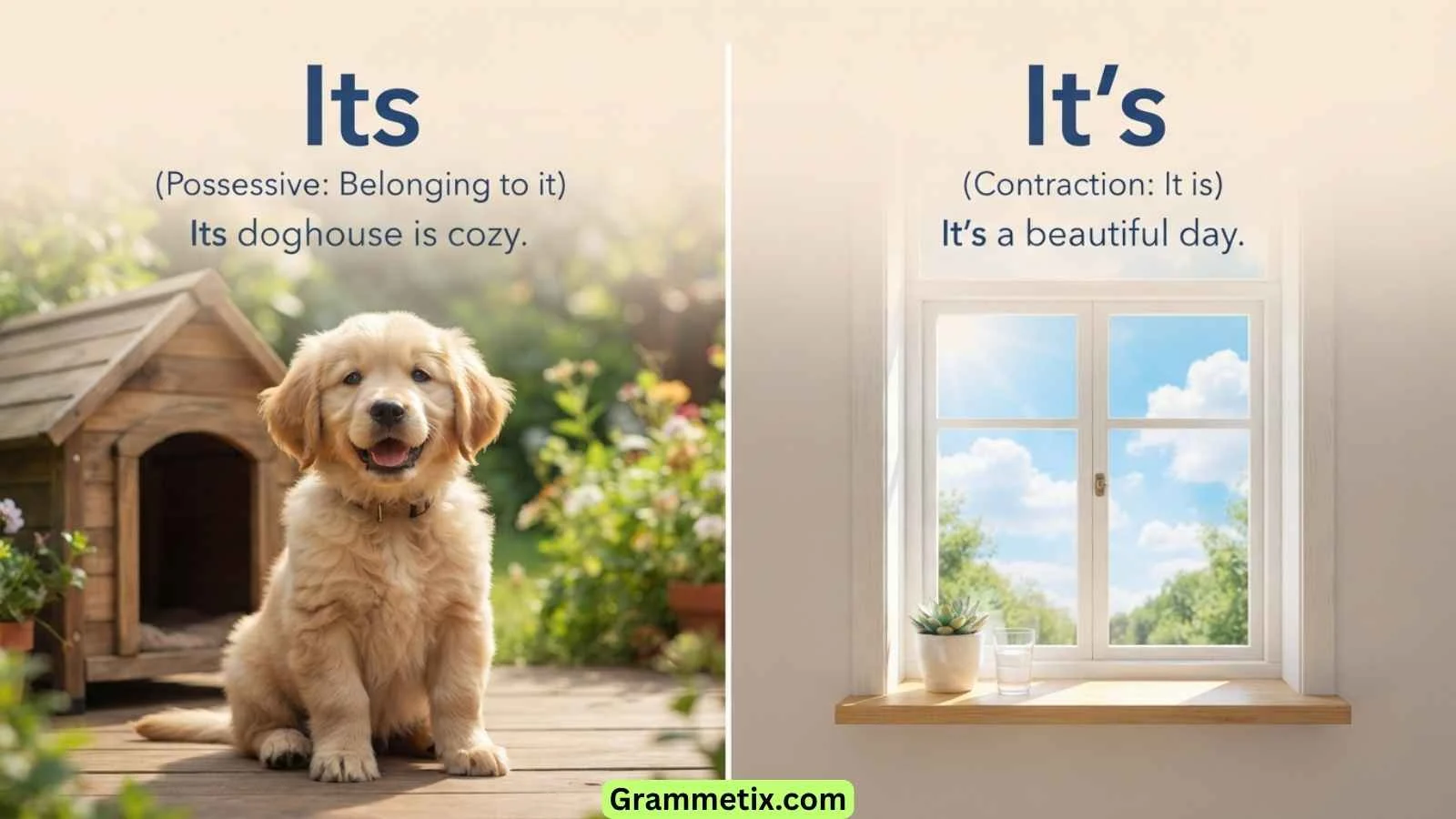
Use it’s when you mean “it is” or “it has.” Use its when you mean “belonging to it.”
- ✅ It’s raining outside. (It is raining.)
- ✅ The dog wagged its tail. (The tail belongs to the dog.)
Key Difference Between Its and It’s
Here is the simple difference in plain English:
- It’s is a shortcut. It combines two words: “it” and “is” or “it” and “has.” The apostrophe (‘) shows that a letter is missing. Think of it like “don’t” (do not) or “can’t” (cannot).
- Its is a possessive word. It shows that something belongs to “it.” It works like “his” (belongs to him) or “her” (belongs to her). No apostrophe is needed.
Here is a comparison table to make it crystal clear:
| Its (Possessive – Belonging to It) | It’s (Contraction – Short for It Is or It Has) |
|---|---|
| No apostrophe | Has an apostrophe |
| Like “his” or “her” | Like “don’t” or “can’t” |
| Shows ownership | Shows a shortened form |
| The cat licked its paw. | It’s a beautiful day. |
| The tree lost its leaves. | It’s been a long week. |
| The company increased its profits. | It’s time to go home. |
Is “Its” or “It’s” Correct or Incorrect?
Both spellings are 100% correct in English. The key is using the right one in the right place. You cannot say one is always wrong because both are valid words with different jobs.
Think of it like “there” and “their.” Both are correct, but they have different meanings. The same rule applies to “its” and “it’s.”
The mistake happens when you use the wrong one. For example:
- ❌ “The dog wagged it’s tail.” (Wrong – you mean possession, not “it is”)
- ✅ “The dog wagged its tail.” (Correct)
If you use the correct form based on your meaning, you are always right.
Why Do People Confuse “Its” and “It’s”?
This confusion is very common. Here are the main reasons:
1. They Sound Exactly the Same
When you speak, both words sound identical (pronounced “its”). You cannot hear the difference. This means many people learn the spoken word first and never think about the spelling rule.
2. The Possession Rule is Confusing
In English, we usually add an apostrophe and “s” to show possession. For example:
- “The dog’s bowl” (the bowl belongs to the dog)
- “My mother’s car” (the car belongs to my mother)
So people naturally think “it’s” shows possession too. But “its” is an exception to this rule. This trips up even native speakers.
3. Native Speakers Make This Mistake Often
I have seen this error in professional emails, news articles, and even books. When you see it so often, you start to think both forms are acceptable. They are not, but the confusion spreads.
4. School Lessons Are Often Forgotten
Many people learn the rule in elementary school. But they forget it over time because they do not use it daily. When they need to write, they guess and hope for the best.
The Origin of “Its” and “It’s” – A Brief History
Understanding the history helps you remember the rule.
Where Did “It’s” Come From?
“It’s” is a contraction. Contractions have been part of English for over 1,000 years. People have always looked for ways to speak faster. “It is” became “it’s” by dropping the “i” in “is” and adding an apostrophe to show the missing letter. The same happened with “it has” → “it’s.”
Where Did “Its” Come From?
Old English had a word “his” that meant “belonging to it.” Over time, this changed. By the 1500s, “its” appeared as the possessive form of “it.” It followed the pattern of other possessive pronouns like “my,” “your,” and “her.” These words never use apostrophes.
The Key to Remembering
Possessive pronouns (my, your, his, her, our, their, its) never use apostrophes. Contractions (don’t, can’t, won’t, it’s) always use apostrophes. “Its” is a possessive pronoun, so no apostrophe.
British English vs American English – Is There a Difference?
Good news: There is no spelling difference between British and American English for these words. Both “its” and “it’s” are spelled the same way everywhere. The rules for using them are identical in all English-speaking countries.
However, there is a small style difference:
| Writing Style | British English | American English |
|---|---|---|
| Formal writing | Avoids contractions more often | Uses contractions more freely |
| Business writing | May prefer “it is” for formality | Accepts “it’s” in most emails |
| Academic writing | Strongly avoids contractions | Also avoids contractions, but less strict |
| Casual writing | Uses “it’s” freely | Uses “it’s” freely |
The rule itself never changes. You just need to decide if “it’s” is appropriate for your tone.
Which Spelling Should You Use?
For US Audience
Use it’s when you mean “it is” or “it has.” Use its for possession. This is the standard rule in all American English writing. In casual emails, “it’s” is very common. In formal reports, write “it is” instead.
For UK/Commonwealth Audience
The rule is exactly the same. Use it’s for “it is” or “it has.” Use its for possession. British English has no special exceptions. In very formal British writing (like academic papers), avoid “it’s” and write “it is” or “it has.”
For Global/SEO Writing
Use the correct form based on the meaning you want. Search engines and readers worldwide will understand you. The rule is universal. For global audiences, clarity matters most. Avoid “it’s” in very formal or technical content. Use “it is” to be safe.
How to Pronounce “Its” and “It’s”
Both words sound exactly the same when you speak. There is no difference in pronunciation at all.
- Phonetic spelling: /ɪts/ (International Phonetic Alphabet)
- Simple rhyme: Like “hits,” “bits,” “fits,” or “sits”
- Tip: Say “hits” but drop the “h.” That is exactly how both words sound.
You cannot tell the difference when someone speaks. You must know the meaning from the sentence. This is why the spelling rule is so important for writing.
Formal vs Informal Usage of “Its” and “It’s”
In Academic Writing
Most professors and journals prefer you to avoid contractions. So instead of “it’s,” write “it is” or “it has.” For example:
- ❌ “It’s clear from the data…” (Too informal for a research paper)
- ✅ “It is clear from the data…” (Better for academic writing)
You still use “its” for possession because there is no alternative. For example:
- ✅ “The study showed its limitations.” (Correct and formal)
In Business Communication
Business emails are less formal than academic papers. Using “it’s” is usually fine and makes your tone friendly. However, in formal business reports or legal documents, use “it is” to sound professional.
- ✅ “It’s a pleasure to work with your team.” (Friendly email)
- ✅ “The contract requires its final approval.” (Formal document)
In Casual Conversation
In texts, social media, and friendly emails, use “it’s” freely. It sounds natural and conversational. The rule for “its” remains the same.
- ✅ “It’s my birthday today!” (Text message)
- ✅ “My phone lost its charge.” (Social media post)
A Simple Rule for Formality
If you are unsure, write “it is” instead of “it’s.” This is always safe. You can never be wrong with “it is.” But you must still use “its” correctly for possession.
Common Mistakes with “Its” and “It’s”
1: Using “it’s” for Possession
- ❌ Incorrect: The cat licked it’s paw.
- ✅ Correct: The cat licked its paw.
- Why: You mean the paw belongs to the cat. “It’s” means “it is” or “it has,” which does not fit here.
2: Using “its” as a Contraction
- ❌ Incorrect: Its a nice day outside.
- ✅ Correct: It’s a nice day outside.
- Why: You mean “it is” a nice day. “Its” shows possession, which does not fit.
3: Using “its'” (With an Apostrophe at the End)
- ❌ Incorrect: The company increased its’ profits.
- ✅ Correct: The company increased its profits.
- Why: The word “its'” does not exist in English. The possessive form is always “its” with no apostrophe.
4: Forgetting the Rule in Long Sentences
- ❌ Incorrect: The committee announced its decision, and its expected to be final.
- ✅ Correct: The committee announced its decision, and it’s expected to be final.
- Why: The first “its” shows possession (the decision belongs to the committee). The second “it’s” means “it is” (the decision is expected to be final). Two different meanings in one sentence.
5: Overusing “it’s” in Formal Writing
- ❌ Incorrect: The experiment proved it’s effectiveness.
- ✅ Correct: The experiment proved its effectiveness. (Or: The experiment proved it is effective.)
- Why: “It’s” is a contraction and is too informal for many formal contexts. Also, the first example is grammatically wrong because you need possession, not “it is.”
“Its” and “It’s” in Everyday Examples
In Emails
Imagine you are writing to a colleague:
“I am happy to say it’s a good time to review the proposal. Please send the report with its final numbers by Friday.”
Here, “it’s” means “it is” (it is a good time). “Its” shows possession (the numbers belong to the report).
In News Headlines
News writers use both forms frequently:
“The city announced its new policy on recycling today. It’s expected to reduce waste by 20%.”
The first “its” shows the policy belongs to the city. The second “it’s” means “it is” (it is expected).
In Social Media
On Twitter or Facebook, you might see:
“It’s my birthday! 🎉 My phone already lost its charge from all the calls.”
The first is a contraction for “it is.” The second shows the charge belongs to the phone.
In Formal Writing
In an academic essay, you might write:
“The study presents its findings in Chapter 3. It is important to note that the sample size was small.”
Here, “its” shows the findings belong to the study. “It is” is used instead of “it’s” to maintain a formal tone.
In a Book or Novel
Authors use both naturally:
“The old house creaked. It’s been empty for years. The roof had lost its shingles in the last storm.”
The first is a contraction for “it has.” The second shows the shingles belonged to the roof.
Simple Rules to Remember
1: The “It Is” or “It Has” Test
Read your sentence out loud. Replace “its” or “it’s” with “it is” or “it has.” If the sentence still makes sense, use it’s. If it sounds wrong, use its.
- “The dog wagged it is tail.” ❌ (Makes no sense. Use “its.”)
- “It is raining outside.” ✅ (Makes sense. Use “it’s.”)
2: The “His” or “Her” Test
Try replacing the word with “his” or “her.” If it fits, use its.
- “The dog wagged his tail.” ✅ (Fits. Use “its.”)
- “His raining outside.” ❌ (Does not fit. Use “it’s.”)
3: The Apostrophe is a “Missing Letter” Signal
The apostrophe in “it’s” always means a letter is missing. If you do not mean “it is” or “it has,” do not use the apostrophe. Simple as that.
4: Create a Mental Picture
Picture a cat with its paw. Imagine a speech bubble above the cat saying, “It’s my paw.” The speech bubble uses the contraction. The paw itself belongs to the cat, so it is “its paw.” This mental image helps you separate the two.
“Its” and “It’s” – Google Trends & Real Usage Data
According to Google Trends data (2024-2025), searches for “its vs it’s” are consistently high in English-speaking countries. The United States leads in search volume, followed by the United Kingdom, Canada, and Australia.
| Country | Monthly Search Volume (Estimated) | Common Usage |
|---|---|---|
| United States | 150,000+ | Both forms used equally |
| United Kingdom | 50,000+ | Both forms used equally |
| Canada | 30,000+ | Both forms used equally |
| Australia | 25,000+ | Both forms used equally |
| India | 60,000+ | Both forms used equally |
The data shows that confusion is global. Most people search for the rule right before they write something important. This guide gives you the answer instantly.
Related Searches People Also Ask
- “Its vs it’s rule”
- “Its or it’s grammar”
- “Difference between its and it’s”
- “How to use its and it’s correctly”
- “Its vs it’s examples”
Related Grammar Terms You Should Know
1. Your vs. You’re
Like “its” and “it’s,” this is a possessive vs. contraction confusion. “Your” shows ownership (“Your book”). “You’re” is short for “you are” (“You’re welcome”). The rule is the same: if you can say “you are,” use “you’re.”
2. There vs. Their vs. They’re
- There shows a place (“The book is over there.”)
- Their shows possession (“Their house is big.”)
- They’re is a contraction for “they are” (“They’re coming over.”)
3. Possessive Pronouns
These show ownership and never use apostrophes: my, your, his, her, its, our, their. Remember this group, and you will never misuse “its.”
4. Contractions
These are shortened forms of words. They always use apostrophes to show missing letters: don’t (do not), can’t (cannot), won’t (will not), it’s (it is/it has). Think of the apostrophe as a flag that says, “A letter is missing here.”
5. Homophones
Words that sound the same but have different meanings and spellings. “Its” and “it’s” are homophones. Others include “there/their/they’re” and “your/you’re.”
FAQs
What is the difference between its and it’s?
The difference is about meaning. “Its” shows that something belongs to a thing or animal. For example: “The cat licked its paw.” “It’s” is a short form of “it is” or “it has.” For example: “It’s raining” means “It is raining.” The apostrophe in “it’s” shows missing letters.
When should I use “its”?
You use “its” to show that something belongs to something else. Always think of “his” or “her.” If you can replace it with “his” and it makes sense, use “its.” For example, “The tree lost its leaves” works because “The tree lost his leaves” also makes sense.
When should I use “it’s”?
You use “it’s” as a short form for “it is” or “it has.” Try saying “it is” or “it has” in your sentence. If it sounds correct, use “it’s.” For example, “It’s been a long day” means “It has been a long day.”
Why does “its” not have an apostrophe?
Possessive pronouns like “his,” “her,” and “its” never use apostrophes. Only contractions use apostrophes. The apostrophe in “it’s” shows that a letter is missing. Since “its” is a possessive pronoun and not a contraction, it has no apostrophe.
Is “it’s” ever used for possession?
No, never. “It’s” is only a contraction for “it is” or “it has.” It is never used to show possession. This is one of the most common grammar mistakes, so always double-check your writing.
How can I remember the difference quickly?
Use the “it is” test. If you can say “it is” or “it has” in your sentence, use “it’s.” If it does not make sense, use “its.” Another trick: remember that possessive pronouns (like his, her, its) never need apostrophes.
What is the correct spelling in British English?
Both “its” and “it’s” are spelled the same in British and American English. The rules for using them are also the same. The only difference is that British English tends to avoid contractions in very formal writing more than American English does.
Why do so many people get this wrong?
People get confused because the words sound the same, the possession rule is tricky, and many native speakers make mistakes. Also, the rule is often taught in elementary school and forgotten over time. You are not alone, and this guide will help you remember.
Can I use “its'” in any situation?
No. The word “its'” does not exist in English. It is always incorrect. Some people add an apostrophe at the end by mistake, but you should never do this. The possessive form is always “its” with no apostrophe.
What if I am still unsure after reading this?
If you are still unsure, write “it is” or “it has” instead of “it’s.” This is always safe. For possession, always use “its” with no apostrophe. You cannot go wrong with these two guidelines.
Conclusion:
Let us recap everything you have learned. It’s (with an apostrophe) is a contraction. It is short for “it is” or “it has.” Its (without an apostrophe) is a possessive word. It shows that something belongs to “it.” The two are not interchangeable, and using the wrong one is a common mistake.
Now you have four simple ways to remember:
- Try “it is” or “it has” in your sentence. If it fits, use it’s.
- Try “his” or “her” in your sentence. If it fits, use its.
- Remember that possessive pronouns never use apostrophes.
- The apostrophe always means a letter is missing.
The next time you write an email, a report, or a social media post, you will know exactly which word to use. You will write with confidence. You will never second-guess yourself again.
Now go write something amazing. It’s your time to shine, and its rewards will follow.