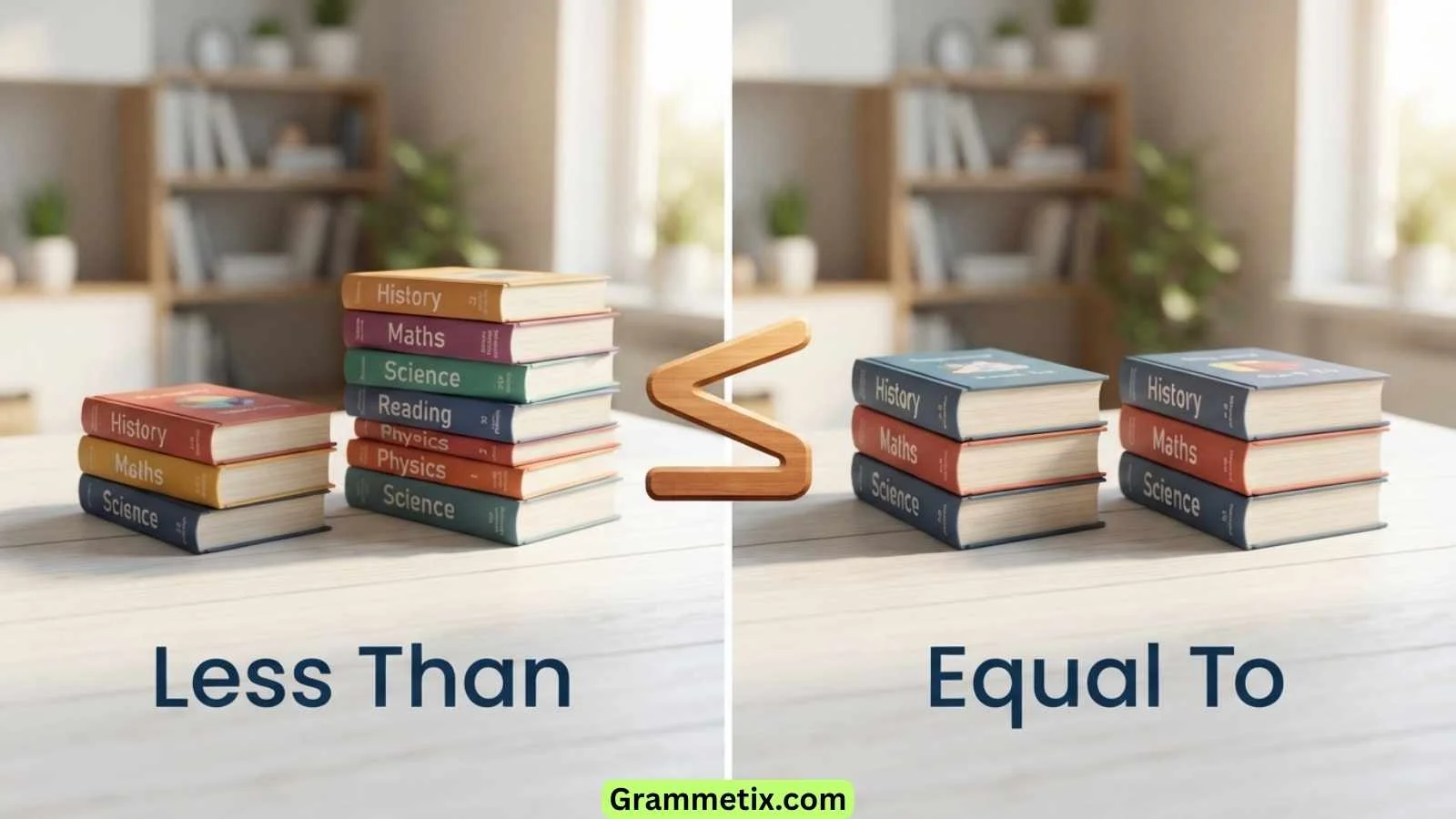
Less than or equal to is one of the most common math comparison terms. It helps us compare two values quickly.
Many beginners understand “less than” but get confused by the extra line. Others see ≤, <, or <= and wonder whether they mean the same thing.
This guide makes the difference simple. You will learn exactly what less than or equal to means. You will also learn how to read the ≤ symbol, compare it with <, and use it in real-life examples.
We will also explain phrases like “at most” and “no more than.” Finally, you will see how <= works in programming. By the end, you should be able to recognize and use this term with confidence.
Less Than or Equal To – Quick Answer
Less than or equal to means one value is smaller than another, or exactly the same. Its math symbol is ≤. For example, x ≤ 10 means x can be 10, 9, 8, or any smaller value. In many programming languages, <= represents the same comparison.
Key Difference Between Less Than or Equal To
The easiest way to understand this term is by comparing symbols.
- < means less than only.
- = means exactly equal.
- ≤ means less than or equal to.
- ≥ means greater than or equal to.
- <= is a common typed form in programming.
The key difference is simple: ≤ includes equality. That extra horizontal line tells you the two values may be equal.
| Symbol | Meaning | Example | Is equality allowed? |
|---|---|---|---|
< | Less than | 4 < 8 | No |
= | Equal to | 8 = 8 | Yes |
≤ | Less than or equal to | 8 ≤ 8 | Yes |
> | Greater than | 8 > 4 | No |
≥ | Greater than or equal to | 8 ≥ 8 | Yes |
Look at These Three Examples
3 ≤ 7 is true because 3 is smaller than 7.
7 ≤ 7 is also true because both values are equal.
9 ≤ 7 is false because 9 is greater than 7.
This gives us the main rule:
Less than or equal to means smaller OR equal.
That is why x ≤ 5 can include 5. It can also include every value below 5.
Is Less Than or Equal To Correct or Incorrect?
Less than or equal to is correct and standard math wording. It is used to describe the mathematical symbol ≤. An inequality compares values using relationships such as less than, greater than, or equality.
There is no special British spelling here. American and British English use the same phrase.
You may see three different forms:
Written phrase: less than or equal to
Math symbol: ≤
Programming form: <=
These forms are not competing spellings. They are different ways of representing the same comparison.
For example:
The temperature must be less than or equal to 20°C.
You could write the same idea in math as:
Temperature ≤ 20°C
In programming, you may see:
temperature <= 20
So the correct form depends on the setting.
Why Do People Confuse Less Than or Equal To?
The confusion usually comes from seeing different symbols and phrases.
British vs American English
Unlike words such as colour and color, this phrase has no major spelling difference.
British writers use:
less than or equal to
American writers use:
less than or equal to
The symbol ≤ is also the same in both settings.
Internet and Global Exposure
Students now see math, coding, and online lessons together.
A school website may use ≤. A coding tutorial may use <=. A simple article may write the words in full.
The forms look different, but the main idea stays the same.
Education Differences
Teachers may introduce words first. Others may introduce the symbols first.
That can make beginners think the expressions have different meanings. They do not.
For example:
x ≤ 12
and:
x is less than or equal to 12
express the same basic relationship.
The Origin of Less Than or Equal To
Mathematical symbols developed to make comparisons faster and easier to write. The modern < and > signs became established in the seventeenth century. Thomas Harriot’s work is commonly credited with introducing these inequality signs in their modern sense.
The ≤ symbol adds an equality bar to the less-than sign. This makes the meaning clear: the value can be smaller, but equality is also allowed.
The extra line is therefore very useful. Compare:
x < 5
with:
x ≤ 5
The first excludes 5. The second includes 5.
This small line changes the result.
How to Pronounce Less Than or Equal To
The phrase is pronounced:
less than or equal to
A simple guide is:
LESS-than-or-EE-kwuhl-too
The wording does not change between British and American English.
The symbol ≤ is normally read aloud as:
less than or equal to
For example:
x ≤ 10
can be read as:
“x is less than or equal to ten.”
You can also read it as:
“x is at most ten.”
Both readings explain the same basic limit.
Formal vs Informal Usage of Less Than or Equal To
Academic Writing
The full phrase is common in lessons and explanations.
Example:
The value must be less than or equal to 50.
In equations, the symbol is usually shorter:
x ≤ 50
Business Communication
Business writing often uses simpler language.
Instead of:
The order must contain less than or equal to 50 items.
A natural sentence could be:
The order can contain 50 items or fewer.
The second version may be easier for general readers.
Casual Conversation
People rarely say the full phrase in daily speech.
They often say:
10 or less
or:
up to 10
For beginner math, however, the full phrase remains useful. It connects everyday language with the mathematical symbol.
Common Mistakes with Less Than or Equal To
1: Thinking ≤ Means Only Less Than
Incorrect example:
x ≤ 10 means x must be below 10.
Correct example:
x ≤ 10 means x can be 10 or below.
Explanation:
The equality bar means 10 is included.
2: Using < When Equality Is Allowed
Incorrect example:
x < 10 when x can equal 10.
Correct example:
x ≤ 10
Explanation:
The symbol < does not include the matching value.
3: Mixing Up ≤ and ≥
Incorrect example:
x ≥ 5 means x is 5 or less.
Correct example:
x ≤ 5 means x is 5 or less.
Explanation:
The two symbols point in opposite directions.
4: Forgetting the Programming Form
Incorrect example:
Writing ≤ directly when the code needs <=.
Correct example:
age <= 18
Explanation:
Programming languages often use typed keyboard characters. In JavaScript, for example, <= returns true when the left value is less than or equal to the right value.
5: Thinking “At Most” Means Less Than Only
Incorrect example:
At most 10 means below 10.
Correct example:
At most 10 means 10 or less.
Explanation:
The maximum value is included.
Less Than or Equal To in Everyday Examples
In Emails
A workplace email may say:
Please keep the file size at 10 MB or less.
A technical email could write:
File size ≤ 10 MB.
The first version is more natural for general readers.
In News
News reports often use everyday wording.
For example:
Visitors must be 12 years old or younger.
That means the same basic idea as:
Age ≤ 12
Clear wording helps readers understand limits quickly.
In Social Media
Social posts often use short phrases.
For example:
Tickets are available for people 18 or younger.
A math post could write:
Age ≤ 18
Both forms show the same limit.
In Formal Writing
Formal writing may use either words or symbols.
Example:
The temperature must remain less than or equal to 25°C.
In a technical report, you might see:
Temperature ≤ 25°C
The best choice depends on the audience.
Simple Rule to Remember
Remember these three rules:
- < means smaller only.
- = means exactly the same.
- ≤ means smaller or the same.
Here is another useful trick:
The small point faces the smaller value.
For example:
3 ≤ 8
The pointed side faces 3. The open side faces 8.
Also remember:
≤ = less than + equal to
So when you see the extra line, equality is allowed.
A Quick Number-Line Idea
For x ≤ 4, the number 4 is included. Values smaller than 4 are included too. A number-line graph uses a closed point at 4 when showing that the endpoint belongs to the solution.
Less Than or Equal To – Google Trends & Usage Data
Search interest for this topic is mainly tied to math education, homework, symbols, and programming.
However, exact Google Trends scores should not be treated like fixed search-volume numbers. Google explains that Trends normalizes results by time and location. The scores show relative search interest, not a direct count of searches.
That matters when comparing countries. A trend score from one place should be read within its selected time and location settings.
| Country or Region | Common Form | Main Search Context |
|---|---|---|
| United States | less than or equal to / ≤ | School math, homework |
| United Kingdom | less than or equal to / ≤ | School math, exams |
| Canada | less than or equal to / ≤ | Math and education |
| Australia | less than or equal to / ≤ | Education and math |
| Global programming | <= | Coding and software |
There is no meaningful US-versus-UK spelling split here. The phrase stays the same in both forms of English.
For SEO research, compare related searches such as:
less than or equal to
less than or equal to symbol
what does ≤ mean
<= meaning
Google Trends supports comparing several search terms and filtering by location.
Because trend data changes over time, exact rankings should be checked for the date and country you are targeting.
Related Terms You Should Know
This topic connects to several useful math and language terms.
Less Than
< means one value is smaller than another.
Example:
3 < 8
Greater Than
> means one value is larger than another.
Example:
8 > 3
Greater Than or Equal To
≥ means a value is larger or exactly equal.
Example:
x ≥ 10
Equal To
= means two values have the same value.
Example:
5 = 5
Inequality
An inequality compares values using symbols such as <, >, ≤, and ≥. These symbols show how two values relate to each other.
At Most
At most 10 means:
10 or less
So it can be written as:
x ≤ 10
No More Than
No more than 10 also means:
10 or less
This phrase often appears in word problems.
FAQs
What does ≤ mean?
The symbol ≤ means less than or equal to. The value can be smaller than the other value, or exactly the same.
What is the difference between < and ≤?
< means less than only. ≤ means less than or equal to, so the second value can also be included.
Does less than or equal to include the number?
Yes. Equality is included. For example, x ≤ 10 allows x to equal 10.
How do you read ≤?
You normally read ≤ as “less than or equal to.” You may also read x ≤ 10 as “x is at most 10.”
What does <= mean?
In programming, <= is commonly used for the less-than-or-equal comparison. In JavaScript, it returns true when the left value is less than or equal to the right value.
Is ≤ the same as less than or equal to?
Yes. ≤ is the standard mathematical symbol for the phrase less than or equal to. The words and symbol express the same relationship.
What does “at most” mean in math?
At most means the stated number is the maximum allowed value. Therefore, “at most 20” means 20 or less, which can be written as x ≤ 20.
Conclusion
Less than or equal to means a value is smaller than another value or exactly the same. Its standard math symbol is ≤. The key difference from < is simple: ≤ includes equality.
For example, x ≤ 10 allows 10, 9, 8, and every smaller value. The same idea may appear in everyday phrases such as “10 or less,” “at most 10,” or “no more than 10.” In programming, you will often see <= instead of the math symbol.
Remember one rule: the extra line under the less-than sign means equality is allowed. Once you understand that line, the whole concept becomes much easier.