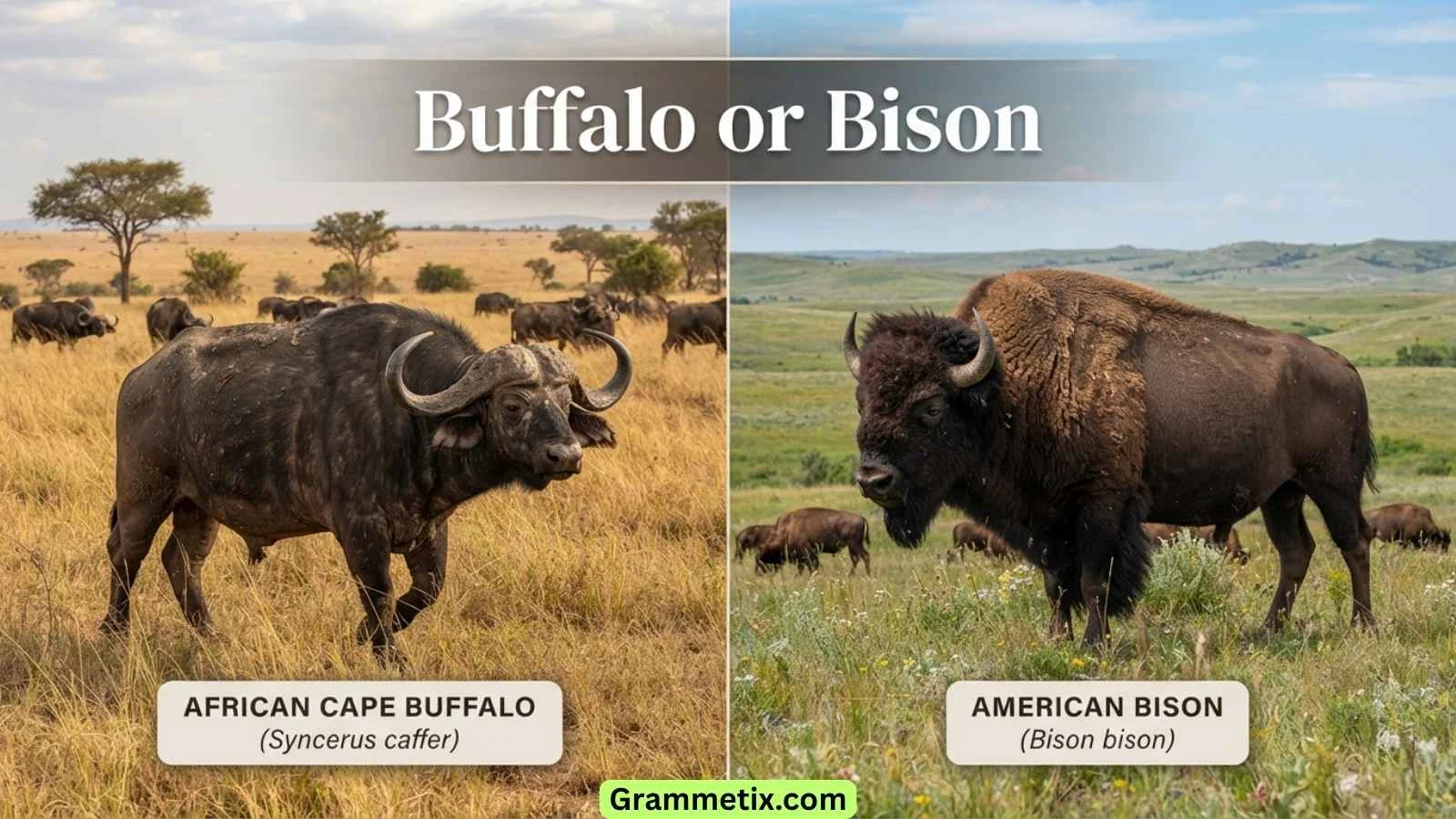
Buffalo or bison is a question many people ask because these animals look very similar. You may hear someone call a large wild animal a buffalo, while another person calls it a bison.
This can make things confusing. Movies, books, sports teams, and even maps often use the names differently. So, which one is correct?
The truth is simple. Buffalo and bison are not the same animal. They belong to the same family but are different species with different homes, bodies, and behaviors.
In this guide, you will learn the key differences, where each animal lives, how to tell them apart, and which name you should use in everyday conversation and formal writing.
Buffalo or Bison – Quick Answer
A bison is a large wild mammal found mainly in North America and Europe. A buffalo lives naturally in Africa and Asia. Although many people call the American bison a “buffalo,” the correct scientific name is American bison.
Key Differences Between Buffalo and Bison
Here are the easiest ways to tell them apart:
- Bison have a large shoulder hump.
- Buffalo have long, curved horns.
- Bison have thick shaggy fur.
- Buffalo have smoother, thinner coats.
- Bison live mainly in North America and Europe.
- Buffalo are native to Africa and Asia.
| Feature | Bison | Buffalo |
|---|---|---|
| Native Region | North America and Europe | Africa and Asia |
| Shoulder Hump | Large hump | No hump |
| Fur | Thick and shaggy | Short and smooth |
| Horns | Short, curved horns | Long, wide-curving horns |
| Climate | Cold grasslands and forests | Warm grasslands and wetlands |
| Common Species | American bison, European bison | African buffalo, Water buffalo |
Are Buffalo and Bison the Same Animal?
No. Buffalo and bison are different animals.
They belong to the same animal family called Bovidae, which also includes cattle, goats, and sheep. Even though they are related, they are separate species with different physical features and natural habitats.
The confusion comes from history. Early European settlers called the American bison “buffalo” because it reminded them of buffalo they had seen elsewhere. That nickname became popular and is still widely used today.
Scientists, wildlife experts, and national parks use the name bison because it is the correct biological term.
Why Do People Confuse Buffalo or Bison?
Many factors have kept this mix-up alive for hundreds of years.
One reason is history. Early explorers gave the American bison the wrong name, and people continued using it.
Movies about the American West often talk about “buffalo hunters” or “buffalo herds.” These animals were actually bison.
Sports teams also add to the confusion. For example, some teams use “Buffalo” in their names even though the mascot may represent a bison.
Schools sometimes teach both names, which can leave students wondering which one is right.
The internet also spreads both terms, making it easy to think they mean exactly the same thing.
In everyday conversation, most people understand either word. However, scientific and educational sources prefer the correct name, bison, for the North American species.
The Origin of the Names
The names buffalo and bison have different histories. Learning where they came from helps explain why people still confuse them today.
Where Did the Word “Bison” Come From?
The word bison comes from Latin and Greek words used for large wild cattle. Scientists later chose this name for the animals found in North America and Europe.
Today, bison is the official scientific name used in books, museums, schools, and national parks.
Where Did the Word “Buffalo” Come From?
The word buffalo entered English through French and Portuguese. It originally referred to animals living in Africa and Asia, such as the African buffalo and the water buffalo.
These animals are different from bison, even though they belong to the same animal family.
How Did the Mix-Up Begin?
When European explorers arrived in North America, they saw large animals that reminded them of buffalo. They started calling them “buffalo” instead of “bison.”
The nickname became popular and appeared in stories, maps, and everyday speech. Even today, many Americans still say “buffalo” when they are talking about the American bison.
Physical Differences Between Buffalo and Bison
At first glance, buffalo and bison may look alike. If you look closer, you will notice several clear differences.
Shoulder Hump
The easiest way to identify a bison is its large shoulder hump. This hump is made of powerful muscles that help the animal push through deep snow and carry its heavy head.
Buffalo do not have this large hump. Their backs are much flatter.
Fur
Bison have thick, shaggy fur, especially around the head, neck, and shoulders. This heavy coat keeps them warm during cold winters.
Buffalo have shorter, smoother hair because they live in warmer climates.
Horn Shape
Buffalo usually have long, wide-curving horns. African buffalo often have thick horns that meet in the middle of the head.
Bison have shorter, sharper horns that curve upward.
Head Size
A bison has a very large head with a broad forehead. Its face looks wide and powerful.
A buffalo’s head is smaller in proportion to its body and has a smoother shape.
Body Shape
Bison are heavier in the front because of their shoulder hump. Their bodies slope downward toward the back.
Buffalo have a more even body shape from front to back.
Beard
Many bison have a long beard under their chin. This is one of their most noticeable features.
Most buffalo do not have a beard.
Size and Weight
Both animals are large and strong.
An adult American bison can weigh up to 2,000 pounds (900 kilograms).
African buffalo usually weigh between 1,000 and 1,900 pounds (450–860 kilograms).
Water buffalo can also become very large, especially domesticated males.
| Physical Feature | Bison | Buffalo |
|---|---|---|
| Shoulder Hump | Large and noticeable | None |
| Fur | Thick and shaggy | Short and smooth |
| Beard | Usually present | Usually absent |
| Horns | Short and curved upward | Long and wide-curving |
| Front Body | Heavy and muscular | More balanced |
| Best Climate | Cold regions | Warm regions |
Where Do Buffalo or Bison Live?
Although they are related, buffalo and bison live on different continents.
American Bison
The American bison lives mainly in the United States and Canada.
You can find wild herds in places like Yellowstone National Park and protected grasslands. They prefer open plains, prairies, and valleys where they can graze on grass.
European Bison
The European bison, also called the wisent, lives in parts of Eastern and Central Europe.
Many herds live in protected forests because the species nearly disappeared in the past.
African Buffalo
The African buffalo lives across many parts of sub-Saharan Africa.
It prefers grasslands, forests, and areas close to rivers or lakes. These buffalo are known for living in large herds and can be very protective.
Water Buffalo
Water buffalo are common across Asia. They are found in countries such as India, Pakistan, China, Thailand, and Vietnam.
Many farmers keep water buffalo because they help plow fields and provide milk, meat, and hides. They enjoy wetlands, rivers, and muddy areas that help keep them cool.
Types of Buffalo and Types of Bison
There are only a few main species, but each has unique features.
American Bison
The American bison is the largest land mammal in North America. It has thick fur, a large hump, and a massive head. Today, conservation efforts have helped increase its population.
European Bison
The European bison is slightly taller than the American bison but usually has a less noticeable shoulder hump. It lives mostly in protected forests.
African Buffalo
The African buffalo is famous for its strength and curved horns. It is one of Africa’s best-known wild animals and is often seen on safari.
Water Buffalo
The water buffalo has been domesticated for thousands of years. It plays an important role in farming throughout Asia and is valued for its hard work and milk production.
Which Name Should You Use?
Using the correct name is easy once you know where the animal lives and what species it is.
When Writing About North America
Use American bison when talking about the large wild animal found in the United States and Canada. This is the correct scientific name used by wildlife experts, schools, and national parks.
Example:
- The American bison is the national mammal of the United States.
- We watched a herd of bison in Yellowstone National Park.
When Talking About Africa
Use African buffalo when referring to the wild buffalo that lives across Africa.
Example:
- African buffalo often travel in large herds.
- The safari guide pointed out several buffalo near the river.
When Talking About Asia
Use water buffalo for the animals commonly raised on farms across Asia.
Example:
- Farmers use water buffalo to help work in rice fields.
- Water buffalo provide milk in many countries.
In Everyday Conversation
Many people still say buffalo when they mean the American bison. Most listeners understand what is meant.
However, if you want to be accurate, especially in writing or education, choose bison for the North American species.
In School or Scientific Writing
Always use the correct animal name.
- American bison for North America
- European bison for Europe
- African buffalo for Africa
- Water buffalo for Asia
Using the proper name makes your writing clearer and more trustworthy.
Common Mistakes
Calling Every Bison a Buffalo
Incorrect:
We saw buffalo in Yellowstone National Park.
Correct:
We saw bison in Yellowstone National Park.
Explanation:
Yellowstone is home to American bison, not true buffalo.
Thinking Buffalo Have Thick Shaggy Fur
Incorrect:
African buffalo have thick shaggy coats like bison.
Correct:
African buffalo have shorter, smoother coats.
Explanation:
The thick fur belongs to bison because they live in colder climates.
Assuming They Live Together
Incorrect:
Buffalo and bison naturally live in the same places.
Correct:
They naturally live on different continents.
Explanation:
Bison are native to North America and Europe, while buffalo are native to Africa and Asia.
Buffalo or Bison in Everyday Examples
In School Assignments
“The American bison once roamed the Great Plains in huge numbers.”
In Wildlife Articles
“Scientists continue to protect wild bison populations across North America.”
In News Reports
“Conservation groups celebrated another successful bison release into protected grasslands.”
In Casual Conversations
“I thought we saw buffalo, but they were actually bison.”
In Travel Guides
“Visitors often come to Yellowstone hoping to see wild bison.”
Simple Rule to Remember
You do not need to memorize many facts. Just remember these simple rules.
- Big shoulder hump = Bison
- Thick shaggy fur = Bison
- Africa or Asia = Buffalo
- North America or Europe = Bison
Easy Memory Trick
Think of this sentence:
“Big hump, think bison. Warm wetlands, think buffalo.”
This simple trick helps you choose the correct name every time.
Buffalo or Bison – Google Trends & Search Popularity
The word buffalo is searched more often than bison. This is mainly because many Americans grew up calling the American bison a buffalo. Cities, sports teams, restaurants, and businesses also use the word “buffalo,” making it even more familiar.
The word bison is more common on educational websites, wildlife organizations, museums, and scientific publications because it is the correct biological name.
| Country or Region | More Common Search | Main Reason |
|---|---|---|
| United States | Buffalo | Traditional everyday name |
| Canada | Bison | Wildlife education |
| United Kingdom | Bison | Scientific accuracy |
| South Africa | Buffalo | Native wildlife |
| India | Buffalo | Water buffalo farming |
As more people learn the difference, searches for bison continue to grow, especially among students and nature enthusiasts.
Related Animal Terms
If you enjoyed learning about buffalo and bison, you may also like these related topics:
- American Bison
- European Bison
- African Buffalo
- Water Buffalo
- Bovidae Family
- National Mammal of the United States
- Prairie Wildlife
- Grassland Animals
These topics are great for learning more about wildlife and animal classification.
FAQs
Is an American buffalo actually a buffalo?
No. The animal commonly called the American buffalo is actually the American bison. The nickname has been used for centuries, but bison is the correct scientific name.
Which is bigger, buffalo or bison?
Most adult American bison are heavier than African buffalo. However, large water buffalo can also grow to impressive sizes. Size depends on the species and the individual animal.
Why do Americans call bison buffalo?
Early European settlers believed the animals looked like buffalo they already knew. The nickname spread through history, books, and popular culture, and many people still use it today.
Can buffalo and bison mate?
No. They are different species and do not naturally breed with each other. Although they belong to the same animal family, they are genetically different.
Where can you see wild bison?
Wild American bison can be seen in places such as Yellowstone National Park and several protected parks across the United States and Canada. European bison live in protected forests in parts of Europe.
Are buffalo more dangerous than bison?
Both animals are powerful and can be dangerous if they feel threatened. It is always best to keep a safe distance and never approach wild animals.
What is the scientific name of the American bison?
The scientific name of the American bison is Bison bison. It is the largest land mammal native to North America.
Conclusion
Buffalo and bison may look alike, but they are different animals with different homes, features, and scientific names.
Bison live naturally in North America and Europe, while buffalo are native to Africa and Asia. The American “buffalo” is actually the American bison, even though the older nickname is still widely used.
By remembering a few simple differences, such as the bison’s large shoulder hump and thick fur, you can identify each animal with confidence.
If you are writing a school report, reading a wildlife article, or simply satisfying your curiosity, using the correct name will make your communication clearer and more accurate.